
Home / Services / REGENERATIVE MEDICINE • DUBAI
Stem Cell Therapy in Dubai
REGENERATIVE MEDICINE • DUBAI
Stem Cell Therapy in Dubai
Stem cell therapy is one of the most discussed — and most misunderstood — areas of regenerative medicine.
It is not one single treatment.
The source of the cells, how they have been processed, the reason they are being used, the route of administration and the regulatory status of the product can completely change what a particular stem-cell treatment actually is.
That is why, when a patient asks me about stem cells, my first question is not:
“How many million cells?”
It is:
“What exactly are we giving you — and why?”
My approach to regenerative medicine is based on appropriate patient selection, documentation, laboratory traceability and understanding where the evidence currently stands

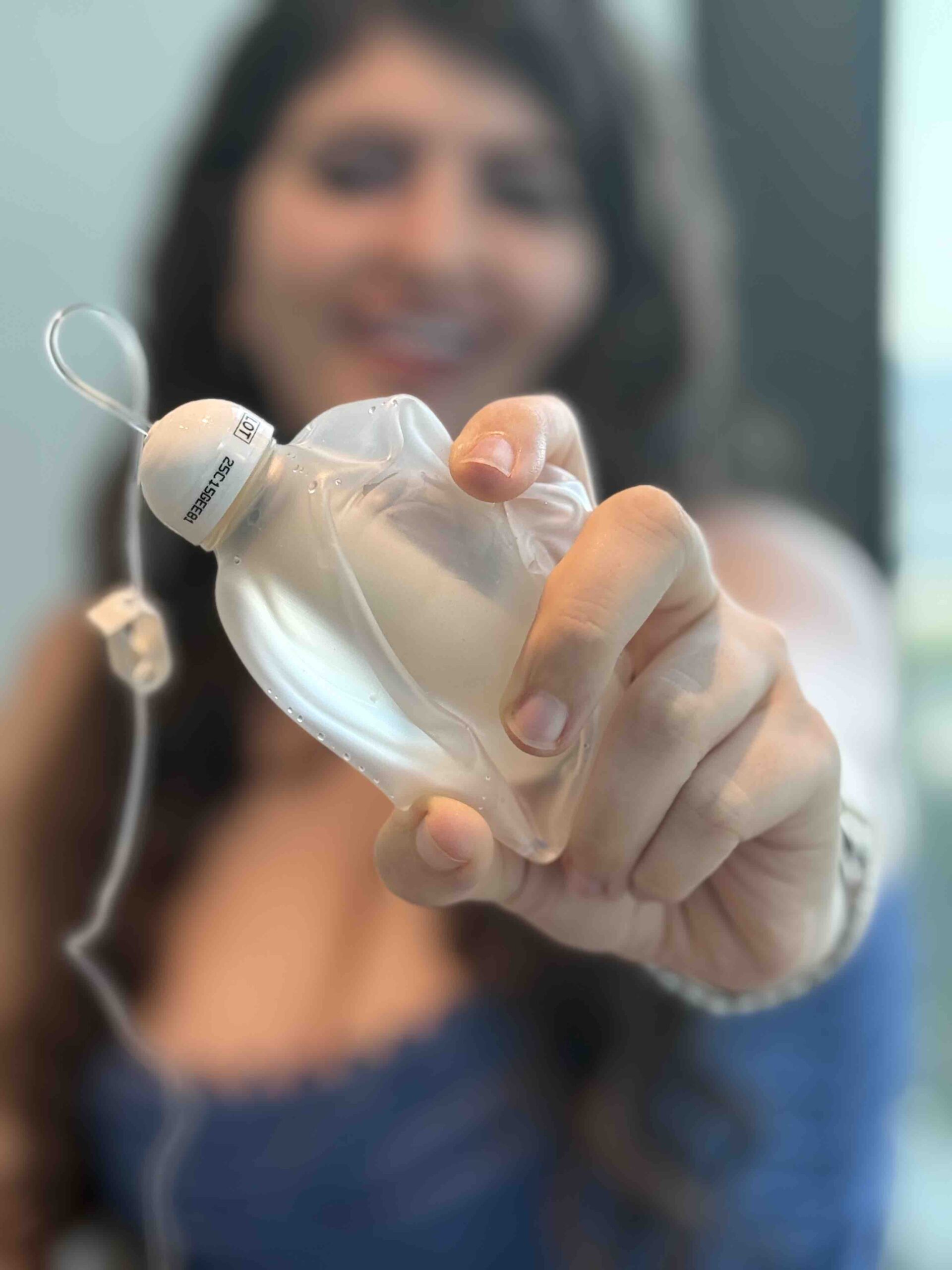
Stem Cell Therapy Is Not One Treatment
The words stem cell therapy are often used as though they describe one standard procedure.
They do not.
Different treatments may involve different cell populations, different tissue sources and very different levels of laboratory processing.
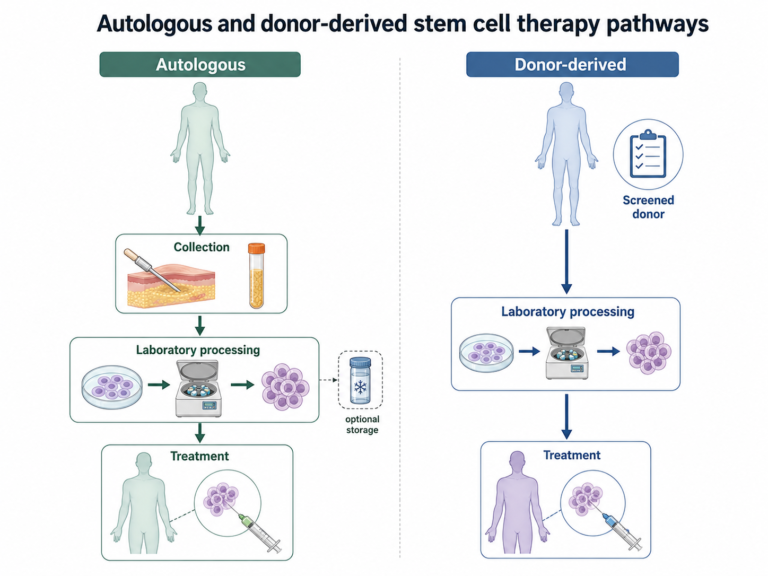
Some use cells obtained from the patient’s own body. Others involve donor-derived cells. Some products are minimally manipulated, while others undergo isolation, culture or expansion before clinical use.
These distinctions matter medically — and they matter from a regulatory point of view.
Before discussing whether a cell-based treatment is appropriate, I want to know exactly what the product is, where it came from, how it was processed and what evidence exists for the proposed use.
Five Things Matter More Than the Number of Cells
01
CELL SOURCE
Where did the cells come from?
Autologous or donor-derived? Adipose tissue, bone marrow, umbilical tissue or another source?
02
PROCESSING
What happened to them in the laboratory?
Were they minimally processed, isolated, cultured or expanded?
03
INDICATION
Why are they being administered?
Evidence for one medical indication cannot automatically be applied to another.
04
ROUTE
How are they being delivered?
Local administration and systemic IV administration are biologically very different.
05
REGULATORY STATUS
Is this particular product and intended use appropriately authorised?
This is the question patients often forget to ask.
GMP Is Important — But It Is Not the Whole Story
GMP stands for Good Manufacturing Practice.
It matters because cell-based products require strict manufacturing processes, quality control, sterility testing, documentation and traceability.
But I would never use the phrase “GMP-certified” as the entire safety argument.
For a cell-based treatment, I want to understand the laboratory documentation relating to the particular product, including its source, processing, release testing, sterility and quality controls, batch traceability, storage and transportation.
And separately from manufacturing quality, I want to know:
Is this particular product being used through an appropriate regulatory pathway for this particular indication?
Those are two different questions.
A useful question to ask any clinic offering stem cells:
“Can you show me exactly what product I am receiving, where it was processed, its quality documentation, and the regulatory basis for using it for my indication?”
A serious provider should be comfortable answering that.
What Can Stem Cells Actually Do
Stem cells have legitimate and established roles in medicine.
Hematopoietic stem-cell transplantation, for example, has long-established uses in serious blood and immune-system diseases. Specific cellular products may also have regulatory approval for defined medical indications.
At the same time, there is enormous research interest in mesenchymal stromal cells and other cellular therapies across regenerative medicine.
But evidence for one use cannot simply be extrapolated to every other organ or condition.
Stem cells should therefore not be presented as a universal treatment capable of:
“reversing ageing,”
“detoxifying the body,”
regenerating every damaged organ,
guaranteeing hair regrowth,
restoring hormonal function,
or treating unrelated medical conditions simply because the treatment involves cells.
Current DHA standards themselves distinguish these established and investigational categories.
What About Stem Cells for Longevity and Aesthetic Medicine?
Regenerative medicine is extremely interesting to me because ageing involves much more than what we see on the surface of the skin.
Cell signalling, inflammation, metabolic health, muscle preservation, vascular health and tissue repair all change with time.
That does not, however, mean that an IV containing cells should automatically be sold as an “anti-aging treatment.”
Research into cellular therapies for regenerative, aesthetic and longevity applications is evolving, but these areas require particularly careful distinction between biological plausibility, early clinical evidence and treatments that are authorised for routine clinical use.
For that reason, I do not believe in recommending a cellular treatment simply because it is new, expensive or technologically impressive.
The treatment has to make sense for the patient.
And it has to sit within the appropriate regulatory framework.
→ Learn more about my approach to Regenerative Medicine in Dubai
How I Assess a Stem Cell Treatment
If you come to see me because you are considering stem-cell therapy — whether it has been suggested by me or offered somewhere else — I want to understand several things before we discuss treatment.
Your medical history comes first.
Then we look at your goals and whether there is a reasonable biological and clinical rationale for using a cellular therapy at all.
After that, I want to know the exact cellular product: its source, degree of manipulation, laboratory, manufacturing documentation, intended indication, administration route and regulatory status.
We then discuss the available evidence, realistic expectations, potential risks and whether a simpler or better-established treatment could achieve the same objective.
If a particular cell-based treatment is appropriate and is available through an authorised clinical pathway, its practical treatment protocol can then be discussed.
Sometimes the correct answer after all of that is:
Yes.
Sometimes it is:
Not this product.
And sometimes it is:
You do not need stem cells at all.
That is still a successful consultation.
Stem Cells vs Exosomes: They Are Not the Same Thing
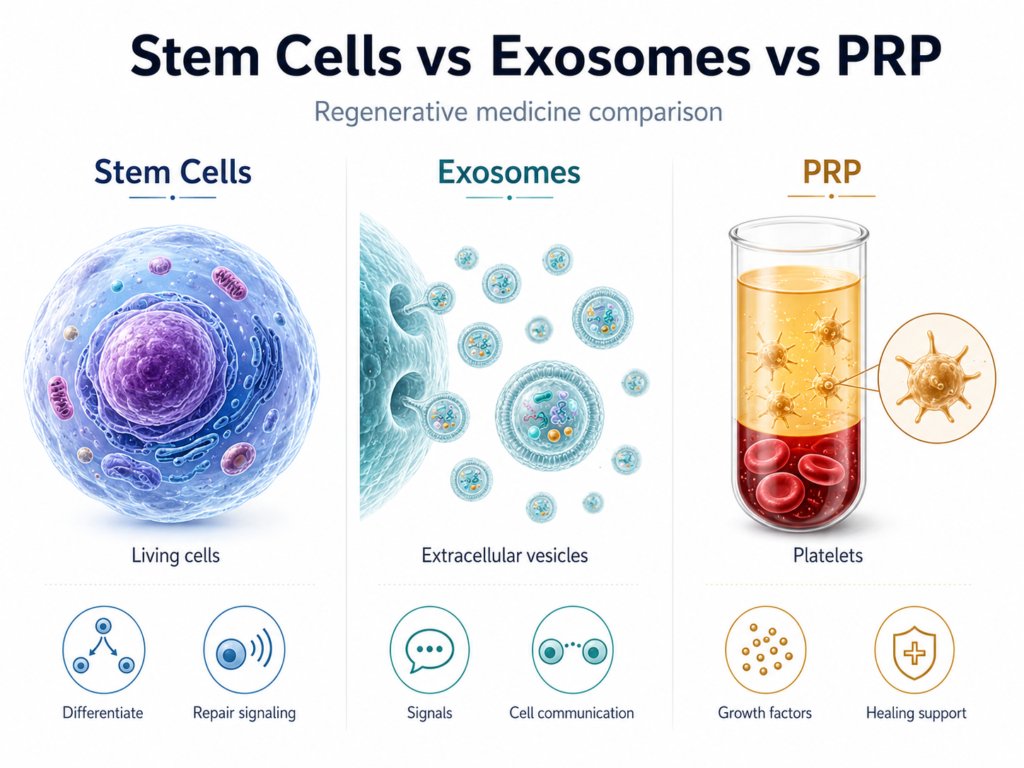
Stem cells and exosomes are often marketed together, but they are fundamentally different.
Stem cells are living cells.
Exosomes are microscopic extracellular vesicles released by cells and contain biological signalling molecules.
Because exosomes do not contain living cells, they are sometimes marketed as automatically safer or simpler.
That conclusion is too simplistic.
Their biological activity depends on the cell source, production method, purification, concentration, contents, sterility and manufacturing consistency.
And stem-cell-derived extracellular vesicles and exosomes can themselves fall within regulated or investigational biological-product pathways.
Cell-free does not automatically mean risk-free.
→ Read more about Exosomes & Regenerative Medicine
Stem Cells vs PRP
PRP is also not a stem-cell treatment.
Platelet-rich plasma is prepared from the patient’s own blood and contains concentrated platelets and signalling molecules.
Its preparation, biological behaviour, evidence base and regulatory considerations are different from cultured cellular therapies.
The fact that PRP, exosomes and stem cells are all discussed under the broad umbrella of regenerative medicine does not make them interchangeable.
That distinction matters when choosing a treatment
Why Laboratory Traceability Matters
With a filler, you can usually look at a box and identify exactly what product is being injected.
Cell therapies are more complex.
For me, traceability matters enormously.
A patient should be able to understand the source of the biological material, where and how it was processed, what quality testing was performed, how it was stored and transported, and what documentation accompanies the final product.
If I am involved in a cellular treatment, I want those questions answered before treatment, not afterwards.
This is one area where I think patients should be demanding.
You are not being difficult by asking for documentation.
You are asking a completely reasonable medical question.
Evidence Before Trends
Regenerative medicine is developing quickly.
That is precisely why I think physicians working in this field have a responsibility to separate three things:
what is biologically interesting,
what has promising evidence,
and what is ready for routine clinical use.
Those three categories are not always the same.
My interest in longevity and regenerative medicine does not mean that I believe every regenerative treatment should be used.
Quite the opposite.
The faster a field moves, the more important careful patient selection becomes.
Frequently Asked Questions
Curious? Start Here
From treatment details to aftercare advice, explore our FAQs for quick and reliable answers to your most common questions.
Stem-cell services are regulated in Dubai by the Dubai Health Authority. Whether a particular treatment can be provided depends on factors including the cell source, degree of manipulation, indication, route of administration, product regulatory status and the licensed scope of the facility.
There is therefore no meaningful blanket answer that “all stem-cell therapy is approved in Dubai.”
The specific treatment has to be assessed.
Not necessarily, but it is also incorrect to say that donor-derived stem cells are simply “invisible” to the immune system.
Some mesenchymal stromal-cell products have relatively low immunogenicity and immunomodulatory properties. Nevertheless, immune interaction remains biologically relevant, and product characterisation, donor screening and regulatory oversight matter.
Donor cells: only one working day — treatment can usually follow your consultation. Your own cells: the laboratory process typically takes several weeks after collection, before your vials are ready for treatment.
The material is produced in GMP-certified laboratories under FDA- and EMA-aligned protocols, with sterility, viability and quality testing on every batch. Donor cells are specifically prepared so your immune system does not recognise them as foreign.
Skin texture and fine lines, hair thinning and early hair loss, and facial volume restoration using your own enriched fat tissue. Suitability is confirmed at consultation.
Because the mechanism is tissue-level repair rather than added volume, results build gradually and tend to hold longer than a filler — improving over months as the underlying tissue responds. Individual results vary.
No. If you choose to use your own cells, a small-volume liposuction procedure can be performed to collect a sample of your adipose tissue. The cells are then processed and can be cryopreserved at the cell bank for future use, according to the laboratory’s storage protocol. This means you can return for treatment at a later date rather than staying in Dubai throughout the laboratory process.
If donor-derived cells are selected, there is no collection procedure or laboratory waiting period for your own cells.
Dr Shiva Faramarzi, MD
Aesthetic & Longevity Physician · DHA licence 43705219
Apogée Clinic, Address Beach Resort, JBR, Dubai
WhatsApp or call: +971 52 328 6185
Last medically reviewed: August 2026