
Home / Services / Food intolerance Tests
Food Intolerance Testing in Dubai
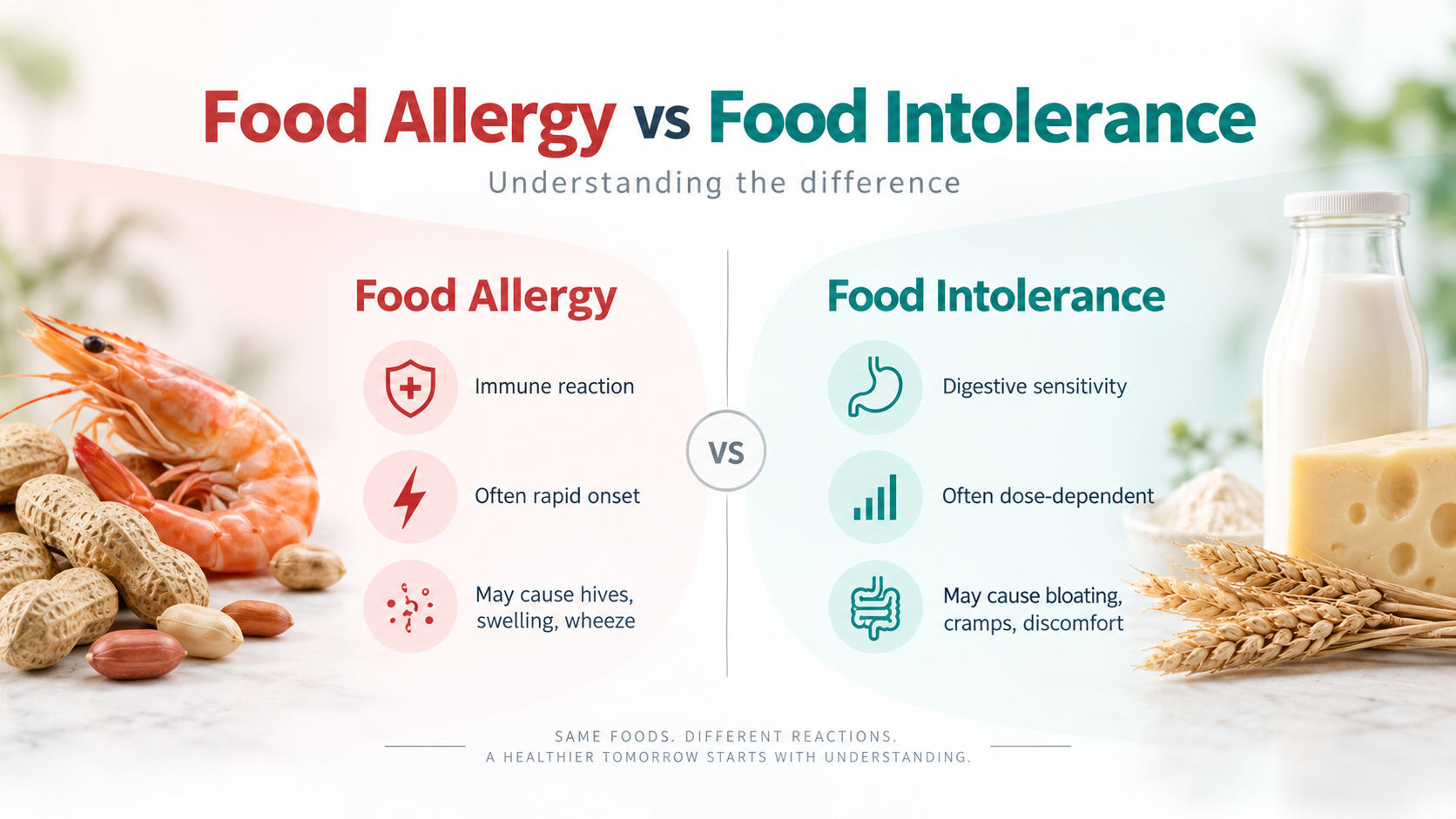
Allergy and intolerance are not the same thing
They are confused constantly, including by the clinics selling the tests. They involve different arms of the immune system, produce different symptoms on different timescales, carry different risks, and require different tests.
Food allergy | Food intolerance | Coeliac disease | |
Mechanism | IgE antibodies, mast cell release | Enzyme deficiency, chemical sensitivity, fermentation, or a non-IgE immune response | Autoimmune — the body attacks its own intestinal lining |
Onset | Seconds to 2 hours | Hours to days — which is why people cannot identify the food themselves | Ongoing, cumulative |
Dose | A trace can be enough | Usually dose-related — a little may be fine, a lot is not | Trace amounts matter; strict lifelong exclusion |
Risk | Can be life-threatening. Anaphylaxis. | Not life-threatening. Miserable, persistent, quality-of-life limiting. | Intestinal damage, malabsorption, long-term complications |
Tested by | Specific IgE blood test, skin prick testing | Depends which type — see below. No single test covers them all. | tTG-IgA with total IgA, then biopsy. Must be eating gluten at the time. |
Allergy and intolerance are not the same thing
Food Intolerance Testing in Dubai
If this is you, book an allergy assessment instead
Lips or tongue tingling or swelling, throat tightness, hives, wheeze, vomiting or faintness within minutes to two hours of eating a specific food.
That is an allergy pattern, and a food intolerance test will not detect it. A normal intolerance result on a food you are genuinely allergic to is dangerous, because it reads as permission. The laboratories that make these tests say the same thing in their own reports: if you have a diagnosed food allergy, keep avoiding that food whatever the intolerance result says.
Most people who come to me about food have already been told two contradictory things: that their symptoms are probably stress, and that a blood test will hand them a definitive list of foods to avoid for life.
Neither is true, and the gap between them is where most people give up.
Food intolerance is real. It is not an allergy, it does not appear on an allergy test, and it behaves differently in the body. What follows is what testing can honestly do, what it cannot, and how I use it — including the part of the argument most clinics leave out.
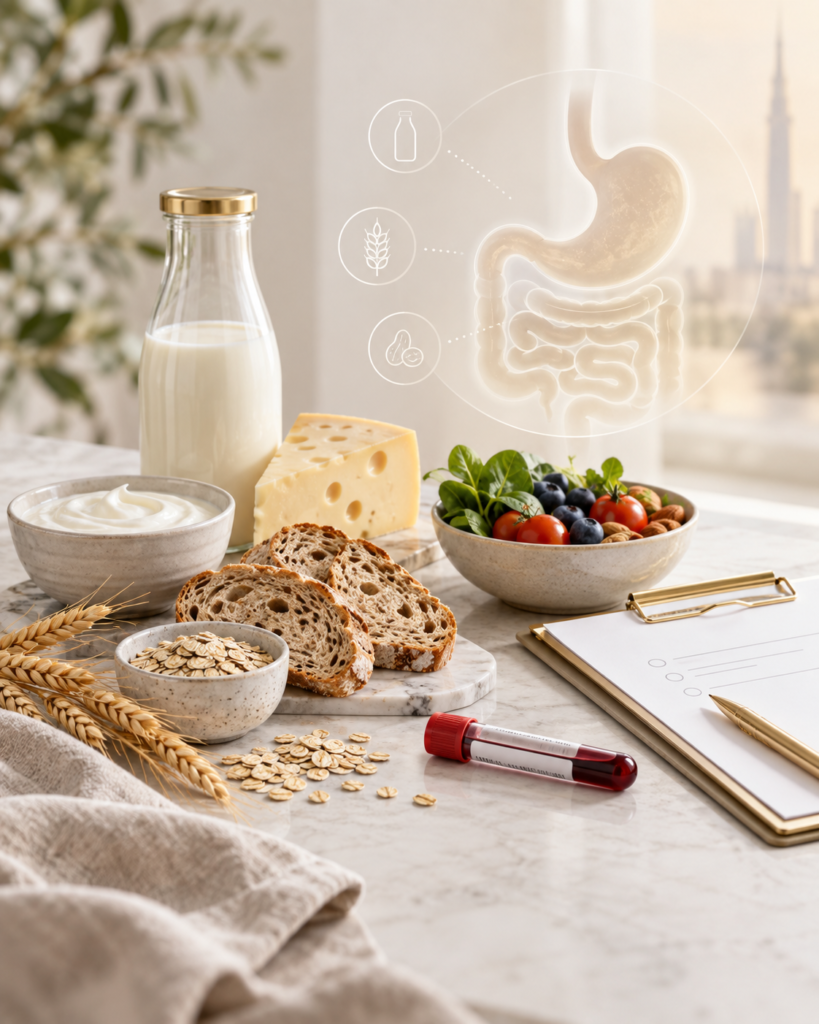
Four different things get called "food intolerance"
This is the distinction that decides which test you actually need — and the reason a single blood panel is not the answer to everything.
01
1. An enzyme you are missing.
- Lactose intolerance is a lactase deficiency, not an immune problem at all. It is diagnosed on a hydrogen breath test, not a blood panel. Fructose malabsorption works the same way. If dairy is your main suspect, this is the test to do first — it is cheaper, it is definitive, and it is available here.
02
A chemical in the food acting pharmacologically.
- Histamine in aged cheese, wine and fermented food. Tyramine. Caffeine. Sulphites. Real symptoms through a mechanism that has nothing to do with antibodies, and no antibody test will find them.
03
Fermentation in the gut.
- FODMAPs — short-chain carbohydrates that draw in water and are fermented by gut bacteria, producing gas, distension and pain. Not an immune reaction either. A structured low-FODMAP diet under dietetic supervision has the strongest trial evidence of any dietary intervention in irritable bowel syndrome.
04
4. A non-IgE immune response.
The contested territory, and what a food-specific IgG test measures. Worth understanding properly before you pay for it.
05
Quick, Non-Invasive Testing
Our tests utilize simple methods like blood or saliva samples, ensuring an accurate, painless experience with fast, reliable results.
What the IgG test measures — and the argument about it
The test measures antibodies called IgG against a large panel of food and drink proteins, and reports how much of each one you have.
Here is what most clinics selling it will not tell you. The major allergy societies do not accept food-specific IgG as a diagnostic test. The European Academy of Allergy and Clinical Immunology concluded that food-specific IgG4 “does not indicate (imminent) food allergy or intolerance, but rather a physiological response of the immune system after exposition to food components”. The Canadian society called it “a marker of exposure and tolerance to food”. The British position is blunter: IgG antibodies to food are formed in all healthy asymptomatic people.
The laboratory that makes the test I use prints the same caveat on the report itself: the link between food, raised IgG and chronic symptoms “is still debated in the scientific community and a consensus has not been reached thus far”.
In plain terms: a raised IgG to bread may mean nothing more than that you eat bread.
So why use it at all?
Because the trials of what happens when you act on the result have been more encouraging than the theory predicts. In 2025, a double-blind, sham-controlled randomised trial across eight centres tested an IgG-guided elimination diet in 223 patients with irritable bowel syndrome. Patients guided by their real results did better than those given a convincing fake diet — 59.6% responded against 42.1%. The benefit was concentrated in constipation-predominant and mixed-pattern IBS, and was absent in diarrhoea-predominant IBS.
An earlier randomised trial pointed the same way, with symptoms returning when the eliminated foods were reintroduced. A 2026 systematic review of thirteen studies and 935 patients found consistent improvement in pain, distension, bowel habit and quality of life — while noting, fairly, substantial variation in study quality and a real risk of malnutrition when multiple foods are removed without supervision.
My position A food-specific IgG result is not a diagnosis. It is a shortlist. It tells us which foods are worth testing by removing them and putting them back, which remains the only way a food intolerance has ever actually been proven. Without a shortlist, an elimination diet means removing almost everything and reintroducing blind over several months, and most people abandon it. I would rather you booked this knowing exactly what it is than discovered the debate afterwards. |
What about inflammation?
The mechanism people describe is real biology. When a food protein crosses the gut wall intact and meets an antibody, the two bind and form an immune complex, and immune complexes are a recognised route to low-grade inflammation.
What has not been established is that this is what is happening in any individual with a raised result — because those antibodies also appear in people with no symptoms whatsoever.
So I will not tell you your result proves you are inflamed. What I will tell you is which foods are worth removing, and that if inflammation was food-driven, it is one of the things that should change when we remove them.
Then we measure it. Where it is relevant, I take baseline inflammatory markers and a structured symptom score before the elimination and repeat them after, so the question is answered with numbers rather than impressions. Measure first, so you can tell whether anything actually changed.
What is on the panel
Panel 1:The panel covers 283 foods and drinks — milk and egg, meat, fish and seafood, cereals and seeds, nuts, legumes, fruit, vegetables, spices, edible mushrooms, coffee and tea, and a group of newer foods including algae and edible insects.
- Camel milk is on the panel, alongside cow, goat, sheep and buffalo. Very few panels test it, and in this region that matters.
- Four proteins are tested separately from the foods they come in — the three main cow’s milk proteins and wheat gliadin. This is useful: it can show that the problem is casein rather than dairy as a category, which changes what you actually have to avoid.
- Results are reported as an actual concentration for each food, not a score out of ten, in three bands — low, intermediate and highly elevated.
Panel 2: The panel covers over 200 foods and drinks across dairy and egg, gluten-containing and gluten-free grains, fruit, vegetables, fish and seafood, meat, herbs and spices, nuts and seeds.
- Gliadin is tested separately from the gluten-containing grains, and the three main cow’s milk proteins separately from milk.
- Results come back two ways — grouped by food type, and ranked in order of reactivity — in three bands: normal, borderline and elevated.
- The report is available in Arabic as well as English.
You can either do both panels or based on your condition and what is more common in your diet we help you coose one.
- The sample is a standard blood draw.
- You come in to go through the results. I do not email you the report with a leaflet attached. These reports run to dozens of pages and the software-generated commentary in them is generic — the same list of symptoms appears beside every food on the list. Reading the numbers against your history is the part that makes the test worth doing, and it is not something a PDF can do for you.
Before you test: what should be ruled out first
A food intolerance panel belongs after the conditions with definitive tests have been excluded, not before.
- Coeliac disease. Not an intolerance — an autoimmune condition causing real intestinal damage. It must be excluded with tTG-IgA and total IgA before anyone removes gluten, because the test only works while you are still eating it. Cutting gluten out first makes coeliac disease hard to diagnose for months.
- Lactose intolerance, where dairy is the suspect — hydrogen breath test.
- Thyroid function, ferritin, B12, vitamin D, full blood count and an inflammatory marker. Fatigue and brain fog attributed to food are very often anaemia, thyroid disease or vitamin D deficiency — all common here, all treatable.
- Helicobacter pylori where the picture is upper gastrointestinal.
When this is the wrong test
- Suspected allergy — see above.
- Any red flag: unintentional weight loss, blood in the stool, iron-deficiency anaemia, fever, vomiting, symptoms that wake you at night, a change in bowel habit after 50, or a family history of bowel cancer or inflammatory bowel disease. These need investigating properly, and a food panel delays that.
- An existing eating disorder, or a restrictive and anxious relationship with food. A list of forbidden foods is actively harmful here, and I will say so rather than take the booking.
- Pregnancy, and children — neither should undertake multi-food elimination without paediatric or obstetric dietetic supervision.
- Diarrhoea-predominant IBS, where the trial evidence showed no advantage over placebo. A low-FODMAP approach has better support.
What happens after the result
The test is the beginning of the process, not the end of it. The result on its own changes nothing.
- We go through the panel together, set it against your symptom history and your actual diet, and decide which reactions are worth acting on. A raised result against a food you eat twice a year is not where we start.
- Structured elimination, around three months. Not everything that came back raised — the shortlist we agreed. With a written plan naming what each food hides in, because the difficult part is rarely the obvious form: milk protein is in processed meat and margarine, gluten is in sauces and beer, and if you do not know that, the elimination is not real.
- Replacements, not just removals. Every food that comes out is replaced by something specific. This is where most elimination diets fail.
- Nutritional cover. The genuine risk of multi-food elimination is an inadequate diet, and it is the risk the research literature raises most consistently — removing wheat, for instance, takes out a major source of B vitamins unless something replaces it. Planned for, not left to chance.
- Systematic reintroduction. One food at a time, every three to four days, with a symptom diary. This is the part people skip and the part that matters most.
- The verdict. It comes from the reintroduction, not from the printout. A food that causes nothing on reintroduction goes back into your diet, whatever it scored.
What this test is not
- It is not an allergy test.
- It is not a diagnosis.
- It is not a permanent list — antibody levels follow what you eat.
- It is not a reason to spend your life eating twelve foods. If the plan is making your diet smaller rather than clearer, the plan is wrong.
Still haven't found your answer??
FAQs

No, and the difference matters. An allergy is an IgE-driven reaction that happens within minutes, can be triggered by a trace amount, and can be life-threatening. An intolerance develops over hours or days, is usually dose-related, and is not dangerous — it is persistent and it lowers your quality of life. They need different tests, and a food intolerance test does not detect allergy.
No. Nut allergy is IgE-mediated and needs specific IgE testing or skin prick testing. If you have a diagnosed food allergy, keep avoiding that food regardless of what an intolerance test shows — that is the laboratory’s own instruction as well as mine.
When a food protein meets an antibody, the two bind and form an immune complex, and immune complexes are one recognised route to low-grade inflammation. That mechanism is real. What is not established is that it is what is happening in every person with a raised result — these antibodies also appear in people with no symptoms. Rather than claim it, I measure inflammatory markers before and after the elimination so we can see whether anything actually changed.
Most people take it once, act on the result, and never need it again — because once you have identified your foods, you know them. But it is not a lifetime fingerprint, and I would rather say so. IgG antibodies follow what you eat: remove a food and levels fall, eat it regularly again and they return. A repeat is worth considering only if your symptoms change, if you want to confirm a reintroduced food is genuinely tolerated, or if your diet, gut health or medication has changed significantly.
Partly, and I would rather explain it than oversell it. The major allergy societies do not accept food-specific IgG as a diagnostic test, because these antibodies are found in healthy people without symptoms and are thought to reflect exposure rather than disease — and the laboratory that makes the test prints on the report that the connection is still debated and no consensus has been reached. Against that, a double-blind sham-controlled trial published in 2025 found that patients with irritable bowel syndrome following a diet guided by their real results did better than those on a convincing fake diet. My conclusion is that the result is a useful shortlist for an elimination trial, not a diagnosis — and that is how I use it.
Panel 1 283 foods and drinks, including camel milk — which most panels do not test — and four individual proteins tested separately from the foods they come in, so that a reaction to casein can be told apart from a reaction to dairy generally.
Panel 2 Over 200 foods and drinks, with gliadin and the three main cow’s milk proteins tested separately from their parent foods. The report is available in Arabic as well as English.
It is a standard blood sample We then review the results together rather than just emailing them to you.
Almost certainly not. The elimination phase is around three months, and then foods are reintroduced one at a time to find out which genuinely cause symptoms. Many foods that came back raised go straight back into the diet. If a plan is making your diet permanently smaller rather than clearer, the plan is wrong.
That is a useful result too, and it happens. It means the answer is somewhere else — lactose or fructose malabsorption, histamine, a FODMAP pattern, coeliac disease, thyroid or iron deficiency, or a gut condition that needs investigating. A negative panel closes a door, and there are other doors.
