Home / Services / Nose Treatment
Ultrasound-Guided Nose Filler in Dubai
ULTRASOUND-GUIDED NON-SURGICAL RHINOPLASTY
Ultrasound-Guided Nose Filler in Dubai
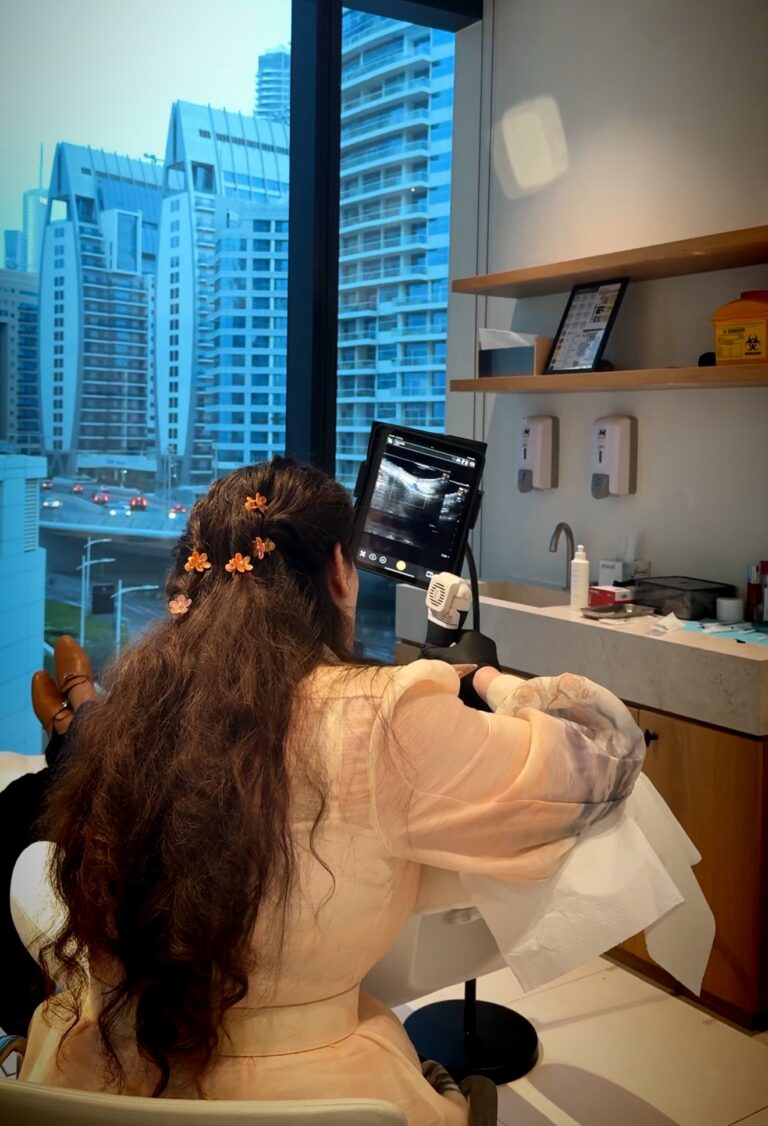
A nose filler treatment requires more than an understanding of facial proportions — it requires detailed knowledge of vascular anatomy.
In my practice, I use high-frequency Doppler ultrasound to map the relevant blood vessels before nose filler, allowing the treatment plan to be adapted to your individual anatomy.
The aim is subtle, structural correction with a natural-looking result.
What Can Nose Filler Improve?
Non-Surgical Rhinoplasty in Dubai
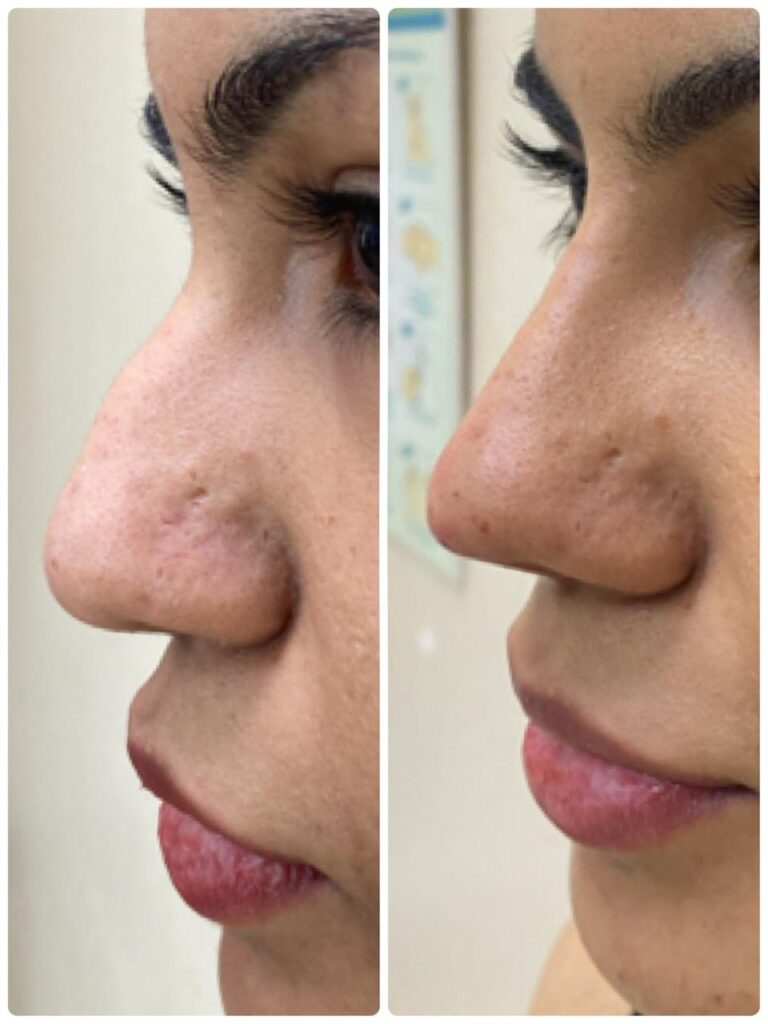
Nose filler can improve selected contours of the nose without surgery. The aim is not to create a completely different nose, but to make small structural adjustments that improve proportion, profile and facial balance.
Depending on your anatomy, treatment may help with:
Camouflaging a dorsal hump to create a smoother profile
Improving a low or uneven nasal bridge
Enhancing tip support or projection in suitable patients
Correcting selected minor asymmetries
Improving radix or bridge definition
Smoothing small contour irregularities
Nose filler works by adding volume strategically. It cannot physically make a large nose smaller, correct major structural deformities or treat breathing problems. In those cases, surgical rhinoplasty may be the more appropriate option.
ANATOMY FIRST. AESTHETICS SECOND.
Why My Approach to Nose Filler Is Different
01
Doppler Ultrasound Mapping
Before treatment, I use high-frequency Doppler ultrasound to assess relevant blood vessels and individual vascular anatomy. This allows me to plan around the anatomy I can actually see rather than relying only on textbook averages.
02
Conservative, Strategic Treatment
The nose is a high-risk area, so I prefer small, carefully planned corrections rather than large-volume injections. More filler does not necessarily mean a better result.
03
Individualised Anatomy
No two noses — and no two vascular patterns — are identical. The treatment plan, injection points, depth and amount of filler are adapted to the patient’s anatomy and previous treatments.
04
Facial Balance, Not an “Instagram Nose”
I assess the nose in relation to the forehead, lips, chin and overall profile. The aim is not to give every patient the same nose, but to improve proportion while preserving individual facial characteristics.
Treatment Options
Hyaluronic Acid Nose Filler
For suitable patients, I use hyaluronic acid filler to make small structural corrections to the bridge, radix or tip.
Because the nose is a high-risk vascular area, treatment is planned conservatively. I use Doppler ultrasound to assess relevant vascular anatomy before injection, and the amount and placement of filler are determined individually.
An important advantage of hyaluronic acid in this area is that it can be dissolved with hyaluronidase if clinically necessary.
Nose Thread Lift
In selected patients, threads may be used to provide temporary structural support or improve tip projection without adding significant volume.
Threads and filler work differently, and one is not automatically better than the other. Suitability depends on the existing nasal structure, skin, previous treatments and the change you are trying to achieve.
In some patients, I may recommend neither and advise that surgical rhinoplasty would provide a more appropriate result.
We’ve Got You Covered!
Nose Filler FAQs

Nose filler is considered a higher-risk filler treatment because of the vascular anatomy of the nose and its connections with the vessels supplying the eye. Most complications are minor, such as swelling or bruising, but rare vascular complications can be serious. For this reason, I use a conservative technique, assess the anatomy carefully and use Doppler ultrasound before treatment. Ultrasound can add valuable anatomical information, but it cannot make any filler procedure completely risk-free.
I use high-frequency Doppler ultrasound to identify relevant blood vessels, their depth and individual anatomical variations before planning the injection. Nasal vessels do not always follow textbook patterns. If I see a vessel in an area I was considering for treatment, I can modify the injection point, depth or treatment plan.
Not physically. Filler always adds volume rather than removing tissue. However, carefully placed filler can sometimes make the nose appear straighter, more proportionate or visually smaller by improving the profile and balance with the rest of the face. If actual reduction is the goal, surgical rhinoplasty is usually more appropriate.
Filler cannot remove a dorsal hump. In suitable patients, small amounts can be placed around the hump to create a smoother and straighter-looking profile. This is camouflage rather than removal, which is why patient selection is important.
In selected patients, strategic filler placement can improve tip support, projection or the appearance of rotation. The amount of change depends on the patient’s existing cartilage, skin and overall nasal anatomy, and not every drooping tip is suitable for filler correction.
In some cases, I may also use short nose threads to provide additional mechanical support and lift to the tip. Whether filler, threads, or a combination is more appropriate depends on the anatomy and the result we are trying to achieve.
There is no exact duration that applies to every patient. Longevity depends on the filler used, the amount and location injected, previous treatments and individual biology. Nose filler can sometimes remain detectable for considerably longer than patients expect, which is why I prefer to reassess the nose rather than automatically adding more filler on a fixed schedule.
Often, yes. High-frequency ultrasound can help identify previous filler deposits, their location and the tissue plane in which they are sitting, even when the treatment was performed some time ago. This can be particularly useful if you are unsure what remains before considering more filler or dissolution.
I change the plan. The purpose of ultrasound is not simply to document anatomy — it is to use that information clinically. Depending on what I see, I may change the injection point, depth or technique, or decide not to inject that area at all.
Patients with significant structural deformity, major nasal deviation, functional breathing problems, or those seeking substantial reduction in the size of the nose may be better suited to surgical rhinoplasty.
I am also particularly cautious in patients who have undergone one or more previous rhinoplasty surgeries. Surgery can alter the normal tissue planes, create fibrosis and scarring, and change both the underlying structure and the expected course of the nasal and facial artery branches. This can make subsequent filler treatment less predictable.
However, previous rhinoplasty does not automatically exclude someone from non-surgical treatment. In these cases, I use Doppler ultrasound to assess the existing anatomy and vascular pattern first. Depending on what I find, I may proceed with a modified treatment plan — or advise against further injectable treatment if I do not consider it appropriate.
Surgery is generally more appropriate when the aim is to physically reduce the size of the nose, substantially change the underlying structure, correct major deviation or address breathing problems. Filler is best suited to selected contour corrections and cannot replace surgery for every nose.
READY TO DISCUSS YOUR NOSE?
Nose Filler & Ultrasound Assessment in JBR, Dubai
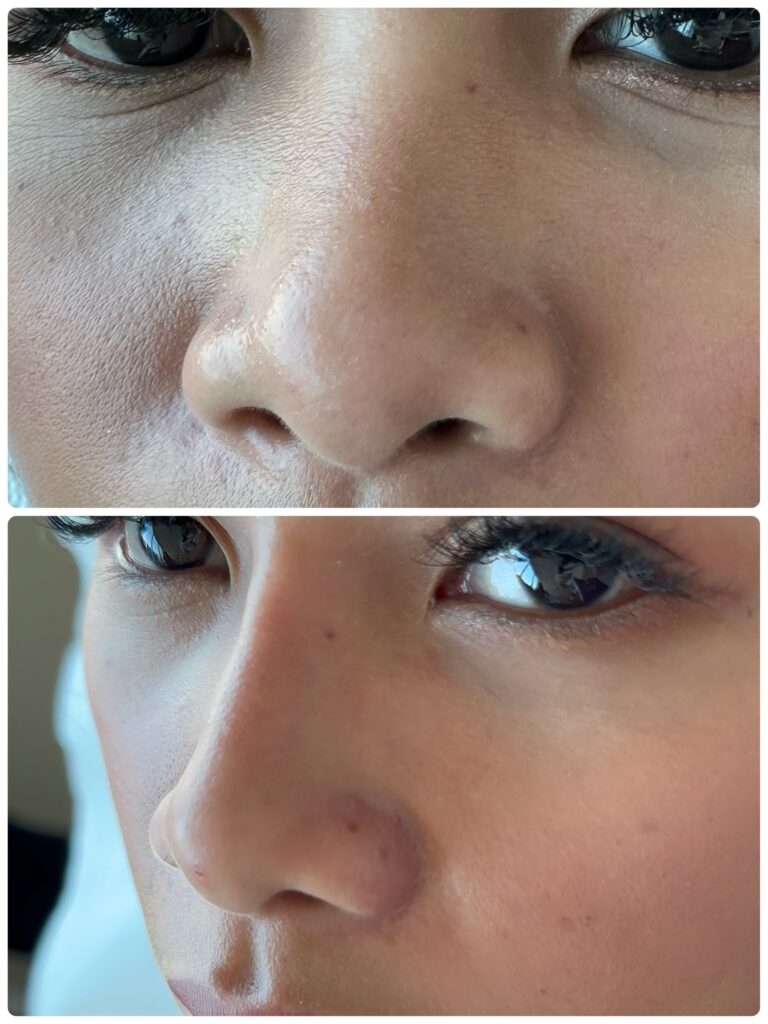
Whether you are considering nose filler for the first time, would like an ultrasound assessment before treatment, or have concerns about filler previously performed elsewhere, you are welcome to contact us.
Dr Shiva Faramarzi sees patients at Apogée Clinic, inside Address Beach Resort, JBR, Dubai.
Previous Nose Filler or a Complication?
If you have had nose filler at another clinic and are experiencing persistent swelling, asymmetry, lumps, migration, unusual tenderness or concerns about previous filler, we can assess the area clinically and with high-frequency ultrasound when appropriate.
If you develop sudden severe pain, blanching or dusky skin, visual disturbance, loss of vision, severe eye pain, or neurological symptoms after nose filler, this may represent a medical emergency. Do not wait for a routine clinic appointment — seek immediate emergency medical care.
WhatsApp / Call: +971 52 328 6185
Location: Apogée Clinic, Address Beach Resort, JBR, Dubai
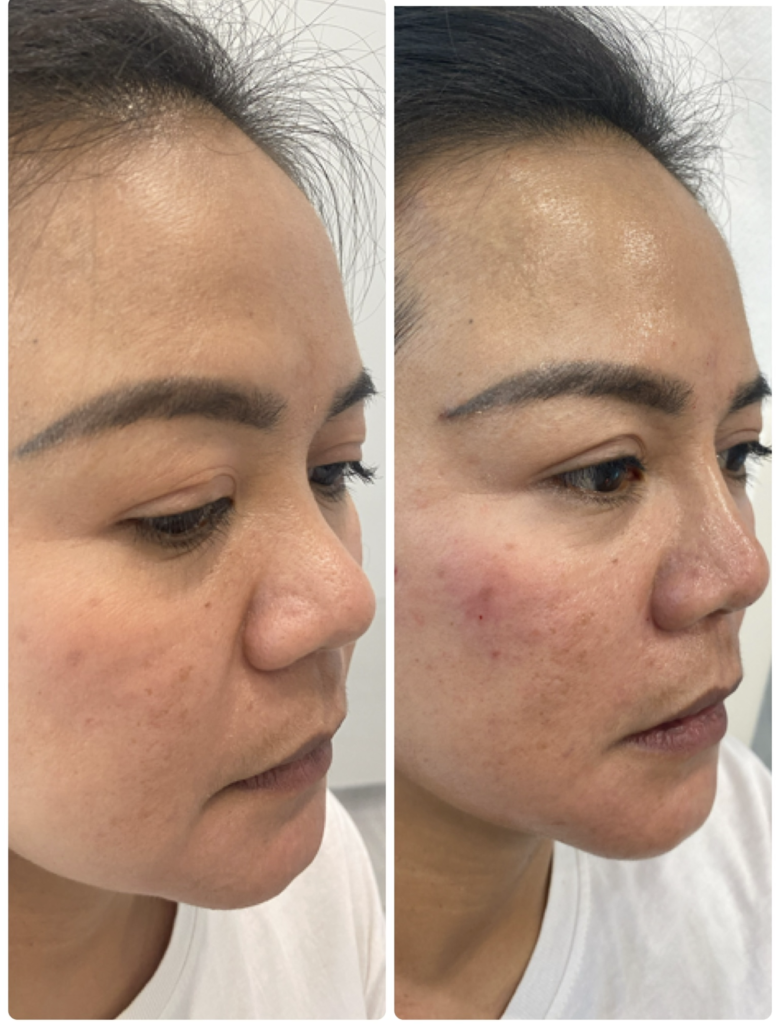
Our patients sharing their journey