Home / Services / Regenerative Volume Restoration in Dubai
Renuva Treatment
Volume your body rebuilds with its own tissue — gradually, and in proportion.
What Is Renuva?
Renuva is an injectable adipose matrix: the natural scaffold of fat tissue, with the fat cells themselves removed. Placed where volume has been lost, it gives your own tissue a framework to grow into. Over the following weeks, your body populates it with fat tissue of its own.
That makes it a different kind of treatment from a filler. A filler is a material that stays where it is placed. Renuva is a starting point that your body finishes. The result arrives slowly, reads as your own tissue because it largely becomes your own tissue, and suits faces and bodies that have lost volume broadly rather than in one sharp spot.
Renuva is not a faster filler. It is a slower, more natural one — and choosing between the two is the first decision we make together.
How Renuva works
Made from donated tissue — what that means
Renuva is derived from human tissue donated after death. I tell every patient this before treatment, because it matters to people and they deserve to know. It is processed by a US tissue bank under the FDA’s regulations for donated human tissue and the standards of the American Association of Tissue Banks: the donor is screened, the donor’s blood is tested for transmissible infections including HIV, hepatitis B and C, and syphilis, and the tissue is processed to remove the donor’s cells before it is supplied. Renuva is donated human tissue, not a drug or a device, so it is not described as FDA-approved or FDA-cleared. The product I use is registered for use in the UAE. If you have personal or religious questions about donor-derived tissue, ask me; it is a reasonable question and we will talk it through.
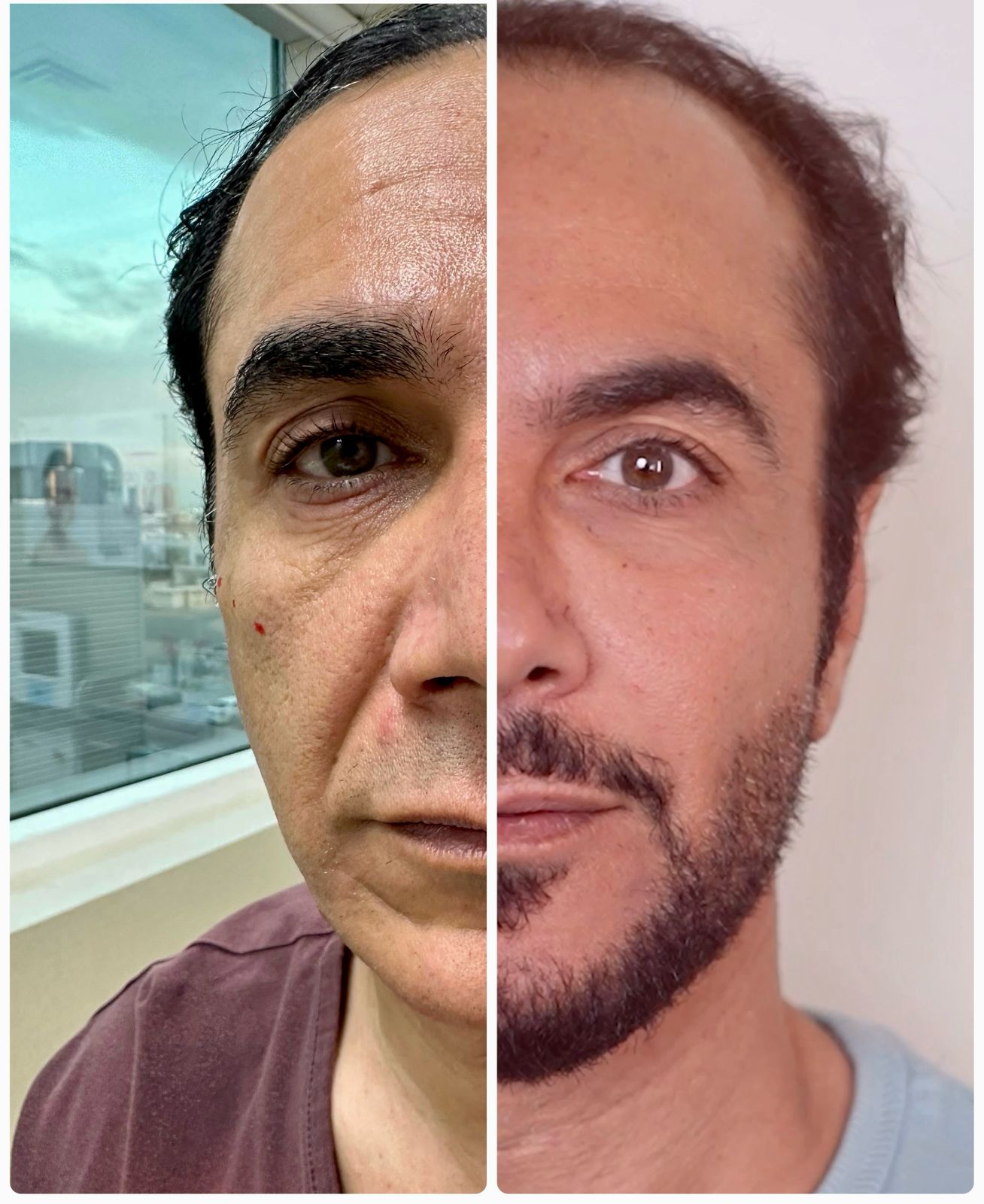
Fat tissue is not only fat cells. It sits on a matrix of collagens and other structural proteins that holds it together and signals to the precursor cells around it. Renuva is that matrix, taken from donated human fat tissue and processed so that the cells are removed and the framework remains. Once injected, it supports the formation of new fat tissue from your own cells — a process shown in laboratory and human tissue studies
Because what remains is your own tissue, it behaves like your own tissue. It moves naturally, it feels like the area around it, and it follows your body weight — which is the reason both for its longevity and for its one real caveat, below.
It also stays where it is placed. In effect, Renuva rebuilds the superficial fat layer, and the new tissue integrates with the tissue around it rather than sitting in a pocket as a gel. That is why, in my experience, it is not prone to the migration or gravitational drift that can happen with filler over time.
Made from donated tissue — what that means
Renuva is derived from human tissue donated after death. I tell every patient this before treatment, because it matters to people and they deserve to know. It is processed by a US tissue bank under the FDA’s regulations for donated human tissue and the standards of the American Association of Tissue Banks: the donor is screened, the donor’s blood is tested for transmissible infections including HIV, hepatitis B and C, and syphilis, and the tissue is processed to remove the donor’s cells before it is supplied. Renuva is donated human tissue, not a drug or a device, so it is not described as FDA-approved or FDA-cleared. The product I use is registered for use in the UAE. If you have personal or religious questions about donor-derived tissue, ask me; it is a reasonable question and we will talk it through.
Wondering whether Renuva or filler suits you better? Send me a message to book an assessment — WhatsApp +971 52 328 6185 |
Restore Volume, Balance, and Harmony with Expert Care!
Where I use Renuva
01
Temples
Temple hollowing is one of the first signs of facial volume loss and one of the hardest to treat well with filler, because the area needs soft, even volume rather than a defined shape. Allograft adipose matrix has been studied specifically for atrophic temples3, and it is one of the areas where I use it most.
02
Cheeks and midface
Where the cheek has thinned across its whole surface, Renuva restores fullness without the sharper edges a structural filler can give. I do not inject close to the under-eye area. In most faces, supporting the cheek and the ligament beneath the eye improves the under-eye hollow on its own — the same principle behind my cheek & midface and under-eye work.
03
Hands
As the back of the hand loses its fat layer, tendons and veins become prominent and the hand looks older than the face. Allograft adipose matrix has been used to restore volume in the dorsal hand4, and it gives a softer, more natural fullness than a firm filler in this thin-skinned area.
04
Hips and buttocks
Renuva is one of three materials I use for body volume, alongside hyaluronic acid body filler and Lanluma. For hips and buttocks I typically use at least two syringes per session, over two sessions about three months apart. How I choose between the three is set out on my body filler page.
05
Atrophic scars
Deep, depressed scars — after injury, surgery or acne — often have lost the tissue beneath them as well as the skin above. Renuva replaces some of that missing support from below. Published experience in contour deformities is still small4, but in my practice it is one of the most rewarding uses of the product. Surface texture is often treated alongside it with microneedling.
Renuva or filler?
| Hyaluronic acid filler | Renuva |
How it works | A gel that holds volume where it is placed | A scaffold your own tissue grows into |
When you see it | Immediately | From about six weeks, improving to three to four months |
Best for | Precise shape and definition: a cheekbone point, a chin, a lip | Broad, soft volume loss: temples, thin faces, hands, scars |
Precision | Sharp and controllable | Softer and less precise by design |
Migration | Can migrate over time, especially with large volumes or mobile areas | Integrates with surrounding tissue; in my experience not prone to migration |
If you change your mind | Dissolvable with hyaluronidase | Not dissolvable in the same way |
Renuva results are not as sharp or precise as filler. That is why I use it mainly for people with moderate to marked volume loss spread across the face — often slim faces that look tired or older because of what they have lost, rather than because of anything they need added.
Renuva or fat transfer?
Fat transfer moves your own fat from one part of the body to another. It works, but it needs a liposuction harvest — a donor site with its own recovery — and the amount of transferred fat that survives varies: in a systematic review of facial fat grafting, average retention was around 42% at follow-up5. Renuva needs no harvest and no donor site, and the recovery is lighter. In my experience it also gives a more controlled, more predictable result, because I decide exactly how much goes where in the first place.
Who Renuva is not for
- Anyone in a calorie deficit or actively losing weight. The whole point of Renuva is that your body builds new fat tissue into it. If your body is burning energy rather than storing it, that tissue does not form well. If you are on Mounjaro or Ozempic, we wait until your weight has settled — see loose skin after weight loss.
- Anyone with permanent filler in the area. Previous permanent or semi-permanent material changes the tissue and the plan. I assess it first, with ultrasound.
- Anyone with a current or past eating disorder. Treatment that depends on body fat is not appropriate here, and the conversation should be with a doctor who can support you properly.
- Anyone who wants sharp definition. A defined jawline or chin point is a job for structural filler.
- Pregnancy and breastfeeding, and any active infection in the area.
How much, and how many sessions
Renuva comes in two sizes, 1.5 cc and 3 cc. For thin, fragile skin where the aim is mainly skin quality and fine lines, 1.5 cc may be enough. For facial volume, I usually use 3 cc. Most faces need one or two sessions, four to six months apart — the second session is planned once the first has fully developed, so we build on what your tissue has actually done rather than on a guess.
What to expect
- On the day: injection with a fine cannula, guided by ultrasound so that blood vessels can be avoided. Local anaesthetic where needed.
- Afterwards: little downtime. Some swelling for a few days; bruising is usually minimal, though it cannot be ruled out.
- Results: the early fullness from the injection settles, then new volume starts to show from around six weeks and continues to improve until about three to four months.
- How long it lasts: this is one of Renuva’s real advantages. The new tissue is your own fat rather than a gel, so your body does not break it down and absorb it the way it does filler. In my experience, at a stable weight, results last for years. Because it is your own tissue, it also follows your body weight: significant weight loss reduces it, as it reduces fat everywhere else.
If you are unhappy with Renuva done elsewhere
Renuva cannot be dissolved the way hyaluronic acid filler can. If a result is genuinely unwanted, there are ways to reduce volume, but they are costly and not something I offer lightly — which is why planning matters so much more with Renuva than with filler. If you are worried about a result from elsewhere, start with an assessment and ultrasound so we know exactly what is there. If you are unsure what was injected, see filler complication management.
Cost
Renuva 1.5 cc — AED 8,400. Renuva 3 cc — AED 12,600. The number of syringes and sessions is agreed at your assessment, before anything is booked.
A note from Dr Shiva I reach for Renuva when a face has lost volume everywhere a little, rather than somewhere a lot. Filling each hollow separately in a face like that tends to look filled. Giving the tissue a framework to rebuild itself tends to look like the person did five years ago. |
Ready to find out whether Renuva is right for you? Book an assessment at Apogee Clinic, JBR — WhatsApp +971 52 328 6185 |
Renuva for the hands: Renuva is my first choice for restoring volume on the back of the hands. See results and how I combine it with laser on my hand rejuvenation page.



































We’ve Got You Covered!
FAQs

Not in the usual sense. A filler is a material that holds volume where it is placed. Renuva is an adipose matrix — a framework that your own tissue grows into over the following weeks, so the final volume is largely your own tissue.
It is made from donated human fat tissue, processed to remove the donor’s cells. It is processed by a US tissue bank under the FDA’s human tissue regulations; donors are screened and tested for transmissible infections, including HIV, hepatitis B and C, and syphilis. As with any donated tissue, the manufacturer notes that infection transmission cannot be ruled out completely, although it is designed to be extremely unlikely. As with any injectable, side effects such as swelling, bruising and tenderness can occur; I go through them with you at your assessment.
The early fullness from the injection settles first. New volume starts to show from around six weeks and continues to improve until about three to four months.
Longevity is one of its main advantages. The new tissue is your own fat, not a gel your body gradually absorbs, and in my experience results at a stable weight last for years. Because it behaves like your own fat, significant weight loss will reduce it, as it reduces fat everywhere else.
They suit different situations. Renuva needs no liposuction harvest or donor site and the recovery is lighter. Fat transfer survival varies — around 42% on average in facial studies5 — and in my experience Renuva gives a more controlled result. Fat transfer can make sense where a large volume is needed; a plastic surgeon would advise on that.
Not in the way hyaluronic acid filler can be dissolved. Volume can be reduced if a result is genuinely unwanted, but it is costly and not routine — which is why the planning stage matters.
I would wait. Renuva depends on your body building new fat tissue into the matrix, which does not happen well in a calorie deficit. Once your weight has settled, it can be a very good option for the volume that weight loss takes from the face and body.
I do not inject Renuva close to the under-eye. In most faces, supporting the cheek and the ligament beneath the eye improves the hollow on its own, and that is where I place it.
In my experience, no. Renuva effectively rebuilds the superficial fat layer, and the new tissue integrates with the tissue around it rather than sitting in a pocket as a gel, so it is not prone to the migration or drift with gravity that can happen with filler.
For facial volume, usually 3 cc per session, over one or two sessions four to six months apart. 1.5 cc can be enough where the aim is skin quality and fine lines. For hips and buttocks, at least two syringes per session.
Yes, for depressed scars that have lost the tissue beneath them. Published experience is still small4, but in my practice it is one of the most rewarding uses of Renuva, often combined with treatment for the scar surface.
