
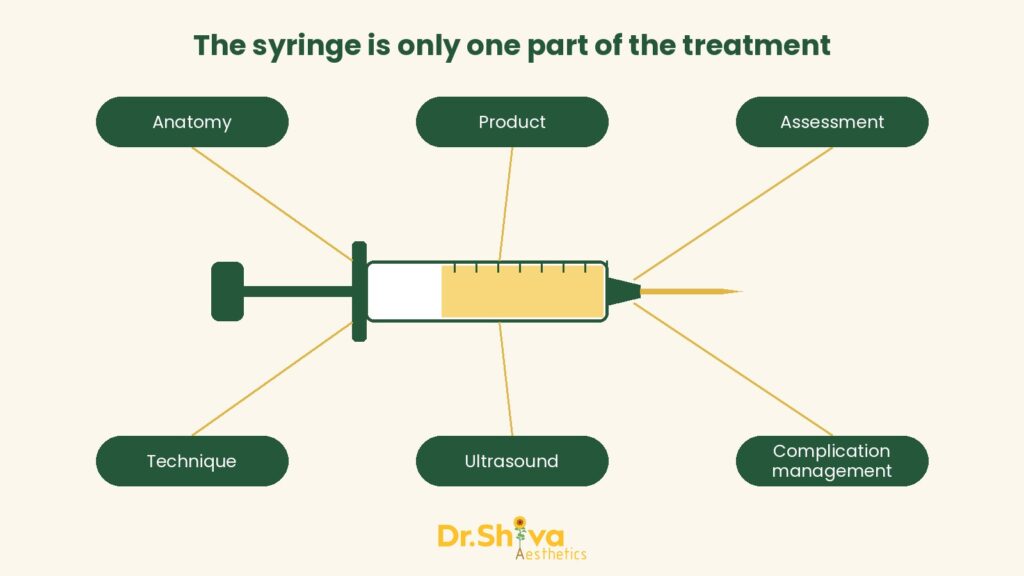
Why the price of a syringe is the wrong question
What patients often compare, and what I think matters more
| What patients often compare | What I think matters more |
|---|---|
| Price per syringe | Whether filler is actually indicated for you |
| Number of millilitres | Where and why the volume is being placed |
| Needle versus cannula | Anatomy, plane and injection strategy. Consensus guidance on filler complications places anatomical knowledge and careful technique at the centre of avoiding them.1 |
| Brand popularity | Whether the product characteristics suit that particular area |
| Before-and-after photos | The ability to recognise and manage complications, including having hyaluronidase available when hyaluronic acid is used1,2 |
| “How long will it last?” | What happens if the result is wrong, or if something goes wrong |
Questions I would ask any injector
- Who is actually performing the injection, and what is their medical training?
- What product are you recommending, and why this product for this area?
- Is the product appropriately registered or authorised for use in the UAE? Can I see the packaging and batch label?
- How much are you planning to inject, and why? Could it be done in stages?
- What are the specific risks of injecting this area?
- What happens if something goes wrong? This may be the most important question of all.
- Do you have access to appropriate emergency treatment, imaging or referral if something does not look right?
Sometimes the best injector is the one who tells you not to inject
Some complications are easier to reverse than others
| Situation | What is generally possible |
|---|---|
| Hyaluronic acid fillers | Often improved or corrected with hyaluronidase, which breaks down hyaluronic acid.1,2 That does not mean every hyaluronic acid problem is immediately or completely reversible. See my article on dissolving filler. |
| A vascular complication | Not made harmless because the product is hyaluronic acid. Vascular occlusion needs early recognition and prompt treatment to limit tissue damage.1,4 |
| Vision loss after filler injection | Rare but devastating. The literature emphasises prevention, because once vision is affected the treatment options have had limited success.3 |
| Collagen-stimulating fillers (PLLA, PCL, CaHA) and similar | There is no equivalent universal “dissolver”. Complications may need observation, targeted treatment, imaging, medication or, occasionally, surgery. See Ellansé lumps and nodules. |
| Permanent or unknown fillers | Management can be considerably more complex, and depends on what the material is and where it sits. |
| Filler that has moved | Can often be improved, but the plan depends on what is found. See filler migration. |
Where ultrasound helps
If you were treated somewhere else, I do not need to know whose fault it was
Not sure about a filler result, or a plan?
When to get urgent help
Frequently asked questions
No, and an expensive one is not automatically safe. Price alone does not tell you who is injecting, what product is used, or what the plan is if something goes wrong. Ask about the product, the injector’s training and the aftercare.
No. Many hyaluronic acid problems can be improved with hyaluronidase,1,2 but even then it is not always immediate or complete. Vision loss and problems with collagen-stimulating or permanent fillers cannot be reversed in the same way.3
Yes. It is reasonable to ask which product is being used, whether it is appropriately registered or authorised for use in the UAE, and to see the packaging and batch label before the syringe is opened.
There is no single number. It depends on the product, the area and your anatomy. A conservative first treatment that can be built on is easier to correct than a large one.
Do not leave it for months hoping it settles. Have it assessed, because the right answer depends on what was used and where it is.
Yes. You do not need to have been my patient before.
Choose the injector, not the syringe.
References
2. Urdiales-Gálvez F, Delgado NE, Figueiredo V, Lajo-Plaza JV, Mira M, et al. Treatment of soft tissue filler complications: expert consensus recommendations. Aesthetic Plast Surg. 2018;42(2):498-510. doi:10.1007/s00266-017-1063-0
3. Beleznay K, Carruthers JDA, Humphrey S, Jones D. Avoiding and treating blindness from fillers: a review of the world literature. Dermatol Surg. 2015;41(10):1097-1117. doi:10.1097/DSS.0000000000000486
4. Lowe S, et al. Hyaluronic acid dermal filler-associated vascular occlusion: a review of prevention and management strategies. J Cosmet Dermatol. 2026;25(5). doi:10.1111/jocd.70884
5. Chiang et al. Mapping filler nodules: ultrasound characteristics and clinical patterns in dermal filler complications. Dermatol Surg. 2026;52(6):571-575. doi:10.1097/DSS.0000000000004963
6. Velthuis PJ, et al. The use of ultrasound imaging in aesthetic injectables: a modified Delphi consensus. J Plast Reconstr Aesthet Surg. 2025;104:33-37. doi:10.1016/j.bjps.2025.03.001