
Home / Services / Cellulite Treatment
Cellulite Treatment in Dubai
CELLULITE • SKIN LAXITY • BODY CONTOURING
Cellulite is not simply “fat under the skin.”
Two patients can have what looks like the same cellulite and need completely different treatments.
In some patients, the main issue is fibrous dimpling. In others, it is skin laxity, reduced dermal support, localized fat — or a combination of all of them.
This is why I prefer to assess what is actually creating the irregularity first, and then decide whether the treatment should focus on fat, collagen, skin tightening, or more than one layer
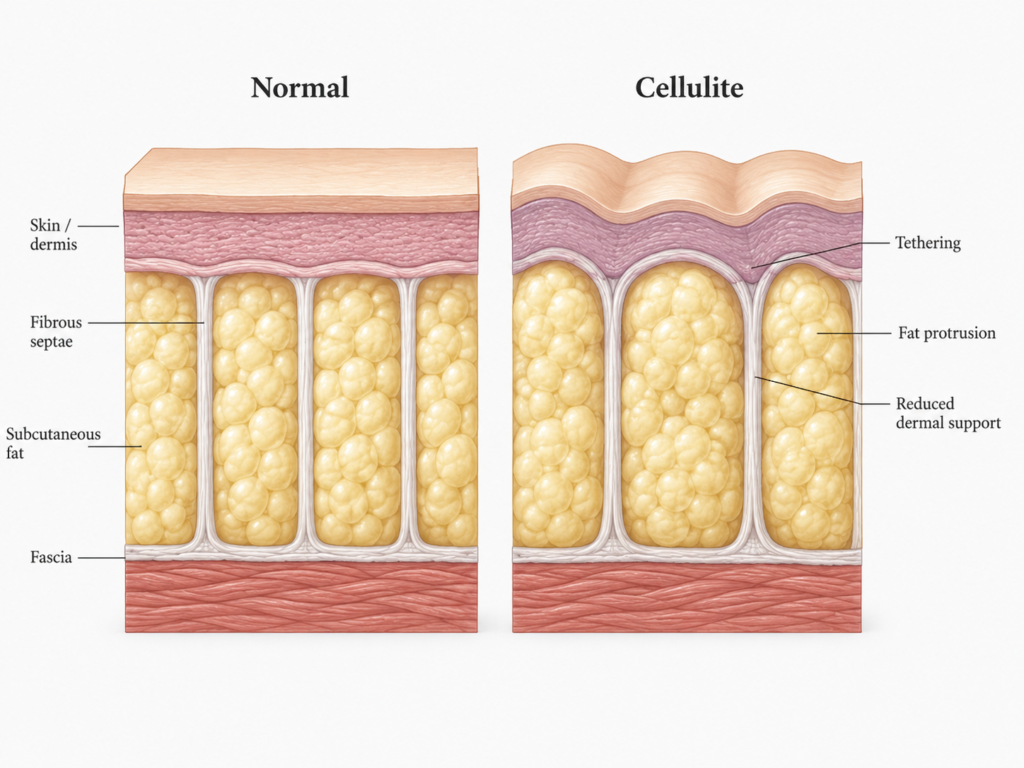
Why Does Cellulite Form?
Cellulite develops because of the relationship between the skin, connective-tissue septae and underlying fat — not because someone is simply overweight.
This is why very slim patients can have significant cellulite, while another patient with more body fat may have relatively smooth skin.
Not All Cellulite Is the Same
01
Fibrous Tethering
Individual depressions caused by connective-tissue bands pulling the skin downward.
02
Localized Fat
Subcutaneous fat can exaggerate the peaks and valleys visible at the skin surface.
03
Skin Laxity
When the skin envelope becomes looser, underlying irregularities become more visible.
04
Reduced Dermal Support
Loss of collagen and dermal thickness can contribute to a thinner or more crepey surface.
The treatment should match the layer creating the problem.
05
Sometimes It’s More Than Cellulite
Not every dimpled or uneven area is simply cellulite. Lipedema, fluid retention, lymphatic congestion or underlying fat-distribution changes can sometimes contribute to the appearance. If I suspect something else is going on, I assess that first rather than treating the surface alone.
How I Treat Cellulite
Forza Laser Lipolysis
I consider Forza when cellulite is associated with localized fat, tissue laxity or loss of definition, particularly around the thighs, hips and buttocks.
The treatment works beneath the skin rather than only treating the surface. Laser energy is delivered into the subcutaneous tissue with the aim of addressing localized fat while producing controlled thermal stimulation within the surrounding tissue.
Forza is therefore more useful to me when the problem is broader than one isolated dimple — for example, when cellulite sits within an area that is also becoming softer, heavier or looser.
I may consider Forza for: localized fat · diffuse irregularity · skin laxity · contour improvement
Sculptra & Lanluma for Cellulite
Sometimes there is very little fat to remove.
Instead, the skin itself has lost support.
In these patients I may use an injectable collagen biostimulator such as Sculptra or Lanluma to stimulate gradual collagen production and improve the structural support of the tissue.
This can be particularly useful when cellulite is accompanied by thin skin, mild laxity or broader textural irregularity.
If a cellulite band is deeply tethered, collagen stimulation alone is usually not enough. I may combine it with subcision or another method that physically releases the tethering, while Sculptra, Lanluma or another biostimulator is used to improve the strength and quality of the tissue around it.
RF Microneedling / Morpheus8
RF microneedling can be useful when the dominant problem is superficial texture and mild skin laxity.
I use it selectively. Someone with crepey skin has a different problem from someone with several deeply tethered depressions, so I would not treat them identically.
What About Subcision?
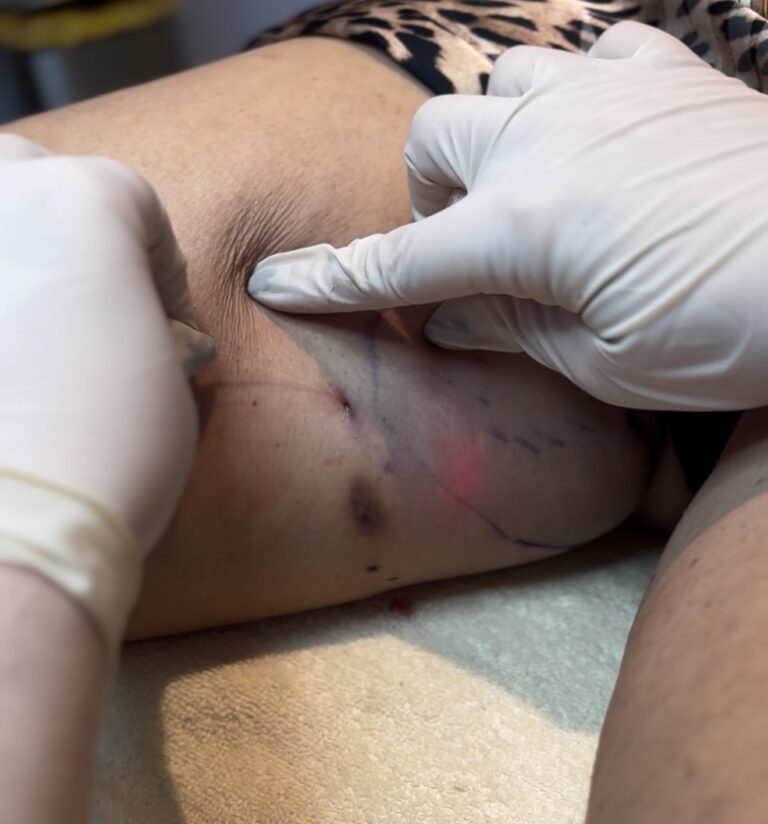
When an individual dimple is caused predominantly by a tight fibrous band, treatment may need to address that tethering itself.
In selected cases, subcision or controlled release of the fibrous component may be considered. Whether this is appropriate depends on the depth, distribution and surrounding tissue.
Why I Sometimes Combine Forza + Collagen Stimulation
In some patients, cellulite exists at more than one level.
There may be localized fat and laxity underneath, while the overlying skin also needs better collagen support.
In those cases, I may combine Forza with a collagen biostimulator rather than expecting one treatment to do both jobs.
Forza works on the deeper contour and tissue.
Collagen stimulation works on the skin envelope above it.The combination is not automatically better for everybody. It makes sense when both components are actually present.
One Cellulite Treatment Does Not Fit Everyone
| What I see | What I may consider |
|---|---|
| Localized fat + laxity | Forza |
| Thin / poorly supported skin | Sculptra or Lanluma |
| Mild superficial texture | RF microneedling |
| Deep tethered dimples | Assess tethering / subcision |
| Fat + laxity + poor skin quality | Combination treatment |
I don’t choose the treatment from a cellulite menu. I choose it after I understand what is creating the cellulite.
Frequently Asked Questions
Curious? Start Here
Cellulite is not a fat problem — it’s a structural one. The dimpling comes from the relationship between the skin, the fibrous septae beneath it and the underlying fat layer. When those connective-tissue bands tether the skin downward, fat pushes up between them and the surface becomes uneven. This is why very slim patients can have significant cellulite while someone with more body fat may have relatively smooth skin.
I assess which layer is creating the irregularity before choosing anything. Individual tethered dimples, diffuse localized fat, a loose skin envelope and thin, poorly supported skin are four different problems, and they respond to different treatments. The assessment comes first — the treatment plan follows from what I find, not from a fixed menu.
Subcision is a controlled release of the fibrous band that is pulling the skin downward. Where an individual depression is caused predominantly by tethering, releasing that band is what addresses the dimple itself. No amount of surface treatment will lift a depression that is being held down from below.
Because they do two different jobs in the same session. The subcision releases the tethering; the collagen biostimulator is then placed to support the tissue as it heals and to improve the quality and thickness of the skin above it. Releasing a band without supporting the tissue around it addresses only half the problem.
They work at different depths and on different problems. Forza laser lipolysis works beneath the skin, addressing localized fat while producing controlled thermal stimulation in the surrounding tissue — useful when an area is also becoming softer, heavier or looser. A collagen biostimulator works on the skin envelope above, improving dermal support. In some patients both components are present, and I may combine them rather than expecting one treatment to do both jobs.
Local anaesthetic is used, so the treatment itself is generally well tolerated. Most patients describe pressure rather than pain. Sensitivity in the treated area for a few days afterwards is normal.
This depends on the mechanism and the area. Collagen biostimulation is gradual by design and typically requires more than one session spaced several weeks apart. Forza is usually a single treatment for a given area. I give a realistic session estimate at the assessment rather than beforehand.
Collagen biostimulators work progressively — meaningful change is usually seen over several months rather than immediately, as new collagen forms. Results following release of a tethered band tend to be visible earlier, once swelling settles. Longevity varies between patients and is influenced by weight change, ageing and individual tissue quality. No cellulite treatment stops the skin from continuing to age.
Bruising, swelling and tenderness in the treated area are expected and typically settle over one to two weeks. Compression may be advised after Forza. Most patients return to normal daily activity quickly, with exercise reintroduced gradually depending on what was done.
Most commonly thighs, hips and buttocks, and in selected cases the arms and abdomen. Suitability depends on the depth and distribution of the irregularity and the quality of the surrounding tissue.
Bruising, swelling and tenderness in the treated area are expected and typically settle over one to two weeks. Compression may be advised after Forza. Most patients return to normal daily activity quickly, with exercise reintroduced gradually depending on what was done.
Dr Shiva Faramarzi Babadi, MD
Aesthetic & Longevity Physician · DHA licence 43705219
Apogée Clinic, Address Beach Resort, JBR, Dubai
WhatsApp or call: +971 52 328 6185
Last medically reviewed: August 2026
