
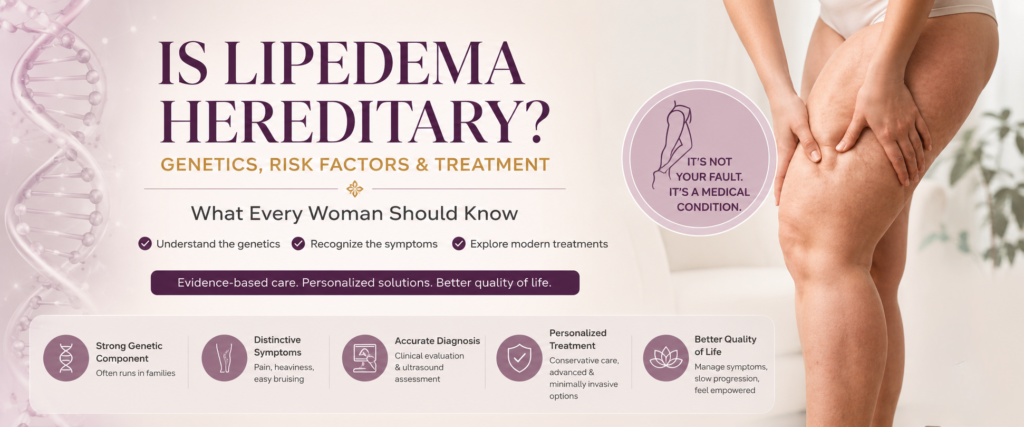
Is Lipedema Hereditary? What Every Woman Should Know About Genetics, Risk Factors, Diagnosis, and Modern Treatment
Lipedema is one of the most misunderstood conditions affecting women’s health. Many patients spend years being told that they simply need to lose weight, exercise more, or accept that their body shape is “genetic.” While genetics certainly play an important role, lipedema is far more complex than ordinary weight gain.
One of the first questions I hear during consultation is:
“Did I inherit this from my mother?”
For many women, the answer is probably yes.
Current research strongly suggests that lipedema has a significant hereditary component. Understanding this genetic basis is important because it changes not only how we diagnose the condition, but also how we manage it over the long term. Earlier diagnosis allows patients to adopt appropriate lifestyle strategies, receive targeted treatment when indicated, and potentially slow disease progression before more advanced tissue changes develop.
A Genetic Condition—Not a Lifestyle Failure
Lipedema is a chronic disorder characterized by an abnormal accumulation of fat and connective tissue, primarily affecting the legs and, in some patients, the arms. Unlike ordinary obesity, the hands and feet are typically spared, creating a distinctive appearance often referred to as the “cuff sign.”
Research has consistently shown that 60–80% of women with lipedema have another affected family member, suggesting a strong inherited component. More recent genome-wide studies estimate that genetic factors account for approximately half of an individual’s overall risk of developing the disease.
Interestingly, scientists have not identified a single “lipedema gene.” Instead, current evidence suggests that multiple genes involved in connective tissue structure, extracellular matrix remodeling, blood vessel function, and lymphatic regulation contribute collectively to the condition.
A large family-based sequencing study published in 2024 identified hundreds of genetic variants associated with microfibril formation, vascular signaling, and connective tissue integrity. This reinforces what clinicians have observed for years: no two families with lipedema look exactly alike.
While genetics may load the gun, hormones often pull the trigger.
Puberty, pregnancy, menopause, hormonal contraception, and other endocrine changes are frequently associated with the onset or progression of symptoms. This hormonal influence explains why lipedema overwhelmingly affects women and remains exceptionally rare in men.
What Happens Inside Lipedema Tissue?
One of the biggest misconceptions about lipedema is that it is simply “excess fat.”
In reality, lipedema tissue behaves very differently from ordinary body fat.
Current research suggests that affected tissue exists in a state of chronic low-grade inflammation involving changes in the fat cells, connective tissue, extracellular matrix, small blood vessels, and lymphatic microcirculation.
These microscopic changes help explain many of the symptoms experienced by patients, including:
- Pain or tenderness when pressure is applied
- Easy bruising
- Persistent heaviness in the legs
- Swelling that worsens throughout the day
- Fat tissue that feels firm or nodular
- Progressive fibrosis over time
As inflammation continues over many years, normal connective tissue may gradually become replaced by increasingly fibrotic tissue. This fibrosis contributes to the characteristic nodules, tissue firmness, discomfort, and reduced mobility seen in more advanced stages of lipedema.
Understanding these biological changes is important because treatment is not simply about reducing fat volume. It is about managing inflammation, protecting lymphatic function, preserving tissue quality, and improving quality of life.
Who Is Most at Risk?
Although lipedema can affect women of any ethnicity or body type, several risk factors have consistently been identified.
These include:
- A first-degree relative with lipedema
- Female sex
- Puberty
- Pregnancy
- Menopause
- Hormonal fluctuations
- Connective tissue disorders
- Obesity (which may worsen symptoms but does not cause lipedema)
Historically, lipedema was reported more frequently among women of Northern and Central European ancestry. However, increased awareness has demonstrated that the condition occurs across diverse ethnic populations worldwide.
In my practice in Dubai, I regularly evaluate women from many different backgrounds who have lived with symptoms for years before finally receiving the correct diagnosis.
Common Symptoms of Lipedema
Although every patient is different, the most common symptoms include:
- Symmetrical enlargement of both legs
- Fat accumulation that stops abruptly at the ankles
- Painful or tender fat tissue
- Easy bruising
- Legs that feel heavy by the end of the day
- Minimal improvement despite dieting
- Small nodules beneath the skin
- Progressive changes after pregnancy or menopause
Unlike lymphedema, swelling usually does not begin in the feet, making this an important diagnostic clue.
Many patients also describe feeling frustrated because friends and family assume they simply need more exercise, when in reality they have already tried multiple diets with very little change in the affected areas.
How Is Lipedema Diagnosed?
There is currently no single blood test or imaging study that can definitively diagnose lipedema.
Diagnosis remains primarily clinical and should be performed by a physician familiar with the condition.
A comprehensive assessment usually includes:
- Detailed medical history
- Family history
- Hormonal history
- Weight history
- Physical examination
- Evaluation of pain and tenderness
- Assessment of bruising
- Distribution of fat tissue
- Skin quality
- Mobility
- Presence or absence of foot involvement
Because other conditions can resemble lipedema, part of the consultation involves excluding alternative diagnoses such as:
- Obesity
- Lymphedema
- Chronic venous insufficiency
- Lipohypertrophy
- Generalized fluid retention
The Role of Ultrasound
Although ultrasound does not diagnose lipedema by itself, it has become an increasingly valuable tool during assessment.
High-resolution ultrasound allows physicians to evaluate the quality of the subcutaneous fat, identify areas of fibrosis, assess tissue thickness, and exclude other abnormalities that may contribute to leg swelling.
In aesthetic and regenerative medicine, ultrasound also helps guide individualized treatment planning by providing a clearer understanding of each patient’s tissue characteristics.
Understanding the Stages of Lipedema
Lipedema is generally considered a progressive condition.
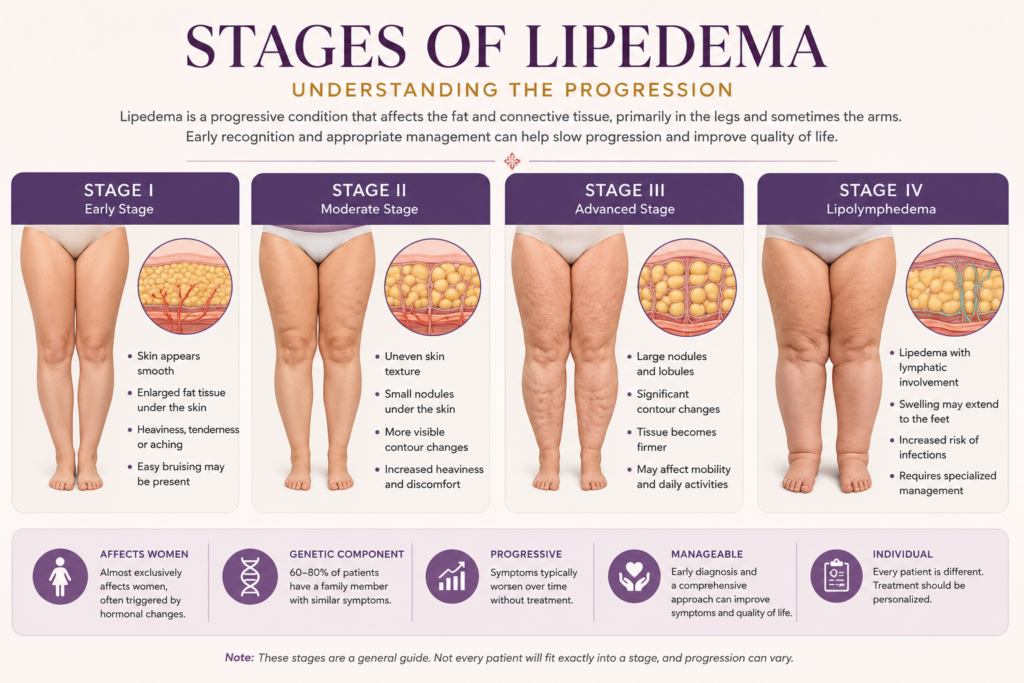
Although progression varies considerably between individuals, the disease is commonly divided into four stages.
Stage I
The skin surface appears relatively smooth, but the subcutaneous fat layer becomes enlarged. Patients often notice heaviness, tenderness, and easy bruising despite minimal visible irregularity.
Stage II
Small nodules begin developing beneath the skin, giving the tissue a firmer, uneven texture. Swelling and discomfort usually become more noticeable.
Stage III
Larger fibrotic nodules develop with significant contour irregularities and bulky tissue deposits that may interfere with walking, exercise, and daily activities.
Stage IV (Lipolymphedema)
Some patients eventually develop secondary lymphatic dysfunction in addition to lipedema, resulting in combined fat accumulation and chronic lymphatic swelling.
Early recognition is important because intervention during the earlier stages may help preserve mobility and improve long-term quality of life.
Lipedema Is Not the Same as Obesity
Perhaps the most harmful misconception surrounding lipedema is that patients simply need to lose weight.
This is both medically inaccurate and emotionally damaging.
Although obesity and lipedema frequently coexist, they are not the same disease.
Normal body fat typically decreases with calorie restriction and exercise.
Lipedema tissue is far more resistant to weight loss because its biology is fundamentally different.
Many women successfully lose weight from their face, chest, and abdomen while their legs remain disproportionately enlarged.
Weight reduction remains extremely important for overall health and can significantly reduce stress on the joints, improve mobility, decrease systemic inflammation, and make symptoms easier to manage. However, losing weight alone does not eliminate lipedema.
For this reason, treatment should focus not only on body weight but also on symptom control, preservation of function, and improving quality of life.
Living with Lipedema: What Can You Do?
Although there is currently no cure for lipedema, there is a great deal that can be done to slow progression, reduce symptoms, and improve quality of life.
The most successful management plans combine lifestyle modifications, conservative therapies, and—when appropriate—minimally invasive or surgical interventions. Every patient is different, which is why treatment should always be individualized rather than following a one-size-fits-all approach.
Exercise: Movement Matters
Many women with lipedema become discouraged because exercise does not significantly reduce the fat deposits in their legs. However, this does not mean that exercise is ineffective.
Regular physical activity remains one of the most important components of long-term management.
Low-impact exercises are generally better tolerated, including:
- Walking
- Swimming
- Cycling
- Water aerobics
- Pilates
- Strength training adapted to individual ability
These activities help improve circulation, support lymphatic flow, maintain muscle mass, reduce joint stress, and improve overall metabolic health.
Prolonged standing or sitting should be minimized whenever possible, as remaining in one position for long periods may increase swelling, heaviness, and discomfort.
The goal is not simply burning calories—it is preserving mobility, maintaining healthy tissues, and improving overall function.
Nutrition and Weight Management
No specific diet has been proven to cure lipedema.
However, many patients report improvement in symptoms after adopting an anti-inflammatory dietary pattern.
Although research is still evolving, dietary approaches commonly recommended include emphasizing:
- Vegetables and fruits
- Lean protein
- Fish rich in omega-3 fatty acids
- Whole grains (when tolerated)
- Healthy fats such as olive oil
- Adequate hydration
Many patients also choose to reduce highly processed foods, refined sugars, and excessive alcohol intake as part of an overall healthy eating pattern.
Some women report symptom improvement after limiting gluten or dairy, although current evidence suggests that these dietary changes should be individualized rather than universally recommended. Working with a physician or registered dietitian can help identify personal triggers while maintaining adequate nutrition.
Importantly, the goal is not simply weight loss. It is reducing systemic inflammation, supporting metabolic health, and helping patients feel their best.
Can Weight-Loss Medications Help?
The introduction of newer medications such as GLP-1 receptor agonists and dual or triple incretin therapies has transformed obesity treatment.
These medications can help many patients lose significant amounts of body weight, improve insulin resistance, and reduce cardiovascular risk.
However, it is important to understand that they do not cure lipedema.
The abnormal fat tissue associated with lipedema often responds differently from ordinary fat.
Nevertheless, reducing excess body weight can still provide meaningful benefits, including:
- Less stress on the joints
- Improved mobility
- Reduced systemic inflammation
- Better cardiovascular health
- Easier participation in physical activity
- Improved overall quality of life
For patients who also have obesity, weight-loss medications may therefore become one component of a comprehensive treatment strategy.
Compression Therapy and Lymphatic Care
Conservative treatment remains the foundation of lipedema management.
Compression garments are commonly recommended to help reduce heaviness, improve comfort, and support lymphatic circulation throughout the day.
Some patients also benefit from:
- Manual lymphatic drainage
- Pneumatic compression devices
- Elevating the legs after prolonged standing
- Appropriate skin care
- Maintaining good hydration
These therapies do not eliminate lipedema but may significantly improve daily symptoms and help maintain function.
When Is Treatment Beyond Conservative Care Appropriate?
For some women, lifestyle measures alone are not enough.
Persistent pain, progressive fibrosis, reduced mobility, or localized areas of disproportion may justify considering procedural treatment.
The decision should always be based on a careful medical assessment, disease stage, patient expectations, and overall health.
Our Approach to Lipedema Assessment
In my practice, every patient begins with a comprehensive consultation.
This includes reviewing medical history, hormonal factors, family history, previous weight-loss attempts, and a detailed physical examination.
When appropriate, high-resolution ultrasound may also be used to evaluate tissue characteristics, assess fibrosis, and exclude other conditions that may mimic lipedema, such as localized fluid collections or certain soft tissue abnormalities.
This detailed assessment allows treatment recommendations to be tailored to each patient’s unique presentation rather than following a generic protocol.
The Role of Forza Endolaser
One of the treatment options we may consider in carefully selected patients is Forza Endolaser.
This minimally invasive laser-assisted procedure is not a cure for lipedema, nor is it suitable for every patient.
However, in selected women with early to moderate disease, particularly those with localized fibrotic tissue and contour irregularities, it may help improve tissue quality while enhancing body contour as part of a comprehensive treatment plan.
Forza Endolaser works by delivering laser energy beneath the skin through a very fine optical fiber.
Depending on the individual patient, the treatment may contribute to:
- Softening localized fibrotic tissue
- Stimulating collagen remodeling
- Improving skin tightening
- Enhancing body contour
- Supporting a smoother transition between treated areas
Because every patient is different, realistic expectations are essential. Procedural treatments should always complement—not replace—healthy lifestyle habits, compression therapy, and long-term medical follow-up.
Can Regenerative Medicine Help?
Regenerative medicine is an exciting and rapidly evolving field.
Researchers are currently investigating how therapies that influence inflammation, tissue repair, extracellular matrix remodeling, and lymphatic biology may eventually play a role in managing chronic conditions such as lipedema.
At present, however, no regenerative therapy has been proven to cure lipedema.
Any regenerative treatment should therefore be considered complementary to established medical management rather than a replacement for evidence-based therapies.
As research continues to evolve, our understanding of lipedema biology—and future treatment options—is likely to expand significantly.
Frequently Asked Questions
Is lipedema hereditary?
Current evidence strongly suggests that genetics play a major role. Approximately 60–80% of women with lipedema report another affected family member.
Can lipedema be cured?
At present, there is no cure. The goal of treatment is to slow progression, reduce symptoms, improve mobility, and enhance quality of life.
Is lipedema the same as obesity?
No. Although the two conditions may occur together, lipedema is a separate chronic disorder involving abnormal fat distribution and connective tissue changes.
Is lipedema the same as cellulite?
No. Cellulite is a cosmetic skin change, whereas lipedema is a chronic medical condition associated with pain, tenderness, bruising, and progressive fat accumulation.
Can men develop lipedema?
Lipedema is overwhelmingly seen in women. Rare cases have been reported in men, usually in association with significant hormonal abnormalities.
Should every patient undergo surgery or Endolaser?
No.
Many patients can be managed successfully with conservative therapy alone.
Procedural treatments should always be individualized after careful medical assessment.
Final Thoughts
For many women, finally receiving a diagnosis of lipedema is a relief. It explains years of frustration, unsuccessful dieting, and symptoms that never quite fit the usual explanations.
While there is currently no cure, today’s understanding of lipedema is far greater than it was even a decade ago. Early diagnosis, individualized treatment, healthy lifestyle habits, and appropriate medical care can make a meaningful difference in slowing disease progression and improving quality of life.
If you recognize these symptoms in yourself—or notice a similar pattern in your mother, sister, or daughter—it is worth seeking a professional evaluation. A comprehensive assessment can help distinguish lipedema from other conditions and guide you toward the most appropriate management strategy for your individual needs.
References
- Morgan S, et al. A Family-Based Study of Inherited Genetic Risk in Lipedema. Lymphatic Research and Biology. 2024.
- Pouwels N, et al. Genetics of Lipoedema: A Systematic Review. Journal of Plastic, Reconstructive & Aesthetic Surgery. 2023.
- Felmerer G, et al. The Genetics of Lipedema: A Systematic Review. Biomedicines. 2022.
- German Society for Phlebology and Lymphology. S2k Guideline: Lipedema – Diagnosis and Treatment. 2024.
- Current Evidence-Based Clinical Nutritional Approaches in Lipedema. Nutrition Reviews.
- Ketogenic Diet: A Nutritional Therapeutic Tool for Lipedema?