EVIDENCE BEFORE TRENDS
Dr Shiva Faramarzi, MD — Aesthetic Physician · Apogee Clinic, Dubai · October 2026
Over the past year, Muse cells have moved from Japanese research laboratories into clinic marketing. Patients now arrive asking for them by name, and I have heard colleagues argue that mesenchymal stem cells are finished — that Muse cells are the only cell therapy still worth offering.
I find Muse cells genuinely interesting. I also think that claim runs well ahead of the evidence. In this article I set out what Muse cells are, what has actually been shown in people, how Muse-derived exosomes compare with mesenchymal ones, and the questions I believe are still unanswered — above all, long-term safety.
In scientific literature, MSC increasingly refers to mesenchymal stromal cells, although “mesenchymal stem cells” remains the term most patients encounter. I use MSC in this article for readability.
In short
- Muse cells are a small subpopulation found inside ordinary mesenchymal stem cell (MSC) cultures — roughly one to several percent of the cells.
- In animal studies they home to damaged tissue and integrate into it more effectively than ordinary MSCs.
- In humans, the evidence comes from small Japanese trials of a single product, with fewer than 70 patients in total. That product’s development was discontinued in 2023, and no Muse cell product is approved by any regulator.
- No human study has compared Muse cells with MSCs head to head, and safety follow-up so far extends to about 18 months at most.
- MSCs are not obsolete: the first MSC therapy received FDA approval in December 2024.
What are Muse cells?
“Muse” stands for multilineage-differentiating stress-enduring cells. They were first described in 2010 by Professor Mari Dezawa’s group at Tohoku University in Japan, who noticed that a small number of cells survived conditions that killed the rest of a culture [1].
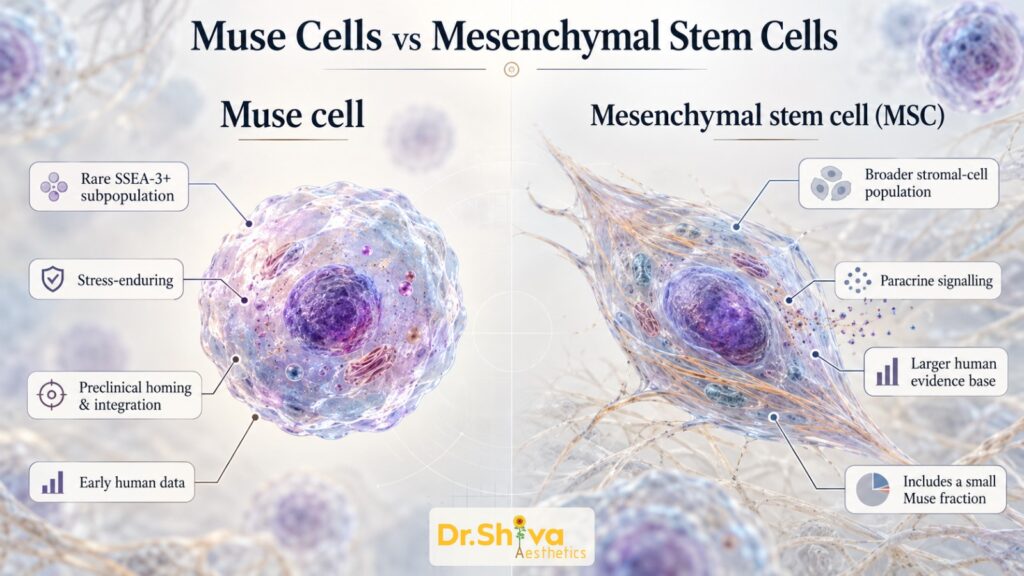
Muse cells are identified by a surface marker called SSEA-3. They express genes associated with pluripotency, can generate cells from all three germ layers starting from a single cell in the laboratory, and — unlike embryonic stem cells — did not form tumours when injected into mouse testes [1, 2]. They are found naturally in bone marrow, blood and the connective tissue of most organs.
The detail that is often left out of the conversation: Muse cells are not a separate source of cells. They are a subset of mesenchymal stem cell cultures. Every conventional MSC preparation already contains some Muse cells. A “Muse product” is an MSC culture that has been sorted and enriched for this fraction.
How mesenchymal stem cells actually work
I explain MSCs to patients as signallers rather than builders. Their benefit comes mainly from paracrine signalling — the cytokines, growth factors and extracellular vesicles they release, which calm inflammation and prompt the body’s own repair processes.
After an intravenous infusion, a large share of MSCs lodge in the lungs on their first pass; in mice, up to 80% of injected cells were found in the lungs within minutes. In patients, labelled MSCs accumulated first in the lungs and then in the liver and spleen [3]. Some cells do reach inflamed tissue, but this homing is inefficient, very few cells engraft, and the effect is largely short-lived. That is why how long the benefit lasts is a fair and recurring question with MSCs.
What MSCs do have is a long track record. Across randomised trials of intravascular MSC therapy, a systematic review found no signal for malignancy; the main consistent association was transient fever [4]. And in December 2024 the FDA approved remestemcel-L (Ryoncil) for children with steroid-refractory acute graft-versus-host disease — the first MSC therapy approved in the United States [5].
What makes Muse cells different — in the laboratory
The case for Muse cells rests on properties that ordinary MSCs show weakly or not at all:
- Active homing. Damaged tissue releases a signal called sphingosine-1-phosphate (S1P). Muse cells carry its receptor, S1PR2, and migrate towards it. In a rabbit heart-attack model, intravenous Muse cells homed to the injured heart, while the non-Muse cells were trapped in the lungs [2].
- Integration and differentiation. In a mouse stroke model, only Muse cells integrated into the brain tissue around the infarct and became neuron-like cells; the other MSCs did not remain [6].
- Clearing damaged cells. Muse cells have macrophage-like behaviour and can take up damaged cells before replacing them [2].
- Immune tolerance. In the clinical trials, donor Muse cells were given without HLA matching and without immunosuppressive drugs [7].
On paper, these are meaningful advantages. But every one of them comes from cell culture and animal work. The question that matters to a patient is what happens in people.
What has been shown in humans
Every published human trial used the same product, CL2020, manufactured in Japan from bone-marrow MSCs by Life Science Institute, a Mitsubishi Chemical Group company.
| Indication | Patients | Design | What it showed |
|---|---|---|---|
| Subacute ischaemic stroke | 35 (25 treated, 10 placebo) | Randomised, double-blind, placebo-controlled | 40% vs 10% reached mRS ≤2 at 12 weeks; confidence intervals overlap. One grade 4 status epilepticus in the treated arm. |
| Acute myocardial infarction | 3 | First-in-human, open-label | No adverse drug reactions; heart function reported as improved, without a control group. |
| ALS | 5 | Open-label, monthly infusions | Well tolerated; slowing of decline was not statistically significant. |
| Cervical spinal cord injury | 10 | Single-arm, no control | No safety concerns; improvement measured against each patient’s own baseline only. |
| Neonatal hypoxic-ischaemic encephalopathy | 9 | Open-label dose escalation | Safe and tolerated; 67% had normal developmental scores, with no comparison group. |
| Dystrophic epidermolysis bullosa | Small adult cohort | Open-label phase 1/2 | Reported as a short letter; no controlled data. |
Three points about this evidence are worth stating plainly.
- It is small. Fewer than 70 patients received CL2020 across the published clinical studies summarized here, and only one study had a control group.
- The product no longer exists. In February 2023 Mitsubishi Chemical Group discontinued development of CL2020, citing clinical developments, commercial timelines and business strategy [14]. No Muse cell product has been approved by the FDA, Japan’s regulator or any other authority.
- The data does not transfer. These results belong to one product made by one manufacturer using one process. Cells sold today under the Muse name — many of them derived from umbilical cord tissue rather than bone marrow — have not inherited that evidence.
There are also no human trials of Muse cells in healthy people or for ageing. Claims of “biological age reversal” currently rest on case reports of a handful of patients who received Muse cells together with exosomes and cord plasma, which makes it impossible to say what, if anything, produced the change.
My concerns about Muse cells
1. We do not have long-term safety data
This is my main reservation. Conventional MSCs generally show limited persistence after systemic administration, while their clinical safety database is also much larger. Muse cells are biologically different precisely because preclinical studies suggest greater homing and integration into damaged tissue. With a cell that may persist and differentiate, the question of what happens over five or ten years is not academic.
The evidence that Muse cells do not form tumours comes from laboratory assays and mouse studies. In humans, the longest follow-up is 52 weeks in the stroke trial and 18 months in the neonatal trial [8, 12]. That is far too short, and the patient numbers far too small, to detect rare late events such as malignancy or tissue forming where it should not. I am not saying there is a signal of harm. I am saying that the absence of problems over a short follow-up is not evidence of long-term safety.
2. The overall safety profile is still thin
With fewer than 70 patients across the published studies, uncommon side effects simply cannot be measured yet. The one randomised trial already recorded a serious neurological reaction in the treated group [8]. That may or may not prove meaningful — and that uncertainty is precisely the point.
3. There is no evidence that Muse cells are the better choice
No human study has compared Muse cells with MSCs. The superiority argument comes from animal models. Until a properly designed trial compares the two in people, “Muse cells are better, so choose Muse cells” is not a conclusion medicine has reached.
4. “Muse” is a description, not a standard
Tissue source, isolation method, the purity of the SSEA-3-positive fraction, cell viability and manufacturing all vary between suppliers. Two products carrying the same name may not be the same thing.
What about Muse-derived exosomes?
Muse exosomes are now marketed as a superior version of MSC exosomes. At present, there is no clinical evidence demonstrating that Muse-derived exosomes are superior to conventional MSC-derived exosomes.
- The advantages belong to the living cell. Homing, integration and differentiation are things a living cell does. An exosome is a vesicle; it cannot migrate towards a signal, engraft or become tissue.
- Intravenous exosomes go to the same places. In animal imaging studies, intravenous exosomes are cleared within minutes and taken up mainly by the liver and spleen [15]. There is no evidence that Muse-derived vesicles behave differently.
- The cargo may differ — but that is untested. It is plausible that Muse cells package different signals. As recently as 2025, a published paper could only propose this as a hypothesis to be tested [16]. I have found no study comparing the two.
For either type, the quality of the product — particle count per dose, purity, sterility, endotoxin testing and batch consistency — matters more than the name on the label. A well-characterised MSC exosome product may well outperform a poorly characterised one sold as Muse.
So — Muse cells or mesenchymal stem cells?
Today I cannot tell a patient that Muse cells are the better option, because the human evidence to support that statement does not yet exist. Equally, I would not dismiss them. Their biology is promising, and they deserve properly designed trials with long-term follow-up.
My approach to any regenerative treatment is the same: the modality is chosen for the indication and the patient, not because it is the newest thing on the market. New is not the same as better, and in cell therapy, “we don’t know yet” is an honest and important answer.
Questions to ask before any cell-based treatment
- What exactly is in the product — cell type, tissue source, and the number of cells or particles per dose?
- Is there a certificate of analysis for this batch, covering identity, viability, sterility and endotoxin?
- What human evidence exists for my condition — and was it generated with this product?
- How is this product regulated and authorised for use in Dubai?
- What follow-up will I have, and who do I contact if something goes wrong?
Frequently asked questions
Are Muse cells better than mesenchymal stem cells?
Not on current human evidence. Muse cells outperform ordinary MSCs in several animal models, but no human trial has compared the two.
Are Muse cells approved anywhere?
No. No Muse cell product has been approved by the FDA, Japan’s regulator or any other authority. The only product tested in published trials, CL2020, was discontinued by its developer in 2023.
Can Muse cells cause cancer?
Laboratory and animal studies suggest Muse cells are not tumour-forming, and no tumours have been reported in human trials. However, human follow-up is limited to about 18 months, across published studies that together include fewer than 70 patients, so long-term risk is not yet known.
Are Muse exosomes better than MSC exosomes?
There is no published study comparing them. The main advantages of Muse cells belong to the living cell, and intravenous exosomes from any source are cleared mainly by the liver and spleen.
Can Muse cells reverse ageing?
There is no controlled, peer-reviewed evidence that they do. I cannot make anyone younger; what I can do is help patients hold on to function for longer, using treatments whose evidence I can explain.
A note from Dr Shiva
If you are considering a regenerative treatment and want an honest assessment of what the evidence supports for your situation, I am happy to talk it through in consultation.
WhatsApp +971 52 328 6185 · shiva@drshivaf.com
References
- Kuroda Y, Kitada M, Wakao S, et al. Unique multipotent cells in adult human mesenchymal cell populations. Proc Natl Acad Sci USA. 2010;107(19):8639–8643.
- Dezawa M. Macrophage- and pluripotent-like reparative Muse cells are unique endogenous stem cells distinct from other somatic stem cells. Front Bioeng Biotechnol. 2025;13:1553382.
- Leibacher J, Henschler R. Biodistribution, migration and homing of systemically applied mesenchymal stem/stromal cells. Stem Cell Res Ther. 2016;7:7.
- Thompson M, Mei SHJ, Wolfe D, et al. Cell therapy with intravascular administration of mesenchymal stromal cells continues to appear safe: an updated systematic review and meta-analysis. EClinicalMedicine. 2020;19:100249.
- US Food and Drug Administration. FDA approves first mesenchymal stromal cell therapy to treat steroid-refractory acute graft-versus-host disease. 18 December 2024.
- Yamauchi T, Kuroda Y, Morita T, et al. Therapeutic effects of human multilineage-differentiating stress enduring (Muse) cell transplantation into infarct brain of mice. PLoS One. 2015;10(3):e0116009.
- Minatoguchi S, et al. Donor Muse cell treatment without HLA-matching tests and immunosuppressant treatment. Stem Cells Transl Med. 2024. doi:10.1093/stcltm/szae018.
- Niizuma K, Osawa SI, Endo H, et al. Randomized placebo-controlled trial of CL2020, an allogenic Muse cell-based product, in subacute ischemic stroke. J Cereb Blood Flow Metab. 2023;43(12):2029–2039.
- Noda T, Nishigaki K, Minatoguchi S. Safety and efficacy of human Muse cell-based product for acute myocardial infarction in a first-in-human trial. Circ J. 2020. doi:10.1253/circj.CJ-20-0307.
- Yamashita T, Nakano Y, Sasaki R, et al. Safety and clinical effects of a Muse cell-based product in patients with amyotrophic lateral sclerosis: results of a phase 2 clinical trial. Cell Transplant. 2023. doi:10.1177/09636897231214370.
- Koda M, Imagama S, Takahashi H, et al. Safety and feasibility of intravenous administration of a single dose of allogenic-Muse cells to treat human cervical traumatic spinal cord injury: a clinical trial. Stem Cell Res Ther. 2024;15. doi:10.1186/s13287-024-03842-w.
- Sato Y, et al. Safety and tolerability of a Muse cell-based product in neonatal hypoxic-ischemic encephalopathy with therapeutic hypothermia (SHIELD trial). Stem Cells Transl Med. 2024;13(11):1053–1066.
- Fujita Y, et al. Intravenous allogeneic multilineage-differentiating stress-enduring cells in adults with dystrophic epidermolysis bullosa: a phase 1/2 open-label study. J Eur Acad Dermatol Venereol. 2021;35(8):e528–e531.
- Mitsubishi Chemical Group. Discontinuation of the development of a regenerative medicine product (CL2020) using Muse cells. February 2023.
- In vivo SPECT imaging and biodistribution of 99mTc-labelled exosomes from human umbilical cord mesenchymal stem cells. Biomed J. 2024;47(5):100721.
- Rajabi A, Bonyadi M. Muse cell-derived exosomes: a hypothesis for a cell-free therapeutic platform in regenerative medicine. Stem Cell Rev Rep. 2025;21:1860–1862.
This article is for education and does not replace an individual medical consultation.
This article is part of my guide to regenerative medicine in Dubai. If you are considering treatment, read how I assess stem cell therapy in Dubai.