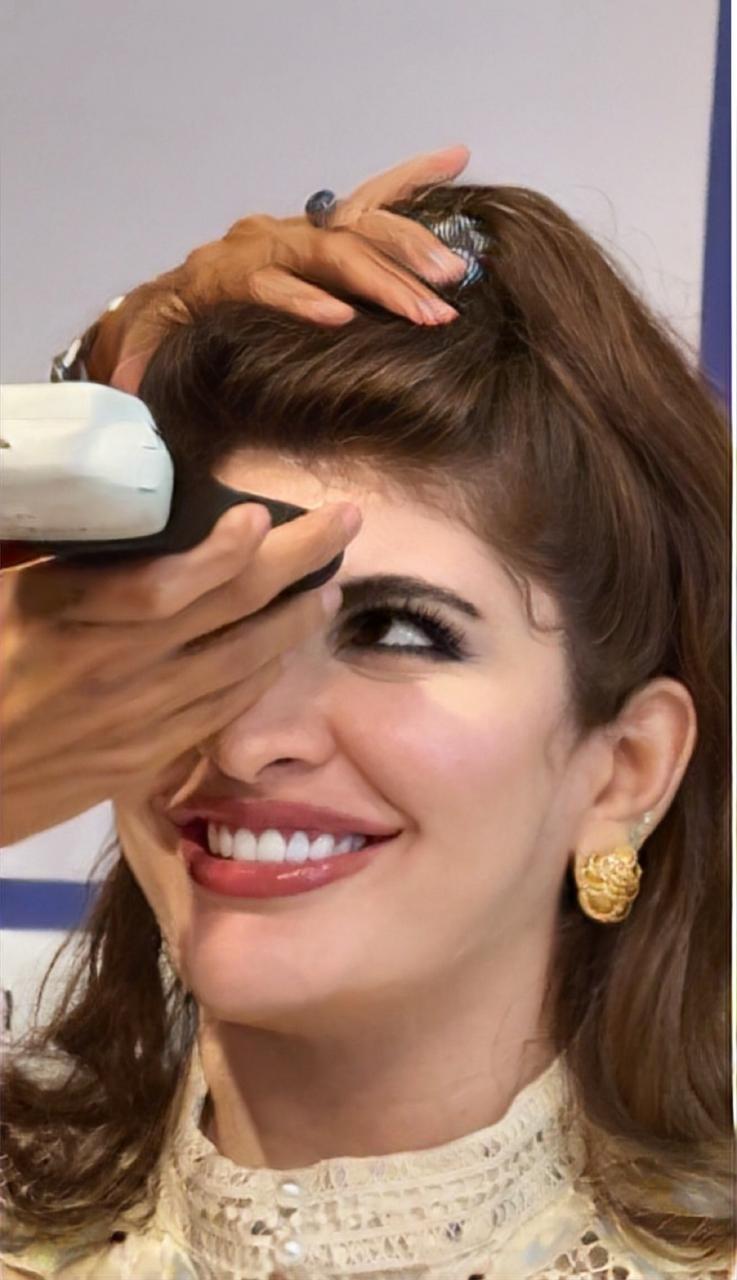
By Dr Shiva Faramarzi · Apogee Clinic, Address Beach Resort, JBR Dubai · September 2026
A young woman came to see me recently with a complaint I want every patient, and every injector, to hear. She had recently had filler and skin boosters. Nothing looked obviously wrong. But she told me that talking, smiling and laughing had become uncomfortable. She felt tension in her face whenever she moved it.
Her face was very delicate: fine features, thin soft tissue, slim muscles. And she was young, with very little sagging. This case is a good example of why “more product” and “it’s only a skin booster” are both dangerous assumptions.
Was she a candidate in the first place?
Honestly, not really. With so little sagging, there was no clear structural problem for filler to correct. If I had assessed her before treatment, the most I would have suggested was a small, structural chin filler, and she was not interested in that either.
That matters. Every injection should answer a specific problem identified at assessment. When there is no clear indication, the only possible outcome of treatment is added volume in a face that did not need it.

What the ultrasound showed
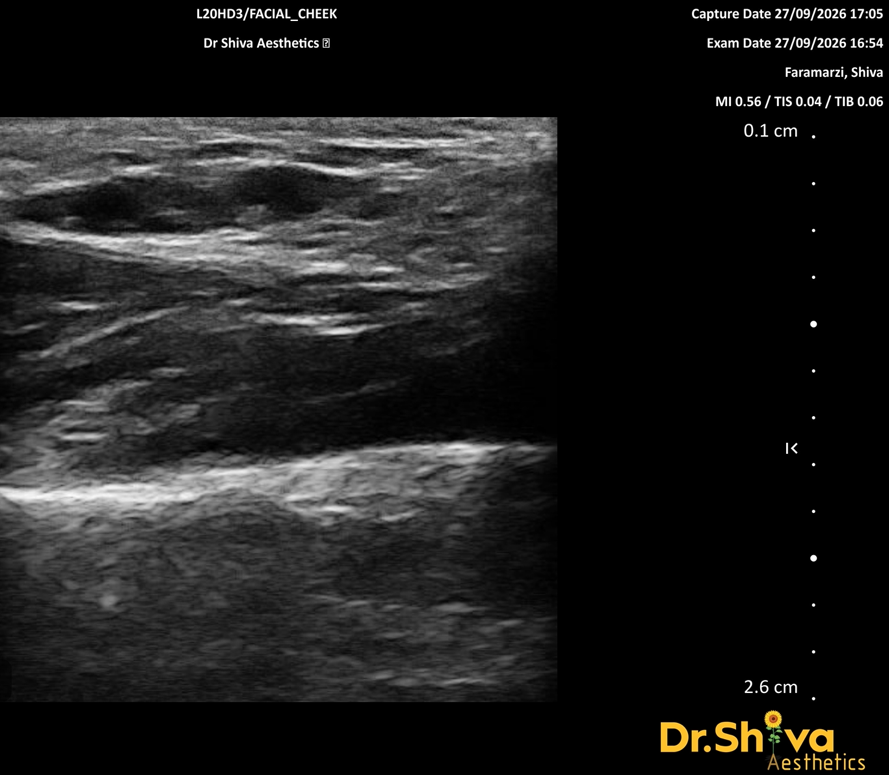
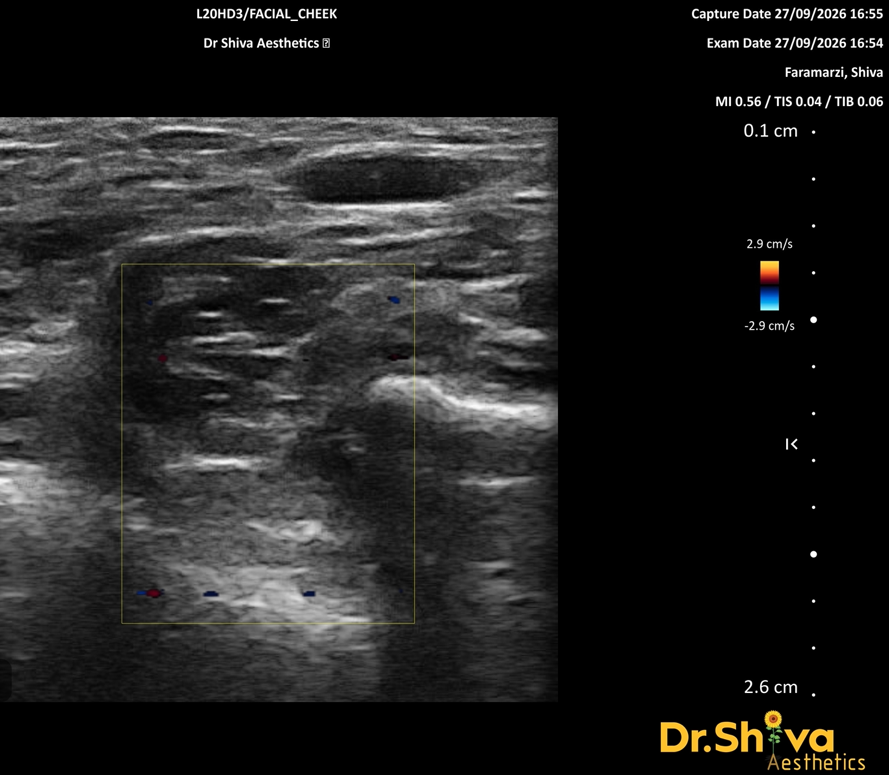
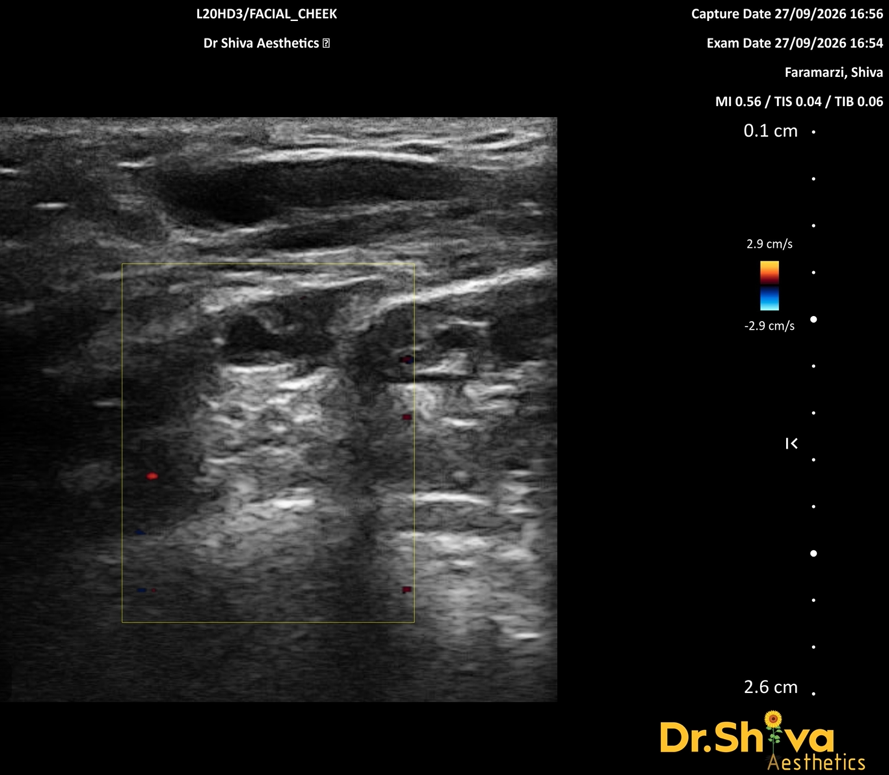
This was the interesting part. I scanned her face with high-frequency ultrasound. Hyaluronic acid products have a characteristic appearance on ultrasound: well-defined, almost black (anechoic to hypoechoic) pockets within the tissue.1,2
In her face, there were large, bulky deposits of this material, most likely the filler and the skin booster. They were not spread as a fine, even layer. They were sitting as boluses.
Then I scanned her while she moved. As she talked and smiled, you could clearly see these boluses of hyaluronic acid pressing on the muscles of expression. The gel was physically in the way of the muscle doing its job. That is exactly what she was feeling as tension.
How filler and facial muscles interact
The muscles that create our expressions sit directly beneath the skin and fat, and are closely bound to both. Filler placed in that neighbourhood does not automatically change how a muscle works. A great deal depends on where it sits, how deep it is, how much of it there is, and its precise relationship to the muscle.
Where those variables line up a certain way, filler can influence muscle behaviour. A deposit placed deep to a muscle may increase its convexity and give it mechanical advantage, in effect assisting its pull; a deposit sitting more superficially on the muscle may impede its contraction.3 These effects are the basis of what is described as myomodulation — the proposed concept of using filler deliberately to alter how facial muscles behave.5 It is a recognised idea in aesthetic practice rather than settled science, and the authors describing it are explicit that more study is needed.3,5
Around the mouth the stakes are higher. The perioral muscles are small, sphincter-like and in motion all day. Product placed into or around them tends to clump and be displaced, and has been associated with later nodularity and swelling, which is why some authors recommend avoiding these mimetic muscles when injecting.4
In this patient, the dynamic scan showed deposits positioned in a way that appeared to limit muscle excursion when she moved her face. That is consistent with the mechanisms described above, and it matched what she was feeling.
Why the same volume behaves differently in a thin face
This next point is a clinical observation rather than a rule established by trial evidence, and I want to label it as such. In a patient with fine bone structure, thin soft tissue and slim muscles, there is less room for a given volume to distribute itself. The same amount of gel that would disappear into a thicker tissue envelope can sit more prominently — and be more mechanically relevant — in a delicate one.
What is better established is that large single deposits behave differently from small, well-distributed ones: a large-volume bolus of hyaluronic acid has been reported to produce a palpable nodule requiring management.8
“It’s only a skin booster”: the myth
Many patients, and some injectors, treat skin boosters as though they carry no real risk.
Many injectable skin boosters are hyaluronic-acid-based, although “skin booster” has become an umbrella term covering several different categories of injectable product. The hyaluronic acid ones are generally intended to improve skin quality — hydration, texture, elasticity — rather than to create substantial structural volume. How they are delivered varies: technique, depth, distribution and volume differ between products and between the areas being treated.
What they are not is free of risk. Hyaluronic acid skin boosting has been associated with lumpiness, nodules and extrusion of material, and the volume injected and the site chosen are among the factors described behind nodule formation.6
And the material itself does not read the marketing. A sufficiently large deposit of an HA-based skin booster can still behave as a space-occupying gel bolus within the tissue, regardless of how the product is marketed.
The label on the box does not change what the gel does in the tissue.
Not sure what was injected or where? An ultrasound shows you. Book an ultrasound assessment on WhatsApp: +971 52 328 6185 |
How we treated her
Treatment was performed in two ultrasound-guided hyaluronidase sessions, two weeks apart, using approximately 1,000 units of hyaluronidase at each session.During the first treatment, the enzyme was directed specifically into the filler deposits identified on ultrasound. Within approximately three days, the patient reported a noticeable reduction in the feeling of pressure and tightness in her face. However, she could still feel some residual pressure, particularly in the left upper cheek when smiling. At the two-week follow-up, we performed a control ultrasound. Residual filler deposits were still visible in several areas, including some very superficial deposits corresponding to the palpable bumps. A second ultrasound-guided treatment was therefore performed using approximately 1,000 additional units of hyaluronidase, allowing the remaining deposits to be targeted precisely while avoiding unnecessary treatment of surrounding tissue. Following the second session, the patient reported that the previous sensation of pressure and restriction had resolved, including during smiling and talking. |
What I can say in general terms is that where the material is hyaluronic acid, it is reversible. Hyaluronidase is the enzyme that breaks hyaluronic acid down, and placing it under ultrasound guidance means it can be directed into the deposits that have actually been seen, rather than injected blindly across an area.7
What I want you to take from this case
- Treatment needs an indication. A young face with little sagging often needs little or nothing. Sometimes the best treatment is no filler.
- Skin boosters are not risk-free. Many are hyaluronic acid, and a large enough deposit of any hyaluronic acid gel occupies space in the tissue.
- Technique matters as much as product. Appropriate amounts, the right layer, and respect for the muscles.
- A thin tissue envelope leaves less room. The same volume can be more noticeable, and more mechanically relevant, in a delicate face.
- If your face feels tight, heavy or restricted and it is not settling, have it assessed. Where the history is unclear or symptoms persist, ultrasound can show what is actually there — and hyaluronic acid is reversible.
Book an assessment with Dr Shiva Book an ultrasound assessment on WhatsApp: +971 52 328 6185 |
Frequently asked questions
Can skin boosters cause the same problems as filler? |
Many skin boosters are hyaluronic-acid-based — the same family of material as HA filler — although the term now covers several different categories of injectable product. The HA-based ones are intended to improve skin quality rather than to build structural volume, and technique, depth and volume vary from product to product. But a sufficiently large deposit of HA gel occupies space in the tissue whatever the product is called, and HA skin boosting has been associated with lumpiness and nodules, with the volume injected and the site chosen among the factors described behind them.6 |
Why would filler make it uncomfortable to smile or talk? |
The muscles of expression sit directly under the skin and fat. A deposit of gel sitting on or around a muscle may — depending on its size, depth and exact position — interfere with that muscle’s contraction. This is most relevant around the mouth, where the muscles are small and in constant motion.3,4 |
How does ultrasound help? |
High-frequency ultrasound shows where the product actually is, roughly how much there is, and which layer it sits in. Scanning while the patient smiles or speaks shows how the gel and the muscle relate to one another in real time. Hyaluronic acid has a characteristic appearance on ultrasound, which helps distinguish it from other materials.1,2 |
Can hyaluronic acid skin boosters be dissolved? |
Hyaluronic acid products can be broken down with hyaluronidase. Placing the enzyme under ultrasound guidance allows it to be delivered into the deposits that can actually be seen, rather than injected blindly.7 Products that are not hyaluronic acid — polynucleotides or collagen stimulators, for example — do not respond to hyaluronidase, which is one reason it matters to know what was injected. |
I had filler or skin boosters and my face feels tight. What should I do? |
Some firmness and swelling in the first days to weeks is common and usually settles. But persistent tightness, heaviness or restriction of movement should not simply be dismissed for months as “settling”. If the symptoms are persistent, worrying, or limiting how your face moves, ask your injector what product was used and where, and have the area assessed. Not everyone who has had filler needs an ultrasound — but where the history is unclear or the symptoms persist, imaging can show what is there rather than leaving it to guesswork. |
This case is shared with the patient’s consent and has been anonymised. It is for education and does not replace an individual medical consultation.
References
- Wortsman X. Identification and complications of cosmetic fillers: sonography first. J Ultrasound Med. 2015;34(7):1163–1172. doi:10.7863/ultra.34.7.1163
- Schelke LW, Van Den Elzen HJ, Erkamp PP, Neumann HA. Use of ultrasound to provide overall information on facial fillers and surrounding tissue. Dermatol Surg. 2010;36(Suppl 3):1843–1851. doi:10.1111/j.1524-4725.2010.01740.x
- Kapoor KM, Saputra DI, Porter CE, et al. Treating aging changes of facial anatomical layers with hyaluronic acid fillers. Clin Cosmet Investig Dermatol. 2021;14:1105–1118. doi:10.2147/CCID.S294812
- Goodman GJ, Al-Niaimi F, McDonald C, Ciconte A, Porter C. Why we should be avoiding periorificial mimetic muscles when injecting tissue fillers. J Cosmet Dermatol. 2020;19:1846–1850. doi:10.1111/jocd.13531
- de Maio M. Myomodulation with injectable fillers: an innovative approach to addressing facial muscle movement. Aesthetic Plast Surg. 2018;42(3):798–814. doi:10.1007/s00266-018-1116-z
- Ghatge AS, Ghatge SB. The effectiveness of injectable hyaluronic acid in the improvement of the facial skin quality: a systematic review. Clin Cosmet Investig Dermatol. 2023;16:891–899. doi:10.2147/CCID.S404248
- Quezada-Gaón N, Wortsman X. Ultrasound-guided hyaluronidase injection in cosmetic complications. J Eur Acad Dermatol Venereol. 2016;30. doi:10.1111/jdv.13286
- Saputra DI, Kapoor KM. Management of non-inflammatory nodule in chin after a large-volume bolus injection of hyaluronic acid filler. Dermatol Ther. 2020;33:e13424. doi:10.1111/dth.13424