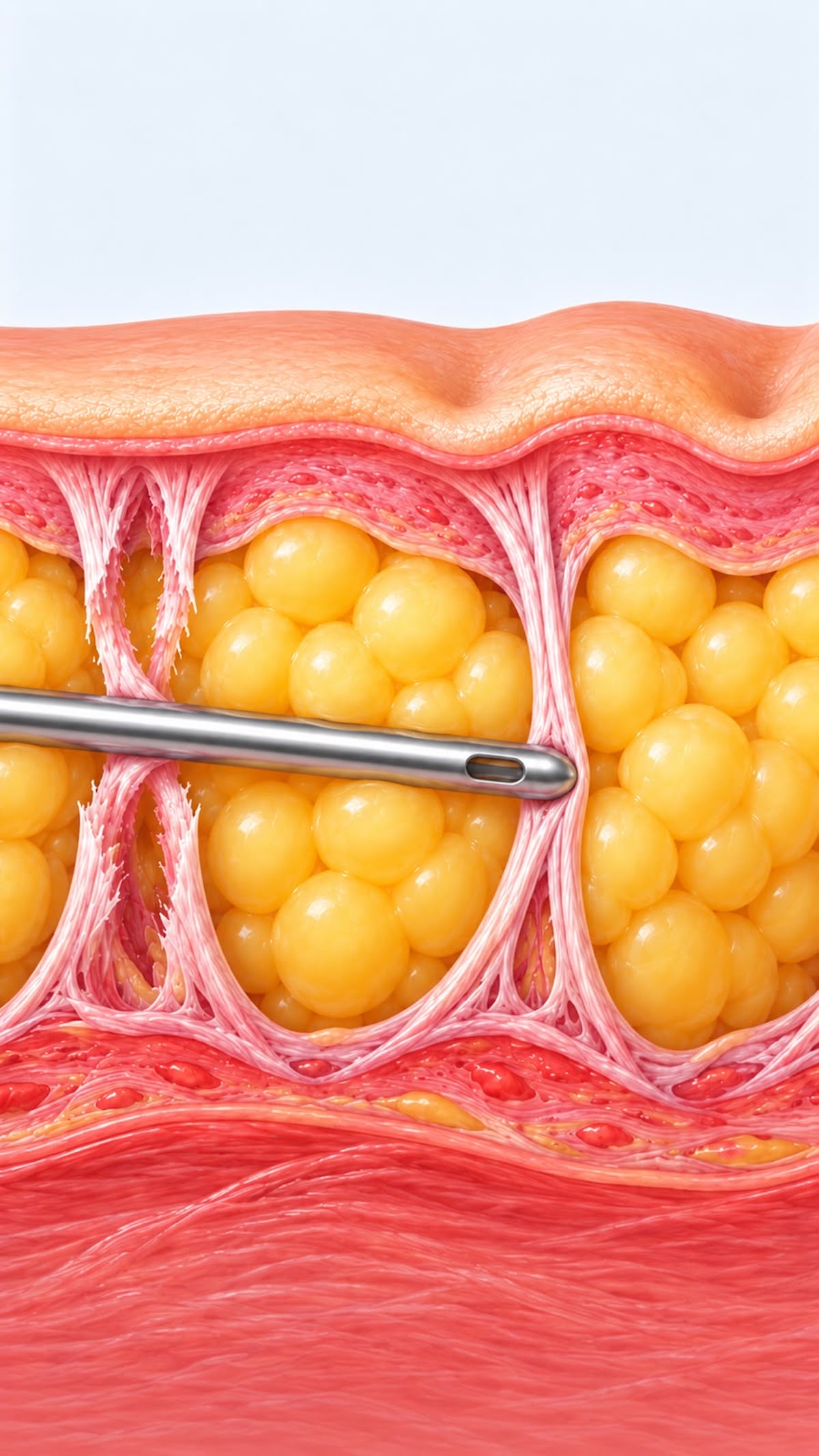
If the area you had treated with fat freezing is now larger than it was before, you are not imagining it, you have not simply gained weight, and it is not a failure of willpower. There is a recognised complication of this treatment in which the treated fat enlarges instead of reducing. It has a name — paradoxical adipose hyperplasia — and it is documented in the peer-reviewed literature.
It is also not something that resolves if you wait, which matters, because waiting is what most patients are told to do.
What paradoxical adipose hyperplasia is
Fat freezing — cryolipolysis — works by cooling fat to a temperature at which fat cells are damaged and gradually cleared by the body over the following weeks. In the overwhelming majority of patients that is what happens.
CoolSculpting is one commercial form of cryolipolysis, and paradoxical adipose hyperplasia has been specifically documented following CoolSculpting treatment in the published medical literature.
In a small number, the opposite occurs. Rather than reducing, the fat in the treated area increases, becoming firmer and denser than the surrounding tissue. The enlarged area characteristically takes on a well-defined shape corresponding to where the applicator sat, with a palpable edge — which is one of the features that distinguishes it from ordinary weight gain.
Why it happens is not fully established. It is thought to involve an abnormal response of the fat tissue to the cold injury rather than anything the patient did or failed to do.
How common is it?
Rarer than most complications, but not as rare as it is usually presented.
The manufacturer figure most often quoted is around 0.025% of treatment cycles — roughly one in four thousand. Independent published data puts it higher. A multicentre review of 8,658 treatment cycles in 2,114 patients found paradoxical adipose hyperplasia in 0.43% of patients and 0.15% of cycles. Even restricting the analysis to more recent equipment, the authors reported roughly one case per two thousand cycles — still above the manufacturer’s figure.
Two patterns from that data are worth knowing. Men appear over-represented among cases relative to how many men have the treatment. And while the abdomen is the most commonly affected area, the bra and back area is among those specifically reported.
Why “just wait and see” is the wrong advice
This is the part that causes the most harm, and it is almost always given in good faith.
Swelling after fat freezing is normal and does settle. So when a patient returns a few weeks later saying the area looks bigger, the reasonable first answer is that it is early, the swelling has not fully resolved, and the result takes months to appear. That advice is correct for most patients.
It is not correct for this. In the published literature there are no reported cases of paradoxical adipose hyperplasia resolving on its own. The affected tissue does not reduce with time, with diet, or with further sessions of the same treatment. Patients are frequently left waiting a year or more — the average interval between treatment and diagnosis in that multicentre series was around sixteen months — during which nothing improves and a good deal of confidence is lost.
If an area treated with fat freezing is firmer and larger than it was, and it has stayed that way beyond the first couple of months, it should be examined rather than waited out.
How it is recognised
It is a clinical diagnosis, made on examination and history.
- The area is larger than before treatment rather than smaller.
- It feels firmer and denser than the surrounding fat.
- It often has a defined edge, roughly corresponding to the treated zone.
- It appeared in the months after treatment and has not reduced since.
Ultrasound is useful here, as it is throughout my practice — not to make the diagnosis, but to assess the thickness and character of the tissue, and to distinguish it from a seroma, a haematoma or a simple contour irregularity, which are different problems needing different answers.
What can be done about it
Published management remains primarily surgical, most commonly liposuction, with the technique adapted according to the degree of fibrosis, the volume involved and the laxity of the overlying skin. The limitation is that it is surgery, under anaesthetic, for a problem the patient acquired while trying to avoid surgery in the first place.
Affected tissue is also denser and more fibrous than ordinary fat, which makes it harder to treat than the volume alone suggests.
In the patient described below, I chose an endolaser approach because the affected area was localised and fibrotic, and because I wanted to address both the abnormal tissue and the overlying skin under local anaesthetic. This represents my treatment approach in this individual case rather than an established standard treatment for paradoxical adipose hyperplasia.
Endolaser involves passing a fine optical fibre beneath the skin through a small entry point. The laser energy breaks down the abnormal fatty and fibrotic tissue so that it can be reduced, and the thermal effect acts on the overlying skin at the same time. Whether it is appropriate in any individual case depends on the volume involved, the density of the tissue and the quality of the skin above it.
→ More about endolaser (link to the laser lipolysis hub page)
A case
A slim woman who had fat freezing to the back some years previously. Rather than reducing, the treated area had enlarged, leaving a firm pad across the mid-back and bra line that was out of proportion to the rest of her body and had not changed in the years since.
She had been told at the time to wait for the swelling to settle. It never did, because it was not swelling.
She was treated with endolaser to the affected area. The photographs below are hers, published with her consent.
Image caption — Before and one week after treatment. This early change reflects this individual case and should not be interpreted as the expected treatment timeline; results develop over the following weeks to months.
A note on timing, because her case was unusual. I normally tell patients to expect two to three weeks before the early change is apparent, and to judge the result at three months. In her case a visible difference was present within a week. I am including that because it is what happened, not because it is what to expect — one patient’s recovery is not a timeline, and dense fibrous tissue behaves differently from ordinary fat in ways that are not fully predictable in advance.
What I would tell you honestly
This is a treatable problem, and the patients I see with it are usually relieved simply to be told it has a name and is not their fault.
But it is a correction rather than a reversal. The aim is to restore the contour towards where it was, not to deliver the result the original treatment was supposed to produce. Where there is significant skin laxity over the area, or a very large volume of affected tissue, a surgical opinion may be the more useful recommendation, and I will say so.
And it does not usually need to be urgent. It needs to be assessed, which is different from being left.
Frequently asked questions
Can fat freezing make you fatter?
In a small number of patients, yes — in the treated area specifically. Paradoxical adipose hyperplasia is a recognised complication in which the treated fat enlarges and becomes firmer rather than reducing. It is uncommon, but it is documented in the peer-reviewed literature and is not a matter of weight gain or imagination.
How common is paradoxical adipose hyperplasia?
The manufacturer figure usually quoted is around 0.025% of cycles. Independent published data is higher: a multicentre review of 8,658 cycles in 2,114 patients reported it in 0.43% of patients and 0.15% of cycles, and roughly one case per two thousand cycles even with more recent equipment.
Will it go away on its own?
There are no reported cases in the published literature of paradoxical adipose hyperplasia resolving spontaneously. It does not reduce with time, with weight loss, or with further sessions of the same treatment. This is why being told to wait is unhelpful, however reasonable that advice sounds in the first weeks.
How do I know whether I have it or it is just swelling?
Swelling settles; this does not. The affected area is larger than before treatment rather than smaller, feels firmer and denser than the surrounding fat, and often has a defined edge corresponding to where the applicator sat. If an area has stayed enlarged beyond the first couple of months, it is worth having examined.
When does it usually appear?
In the months following treatment. Diagnosis is often considerably later — in one multicentre series the average interval between treatment and diagnosis was around sixteen months, largely because patients are told to wait.
Who is more likely to get it?
Published data suggests men are over-represented relative to how many men have the treatment. The abdomen is the most commonly affected area, though the bra and back area is also specifically reported, and cases have followed a single treatment cycle.
Can it be treated without surgery?
The management described in the literature is surgical removal, usually by liposuction. I treat it with endolaser — a fine fibre passed under the skin through a needle puncture, under local anaesthetic, which reduces the affected tissue and tightens the skin over it. Whether that is appropriate depends on the volume involved and the quality of the skin above it, which is what the assessment establishes.
Is it my fault?
No. The mechanism is thought to involve an abnormal response of the fat tissue to cold injury. It is not caused by diet, by weight gain, or by anything you did after the treatment.
Individual results vary. Images published with written patient consent. This article is educational and does not constitute medical advice. Suitability, risks and expected outcomes are assessed individually at consultation.
References
Multicenter Evaluation of Paradoxical Adipose Hyperplasia Following Cryolipolysis for Fat Reduction and Body Contouring: A Review of 8658 Cycles in 2114 Patients — Aesthetic Surgery Journal, 41(8). Source of the 0.43% and 0.15% figures, the approximately one case per 2,000 cycles with newer equipment, the sixteen-month mean interval to diagnosis, the male over-representation, the bra and back area, and the absence of reported spontaneous resolution.
Treatment of Paradoxical Adipose Hyperplasia following Cryolipolysis: A Single-Center Experience — PubMed 29952891. Surgical management.
Paradoxical Adipose Hyperplasia After Cryolipolysis — JAMA Dermatology; and the 2024 Aesthetic Surgery Journal review. Background and clinical description.
Change log
“What paradoxical adipose hyperplasia is” — one sentence added. “CoolSculpting is one commercial form of cryolipolysis, and paradoxical adipose hyperplasia has been specifically documented following CoolSculpting treatment in the published medical literature.” The brand appears nowhere else in the article, and not in any metadata, heading or caption.
“What can be done about it” — three paragraphs replaced. Published management is now described as primarily surgical, adapted to the degree of fibrosis, volume and skin laxity. The endolaser paragraph is rewritten as a decision taken in this individual case, with the explicit statement that it is not an established standard treatment for paradoxical adipose hyperplasia, followed by a plain description of what endolaser involves and what determines whether it suits a given case.
“A case” — image caption added. “Before and one week after treatment. This early change reflects this individual case and should not be interpreted as the expected treatment timeline; results develop over the following weeks to months.”
Nothing else altered. The incidence figures, the diagnostic and ultrasound section, the case timing disclaimer, the closing section, the FAQs and all SEO fields are unchanged.