
Home / Services / Body Fillers Treatments
Body Filler in Dubai — Hips, Hip Dips, Buttocks and Hands
Sculpted Elegance with Precision Care!
Body Filler in Dubai — Hips, Hip Dips, Buttocks and Hands
Body filler is not one treatment. It is three separate decisions: where volume is actually missing, what should replace it, and how much. Get the third one wrong and the first two do not matter.
Most of what is advertised in this city as “body filler” answers only the second question — a product name and a price. This page answers all three, including the part clinics leave out: how much product a hip or a buttock genuinely needs, and what that means for what it costs.
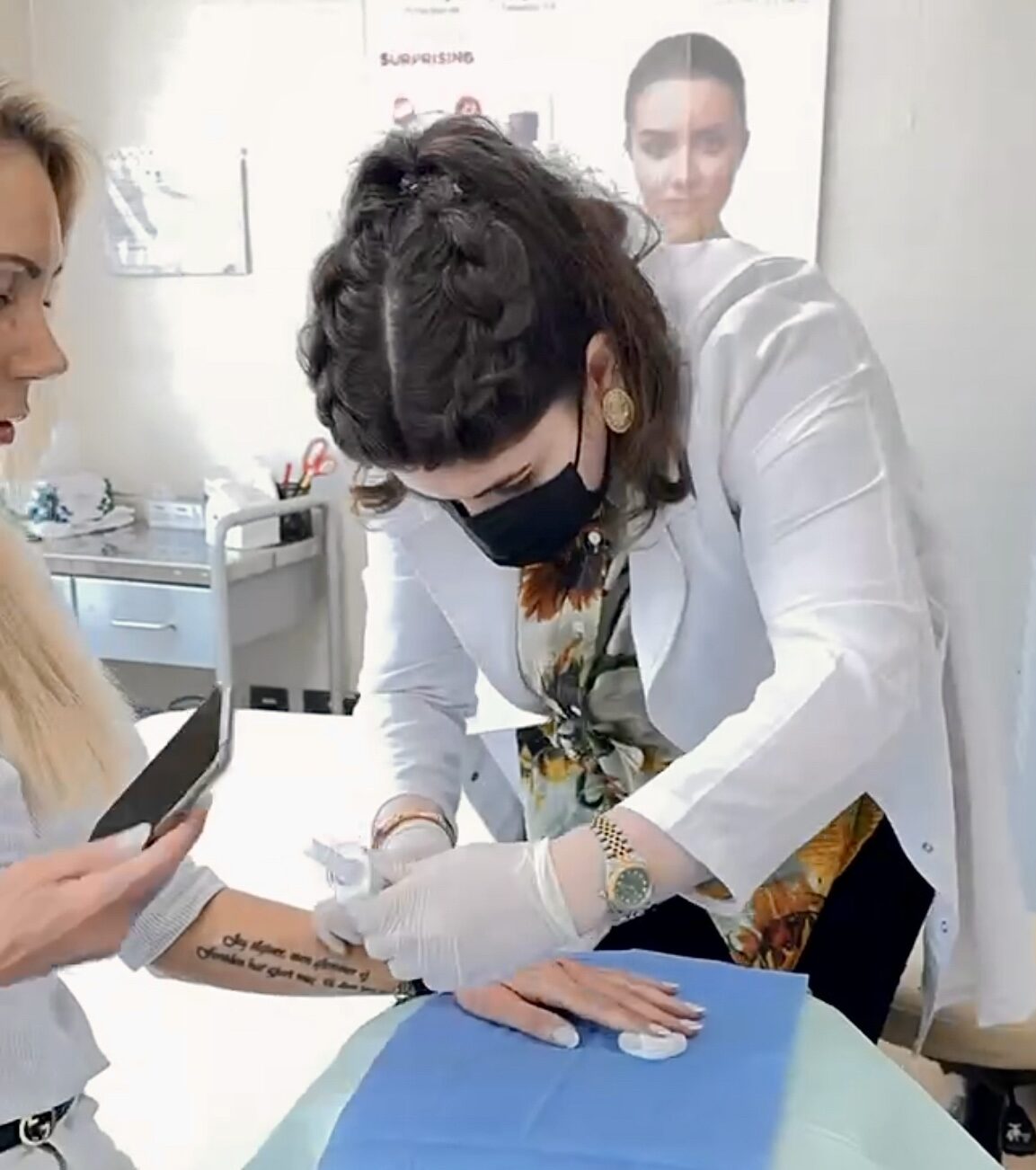
I treat four areas: the hips and hip dips, the buttocks, the hands, and the intimate area. I assess all of them with high-frequency ultrasound before anything is injected, I place body filler with a blunt cannula rather than a needle, and I use registered product only — opened in front of you, as DHA requires.
And the line that governs everything on this website: I combine treatments when I can identify two different problems — not because combining more treatments automatically produces a better result.
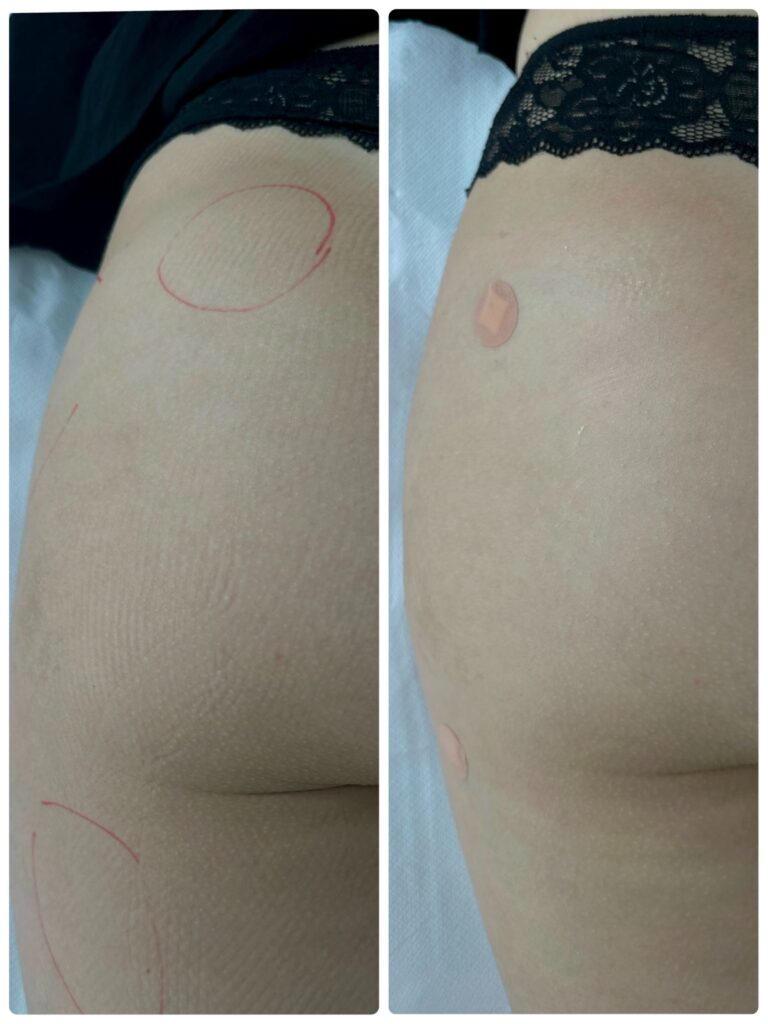
Hip dips — what they actually are
A hip dip is the inward curve between the top of your pelvis and the top of your thigh bone. It exists because of the distance between the iliac crest, the greater trochanter of the femur and the muscle that spans them. It is skeletal architecture. It is not fat you failed to lose, it is not a sign of anything, and no amount of training will remove it — many of the most visible hip dips belong to the leanest, fittest people, because there is less soft tissue sitting over the bone.
That matters clinically, because it sets the ceiling on what filler can do.
What filler does | What filler does not do |
Adds soft tissue volume over the depression, so the light falls differently and the outline reads as a continuous curve | Change the position of your iliac crest or femur |
Softens the shadow at the trochanteric depression | Remove the dip completely in someone whose dip is mostly skeletal and who has very little soft tissue |
Widens the upper-outer silhouette and improves the hip-to-waist transition | Lift or tighten loose skin — filler adds volume, it does not treat laxity |
Corrects side-to-side asymmetry, which is common and which most people only notice once they look for it | Survive significant weight loss unchanged |
If you are lean, have a deep bony dip and want it gone rather than softened, I will tell you so at the consultation rather than after you have paid for product. That conversation is the consultation. |
The volume conversation — the part nobody publishes
This is where most body filler in Dubai goes wrong, and it has nothing to do with the brand on the box.
A systematic review of ten studies of hyaluronic acid gluteal augmentation found the mean volume injected for an optimal result was 206.7 ml — roughly 207 millilitres, across 168 patients.1 That is the number the published literature settles on for the buttock. Hip dips alone need less; a full gluteal correction often needs more.
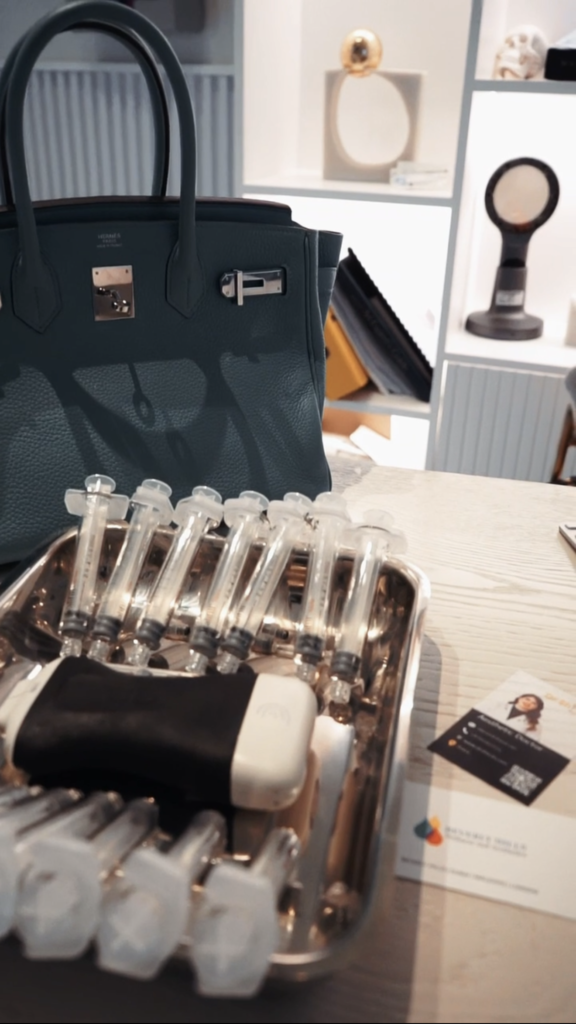
For scale: a standard facial filler syringe holds 1 ml. Body filler is supplied in 10 ml syringes. So an adequate gluteal correction is in the order of twenty body syringes, not two.
Which is why a price quoted without a volume tells you nothing. If you are comparing quotes across clinics, the only comparison that means anything is price per 10 ml of a named, registered product, and the volume the doctor says your particular anatomy needs. A low headline price almost always means a small volume — and a small volume in a buttock is money spent on a result nobody will see.
I quote by volume. I tell you at the consultation what I think your result needs, and if that number is more than you want to spend, we either stage it across sessions or we choose a different material — both of which are discussed below. What I will not do is inject a token volume and let you find out for yourself.
Want to know what volume your anatomy actually needs? Ask at the consultation. WhatsApp +971 52 328 6185 · Apogee Clinic, Address Beach Resort, JBR, Dubai |

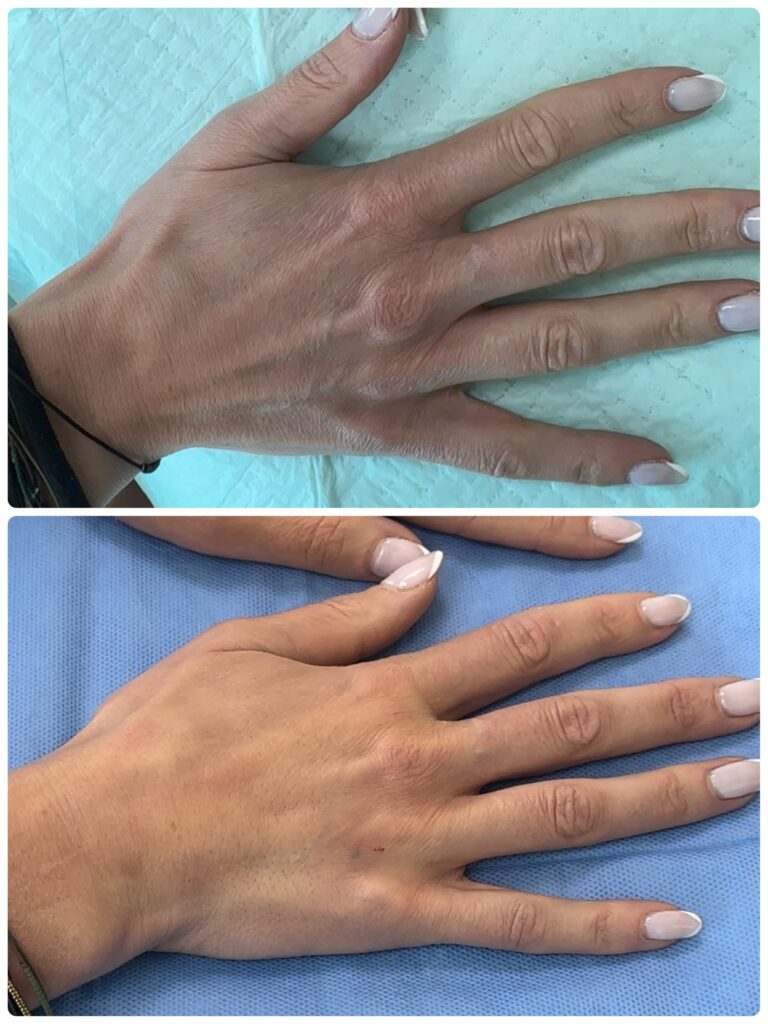
Hands
Hands age differently from the face. The skin thins, the fat pad on the back of the hand atrophies, and what was previously covered — tendons, veins, the spaces between the metacarpals — becomes visible. Nothing about the hand has changed except what is no longer padding it.
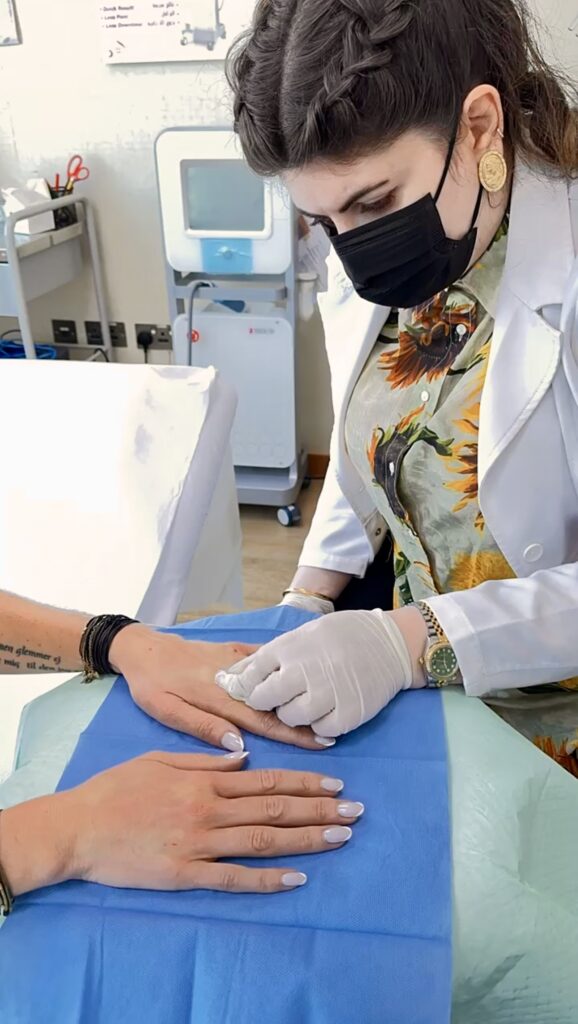
Filler is placed in the superficial dorsal lamina, the plane immediately under the skin, which is the safest layer because it contains almost no significant vessels.3 Placement is by cannula, fanning from a single proximal entry point, which means one puncture rather than several and much less bruising in an area that bruises easily.
- Typically 1–2 ml per hand, occasionally up to 3 ml where loss is marked.3
- Hyaluronic acid 6–15 months; poly-L-lactic acid 18–24 months, because it works by collagen rather than gel.3
- Safety record. Reported adverse events in this area are mild — swelling, bruising, occasional nodules.3
- What it does not treat. Pigmentation and crepey skin texture are separate problems needing separate treatment. Volume restoration on its own can make a hand look padded but still sun-damaged. If both are present, I will say so.
Renuva is a particularly good fit for hands, for the same reason it suits any area where what is missing is fat: what replaces it is fat.
At a glance
Hyaluronic acid | Lanluma (PLLA) | Renuva | |
Result appears | Immediately | 2–3 months | ~3 months per session |
Sessions | Usually one | Minimum three | Two, three months apart |
Typical duration | 12–18 months | ~2 years and beyond | Long-lasting; follows body weight |
Reversible | Yes — hyaluronidase | No | No |
Also improves skin firmness | Minimally | Yes | Yes |
Best for | Hip dips; immediate result; first-timers | Hips and buttocks with skin laxity; long game | Global volume loss; post-weight-loss |
Gluteal volume correction — and the phrase “non-surgical BBL”
“Non-surgical BBL” and “liquid BBL” are marketing terms. A Brazilian butt lift is a surgical fat transfer. An injectable treatment is not that, cannot do what that does, and should not borrow its name. I keep the phrase on this page once, because it is what people search, and I would rather you read an accurate explanation of it here than an inaccurate one elsewhere.
What injectable gluteal treatment can genuinely do:
- Add projection and upper-pole fullness, within the volume limits discussed in section 2
- Correct asymmetry between sides
- Fill the transition between buttock and hip so the two read as one curve
- Improve skin firmness over the area, where a collagen stimulator is used
- Restore volume lost to significant weight reduction — increasingly the reason people come, and dealt with in section 6
What it cannot do is lift. Descent is a skin and support problem, not a volume problem, and filling a descended buttock makes it heavier, not higher.
After significant weight loss
A growing number of the people I see for body filler have lost a substantial amount of weight, often on GLP-1 medication, and have found that the fat left first from the places they wanted to keep it: the buttocks, the hands, the face.
Two things to say honestly about that.
- Stabilise first. If you are still actively losing, filler placed now will be sitting in a body that is still changing. I would rather wait until your weight has been stable for a few months than treat a moving target.
- If you lose weight later, the volume will change. This is true of all three materials and it is especially true of Renuva, precisely because what is there is your own fat tissue. It is not a flaw in the treatment. It is the treatment working the way it is supposed to.
Where the loss is global rather than one defined depression, a collagen stimulator or adipose matrix usually serves better than gel filler, and the plan is often a course rather than a single appointment.
Intimate area
Volume loss in the labia majora is a normal consequence of ageing, of significant weight loss and of the post-menopausal decline in oestrogen. It can cause visible deflation, skin laxity and, for some women, discomfort with clothing or activity. Hyaluronic acid volume restoration to this area is an established treatment with published clinical evidence behind it.
I treat it the same way I treat everything else on this page: assessment first, cannula, registered product, sterile field, local anaesthetic. It is discussed privately in consultation, and there is nothing further about it on this page — not because it is unusual, but because it is nobody else’s business.
If this is why you are here, say so when you book and it will be dealt with straightforwardly.
How it is done safely — and why that is not a formality here
Body filler involves large volumes injected into deep tissue planes. It is the least trivial injectable treatment in aesthetic medicine, and the honest version of this page has to say so.
The same systematic review that supports the technique also documents the range of what has gone wrong with it in published series: bruising and erythema, inflammation and effusion, migration of product, contour irregularity — and, at the severe end, cases of major complication including a reported death.1 Most published harm in this area, worldwide, involves unregistered material, non-medical injectors, or volume delivered without regard for the plane it is going into. All three are avoidable. Here is how I avoid them.
High-frequency ultrasound
Before anything is injected, I scan the area. Ultrasound tells me the thickness of the tissue I am working with, whether there is old product in there from a previous treatment somewhere else, and where the plane and the vessels actually are in you — not where an anatomy diagram says they should be. It is the same equipment and the same discipline I use for facial filler complications, and it is the reason this practice exists in the form it does.
Blunt cannula, not needle
Everything on the body goes in through a blunt-tipped cannula. A cannula pushes vessels aside rather than piercing them. This is not a stylistic preference: in a study of approximately 1.7 million filler injections by 370 dermatologists, vascular occlusion occurred once in every 6,410 needle injections and once in every 40,882 cannula injections — around 77% lower odds with a cannula.4 It also means one or two entry points for a whole area instead of dozens of punctures, which matters for comfort and for infection risk.
Registered product, opened in front of you
Only products registered for use in the UAE, supplied through legitimate channels, and opened in front of you — which is DHA policy and also simply the right way to work. I do not use permanent or semi-permanent body filler of any kind. If you are offered “biopolymer”, silicone or any permanent body filler anywhere, at any price, walk out: it cannot be dissolved, and the delayed inflammatory reactions it causes can begin years later, triggered by an infection, a vaccination or an unrelated illness.
Sterile technique
Large-volume deep injection carries a genuine infection risk, and infection in a deep gluteal plane is a serious matter. Full aseptic preparation, sterile field, single-use equipment, and no shortcuts on this point for anybody’s convenience including my own.
Local anaesthetic
The area is numbed with local anaesthetic before treatment. Most people describe the procedure itself as pressure rather than pain. The entry point is anaesthetised first, and because a cannula is blunt, what happens after that is felt as movement, not as needling.
Had body filler elsewhere and unsure what is in there? Ultrasound will tell us. WhatsApp +971 52 328 6185 · Apogee Clinic, Address Beach Resort, JBR, Dubai |
What I will not do
- I will not inject permanent or unregistered body filler. At any price, for any reason, at anybody’s request.
- I will not inject large volume without scanning first. If you decline the ultrasound, I decline the treatment.
- I will not sell you volume when your problem is laxity. If your buttock has descended rather than deflated, filler will make it heavier. There are other things to do, and I will tell you what they are.
- I will not promise a hip dip will disappear. I will show you what softening the shadow realistically looks like for your anatomy, before you commit to anything.
- I will not sell packages by syringe count. The volume follows your anatomy and your goal. A price list that decides it in advance is selling product, not treatment.
- I will not inject into an area with active infection, inflammation, or unresolved product from a previous treatment. The old problem gets dealt with first.
If you have had body filler elsewhere and something is wrong
This is a significant part of my practice, and it is why people travel to this clinic. If you have been treated somewhere else and you are now dealing with:
- Lumps, nodules or areas that feel hard
- Product that has moved from where it was placed
- Visible asymmetry or contour irregularity that has not settled
- Swelling that comes and goes, or that began months or years after the treatment
- Pain, redness or heat over the treated area — which needs assessing urgently, not next week
— then the first step is always the same: ultrasound, to establish what material is present, how much of it, and in which plane. You cannot treat what you have not characterised, and a great many people have been told “it will settle” by someone who never looked.
From there: if it is hyaluronic acid, it can be dissolved with hyaluronidase, staged over more than one appointment so the tissue is not collapsed all at once. If it is a collagen stimulator, the management is different and usually medical rather than enzymatic. If it is permanent material, I will tell you honestly that I cannot dissolve it, and refer you to the clinic’s plastic surgeon — which is the correct answer, not a brush-off.
Bring whatever paperwork you have. If you do not know what was injected, that is very common and it is exactly what the scan is for.
11. Recovery and aftercare
When | What to expect, what to do |
Day of treatment | Swelling and tenderness over the treated area. You go home the same day. Take it quietly; no gym, no heat. |
First 1–2 nights | Do not sleep on the treated area. For hips and buttocks that means sleeping on your front. It matters more than it sounds — sustained pressure on fresh product while it is still settling is how asymmetry is created. |
First week | No exercise. None — not a light session, not “just legs”. Heat, sauna, steam and hot yoga are out for the same period. Avoid massage or pressure on the area unless I have specifically asked for it. |
Bruising | Expected at entry points, sometimes beyond. Most of it resolves within a week to ten days. Cannula placement keeps it to a minimum but does not eliminate it. |
Weeks 2–6 | Back to normal activity. With hyaluronic acid the result is already there and simply refining as swelling settles. With Lanluma or Renuva, this is when the tissue begins responding. |
Month 3 onwards | Collagen stimulator and adipose matrix results read properly here, and continue improving. Review appointment, and the next session in the course if there is one. |
Planning around an event or a holiday: allow six to eight weeks for hyaluronic acid, and plan a Lanluma or Renuva course to finish a good three months before the date. Do not start either one a month beforehand. |
Is this right for you?
This probably suits you if | This is probably not the right treatment if |
Your weight has been stable for several months | You are still actively losing weight, or about to start |
You want your existing shape improved rather than replaced | You want a surgical-scale change in volume — that is a fat transfer conversation |
You have a defined depression, asymmetry or area of volume loss | Your main issue is loose skin rather than missing volume |
You are comfortable with a staged plan where one is indicated | You need a defined result inside three weeks and would only consider a collagen stimulator |
You are in good general health | You are pregnant or breastfeeding, have an active infection or skin condition over the area, a bleeding disorder, or an autoimmune condition that has not been discussed |
You want to know what is being used and why | You are shopping on headline price alone — see section 2 |
Consultation and cost
Every body filler plan here starts with an assessment: history, examination, high-frequency ultrasound of the area, and a discussion about what volume your result actually requires before any product is discussed.
Cost is quoted by volume and by material, not by area. Two people asking for the same thing can need very different amounts of product, and quoting anything else in advance would be guesswork. You will be given a written plan with the material, the volume, the number of sessions and the total before you commit to anything.
Book a body filler assessment at Apogee Clinic, JBR WhatsApp +971 52 328 6185 · Apogee Clinic, Address Beach Resort, JBR, Dubai |
There is no single best product. There is a best product for your anatomy, your timeline and your tolerance for a result that arrives gradually rather than immediately.
Three materials, and how I choose between them
01
Hyaluronic acid body filler
A registered, body-specific hyaluronic acid — a different formulation from facial filler: larger particle, lower elasticity, designed to integrate into deep soft tissue rather than sit under skin.
- Immediate result. You leave with the volume in place, swelling aside.
- This is the reason I reach for it more often than people expect. Hyaluronic acid can be dissolved with hyaluronidase. Nothing else on this list can. If you have never had body filler before and you are not certain about the result, reversibility is worth a great deal.
- The same systematic review estimated effectiveness at around 16 months.1 In practice, 12–18 months is the honest range, and larger volumes in the buttock often outlast that.
- Best for: hip dips, moderate gluteal correction, anyone who wants to see the result immediately, and anyone treating a defined localised depression rather than a global loss of volume.
02
Lanluma — poly-L-lactic acid (my usual first choice for hips)
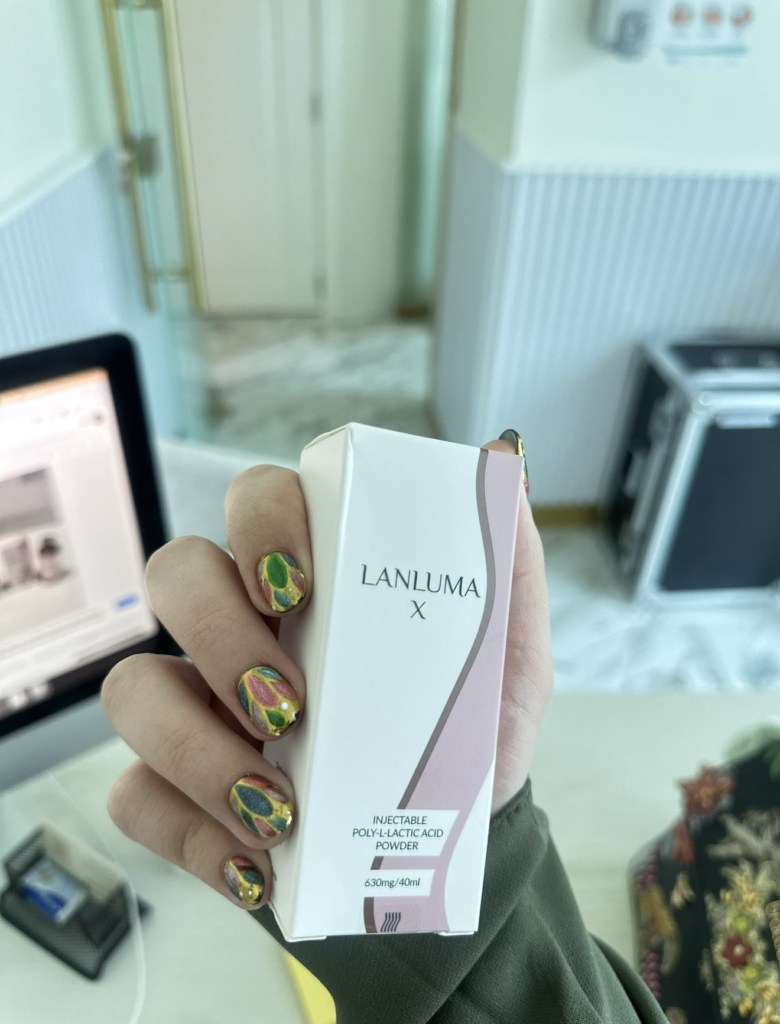
Lanluma X is a poly-L-lactic acid collagen stimulator, 630 mg per vial, formulated for the body. It does not add volume directly. It provokes your own tissue to build collagen over the following months, so the volume that appears is yours.
- At least two vials per session, and a minimum of three sessions. It is not a one-visit treatment and I do not sell it as one.
- Nothing much for the first few weeks. Build from around weeks four to six, with the result reading properly at two to three months after the course.
- Why I prefer it here. It firms. Hip and buttock skin quality is part of the problem for most people who ask about this area, and a collagen stimulator addresses volume and skin texture in the same treatment — two problems, which is my threshold for combining anything.
- Longer than hyaluronic acid — typically around two years and often beyond, because what persists is collagen rather than gel.
- The trade-off. It is not reversible and it is not immediate. If you need to look different in three weeks, this is the wrong choice.
03
Renuva — allograft adipose matrix
Renuva is processed donor fat tissue with the cells removed, leaving the scaffold: collagens, growth factors and the structural proteins of native fat. Injected, it is gradually replaced by your own adipose tissue, recruited into the scaffold.
- At least two syringes, and two sessions three months apart.
- Why it is different. What you end up with is your own fat, in a place you did not previously have it. It therefore behaves like your own fat — which is the whole point, and also the caveat: if you lose significant weight, the volume goes with it, exactly as it would anywhere else on your body.
- Gradual, over roughly three months per session, continuing to refine beyond that.
- Long-lasting, for the reason above. Published clinical experience covers the face, hands and body.2 I will not put a figure in years on this page, because no one has published follow-up long enough to support one — and I would rather tell you that than quote a number I cannot stand behind.
04
Sculptra
Sculptra is also poly-L-lactic acid and I use it elsewhere in the practice. For hips and buttocks it works, but the vial count required to cover an area that size makes it the more expensive route to the same mechanism. For body work I would rather use Lanluma. That is a preference about cost and vial economics, not a claim that one product is clinically superior to the other.
05
Fat transfer and BBL
I do not perform fat transfer. If your volume requirement is genuinely surgical — or if you would simply rather use your own fat — I will arrange a consultation with the clinic’s plastic surgeon, a French-trained surgeon with a deliberately conservative aesthetic and structured aftercare. You are not obliged to take it, and I do not treat a referral as a lost patient. Sometimes the honest answer is surgery.
References
- Mortada H, et al. Effectiveness and Role of Using Hyaluronic Acid Injections for Gluteal Augmentation: A Comprehensive Systematic Review of Techniques and Outcomes. Aesthetic Plastic Surgery. 2023;47:2719–2733. doi:10.1007/s00266-023-03458-0
- Gold MH, et al. Real-World Clinical Experience With an Allograft Adipose Matrix for Replacing Volume Loss in Face, Hands, and Body. Journal of Cosmetic Dermatology. 2024. doi:10.1111/jocd.16579
- Hassan S, et al. Hand rejuvenation with dermal fillers: key aspects and a comparison of commonly used fillers. Clinics in Dermatology. 2026;44(1). doi:10.1016/j.clindermatol.2025.12.001
- Alam M, et al. Rates of Vascular Occlusion Associated With Using Needles vs Cannulas for Filler Injection. JAMA Dermatology. 2021;157(2):174–180. doi:10.1001/jamadermatol.2020.5102



Testimonials





































Still did not find what you re looking for?
FAQs
It depends entirely on the material. Hyaluronic acid body filler gives 12–18 months, with published work estimating around 16 months for gluteal treatment.¹ Lanluma, a collagen stimulator, typically gives around two years and often longer, because what persists is your own collagen. Renuva is longer still, because what persists is your own fat tissue — and like any fat on your body, it responds to significant weight change.
More than most people expect. Published work puts the mean volume for an optimal gluteal result at around 207 ml.¹ Hip dips alone need less. The precise number for you comes from the assessment — but if a clinic quotes you a price before establishing a volume, the two are not connected.
Not in most people. A hip dip is created by the relationship between your pelvis and your femur, and filler does not move bone. What filler does is add soft tissue over the depression so the shadow softens and the outline reads as a continuous curve. In someone with a very deep bony dip and very little soft tissue, the change is a softening rather than an elimination, and you should be told that before treatment rather than after.
The area is numbed with local anaesthetic first. Because a blunt cannula is used rather than a needle, what you feel after that is pressure and movement rather than needling. Most people are comfortable throughout. Tenderness for a few days afterwards is normal.
One week, with no exceptions and no partial version of it. For the first one or two nights, avoid sleeping on the treated area — for hips and buttocks, that means sleeping on your front. Heat, sauna and steam are out for the same week.
It is safe when three conditions are met: registered product, an appropriate plane confirmed by ultrasound, and full sterile technique. Published series do document serious complications with gluteal filler, including major events at the severe end,¹ and almost all reported harm worldwide involves unregistered material or non-medical injectors. That is the real risk in this market, and it is avoidable. The cannula matters too — vascular occlusion has been reported at roughly one in 6,410 needle injections versus one in 40,882 cannula injections.⁴ Sometimes ultrasound can help us map the vessels beforehand and have a safer planning.
Hyaluronic acid can, with hyaluronidase. Collagen stimulators such as Lanluma and Sculptra cannot, and neither can Renuva. Permanent and semi-permanent fillers cannot be dissolved by anyone, which is why I do not use them. If reversibility is important to you, that points clearly to hyaluronic acid, and I will say so.
No. A BBL is surgery: your own fat, harvested by liposuction and transferred. “Non-surgical BBL” and “liquid BBL” are marketing names for injectable treatment. Injectable treatment can add volume and improve contour within the limits described on this page; it cannot do what surgery does. If surgery is the honest answer for what you want, I will arrange a consultation with the clinic’s plastic surgeon.
Yes, and this is a substantial part of my practice. The first step is ultrasound to establish what is in there, how much, and in which plane. Hyaluronic acid can then be dissolved, staged across more than one appointment. Other materials are managed differently, and permanent material is a surgical referral. Come in with whatever paperwork you have — and if you have none and do not know what was injected, that is common and it is what the scan is for.
Often yes, and it is a sensible use of one recovery period. It depends on total volume and on which materials are involved. We plan that at the consultation
If you are still losing, yes — wait until your weight has been stable for a few months. Treating a body that is still changing means treating a moving target, and the volume you pay for now may not be the volume you have in six months. Once you are stable, post-weight-loss volume restoration is one of the things this treatment does best.