
Have you had fillers, threads or collagen-stimulating treatments over the years? Do you remember exactly what was used, where it was placed, or whether it is still there? The Aesthetic Passport is a structured clinical assessment designed to help you understand your face and neck today and plan your next steps with greater clarity.
Your face. Your history. Your future. Rather than trying to reconstruct every treatment you have ever received, I combine your available history with clinical examination and comprehensive high-frequency ultrasound mapping. The result is a personal medical record that documents what we can identify, what remains uncertain, and what should happen next.
Explore your Aesthetic Passport
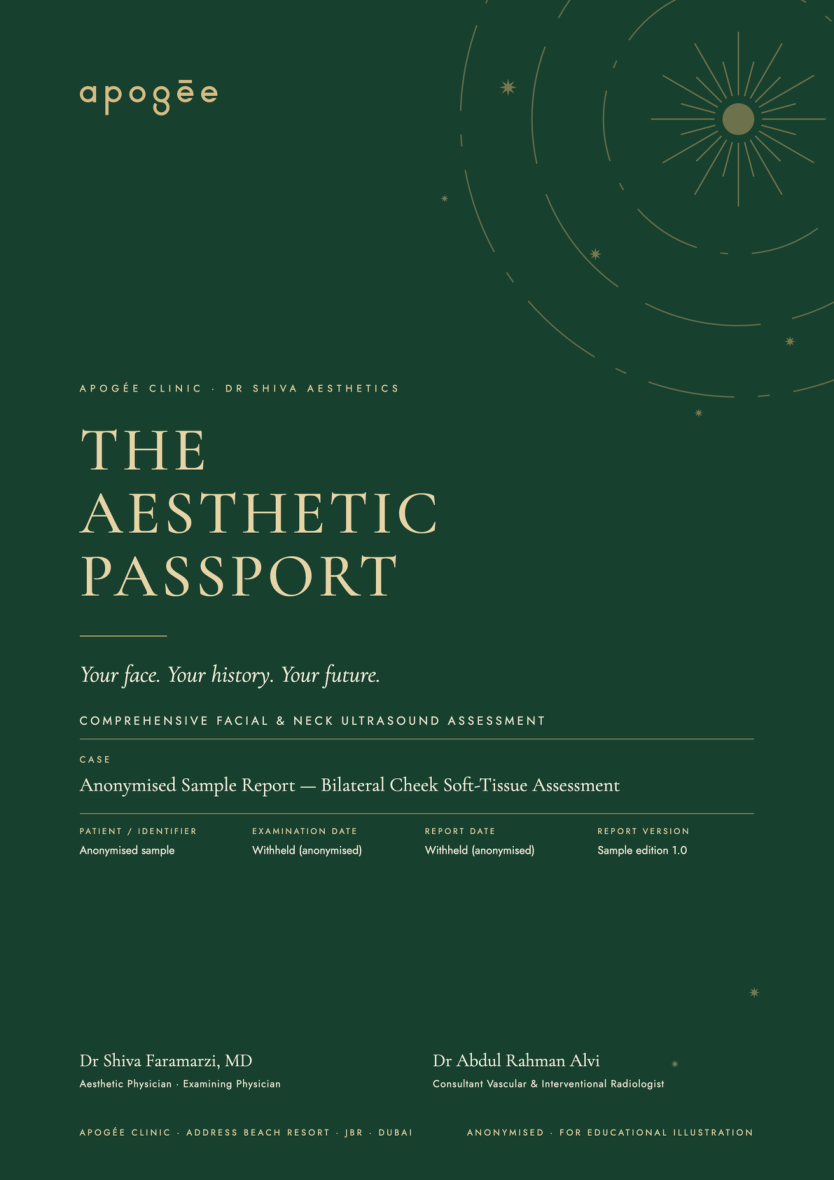
Your face. Your history. Your future. See the format of the clinical imaging record you receive: your assessment, illustrated anatomical map, selected ultrasound images, findings, interpretation and a personalised plan.
26 pages · PDF · Educational sample of a bilateral cheek assessment, not a complete face-and-neck examination. Consultant radiologist review and sign-off are not documented in this anonymised sample. The report for each patient is individualised.
What is the Aesthetic Passport?
A comprehensive face and neck aesthetic ultrasound assessment with a written report and a personalized clinical plan. It is particularly useful for patients who have received treatments at different clinics or in different countries, or who want a baseline before future procedures. It is not a guarantee that all previous products or procedures can be detected.
Your assessment, step by step
1. Your clinical examination
We review your goals, symptoms, medical history and any available treatment records, then examine your face and neck. You can attend even if you do not know which products were used.
2. Comprehensive face and neck ultrasound mapping
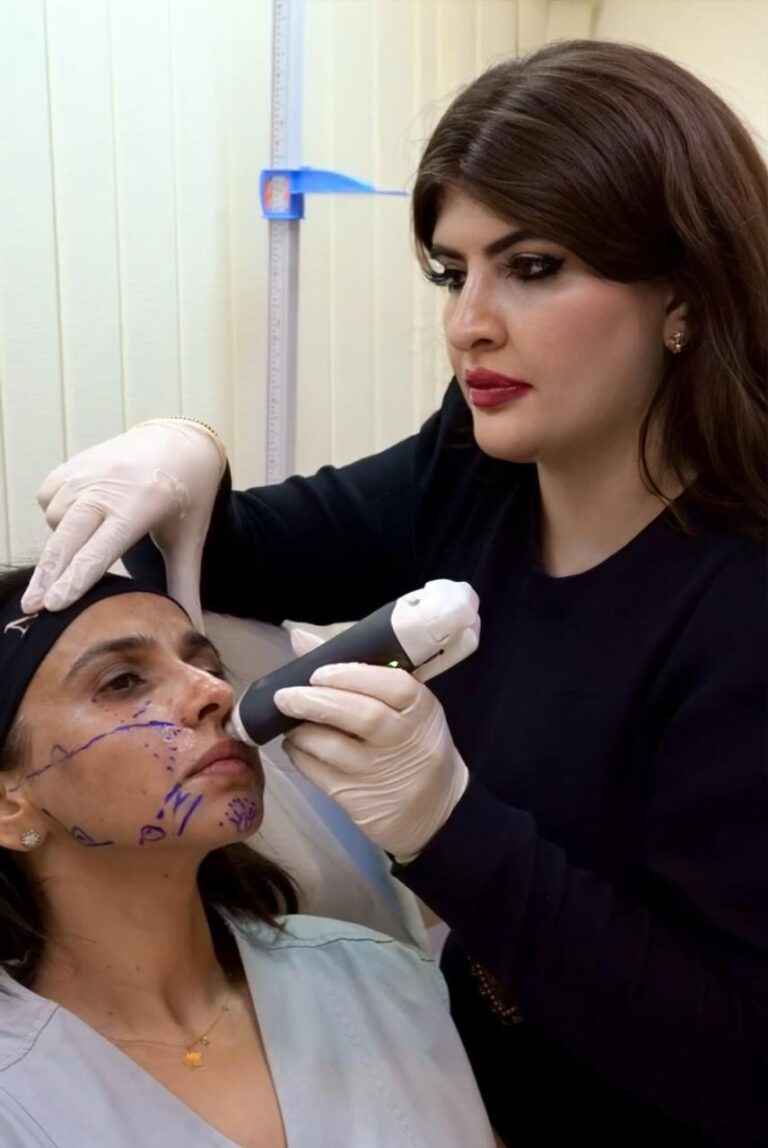
High-frequency ultrasound is used to examine clinically relevant superficial tissue layers and regions of the face and neck. Depending on your history and findings, the assessment may include the forehead and temples, cheeks, under-eye area, lips, chin, jawline and relevant neck regions. Doppler may be used to assess vascular structures where indicated. The scope is individualized; this is not a substitute for a full diagnostic neck study or other imaging when medically required.
3. Your findings and imaging record
We document the location, depth and distribution of visible injectable deposits when identifiable, relevant tissue changes, and areas that warrant further investigation. Ultrasound can suggest certain material characteristics but cannot reliably establish the brand, exact composition, dose or date of every prior injectable. Threads, biostimulators and other treatments may be difficult or impossible to identify. Where needed, additional imaging or specialist assessment may be recommended.
4. Your personal report and forward plan
The Aesthetic Passport is the illustrated report format for our existing comprehensive facial ultrasound mapping service. I perform the clinical examination and acquire the ultrasound images, then Dr Abdul Rahman Alvi, Consultant Vascular & Interventional Radiologist, provides an independent review of the stored images as part of the comprehensive reporting pathway. Clinical treatment planning and radiological interpretation are documented separately. Your report includes selected images, a clear explanation of findings and personalised clinical recommendations. The team confirms the examination scope and delivery arrangements before your appointment.
What your Aesthetic Passport will contain
- Your assessment date and relevant medical and aesthetic history, distinguishing patient-reported information from verified records.
- A region-by-region summary of clinical and ultrasound findings, with selected annotated images.
- Identifiable deposits and relevant tissue changes, with clear uncertainty statements when material cannot be confirmed.
- Important precautions and areas that need further assessment before any intervention.
- A prioritized future plan: what may be considered, what should wait, and what needs monitoring or referral.
- Recommended review timing and follow-up instructions.
The report can be provided in printed form, with a secure digital copy where available. It is a snapshot of your clinical findings on the day of assessment and can be updated after future treatments. It is not a clearance certificate or a guarantee that a future procedure will be safe.
Why keep an Aesthetic Passport?
- You have had aesthetic treatments over many years and want to understand your current anatomy.
- You are planning a new treatment and want to clarify previous filler or other deposits first.
- You travel frequently and want to share relevant clinical findings with future treating physicians.
- You want a baseline for monitoring changes over time.
- You have concerns about puffiness, asymmetry or old injectable material and need a structured assessment.
A clinical report, not a treatment-history guessing game
It is helpful to bring any available clinic records, product labels, treatment dates or photographs. However, missing records do not prevent an assessment. The report will distinguish confirmed information, your recollection, imaging-based observations and unresolved questions. A finding that cannot be confirmed will be documented as such.
Is this different from a second opinion?
Yes. A second opinion is a focused consultation to help decide what to do next. The Aesthetic Passport is a more comprehensive imaging-led assessment and documentation pathway for patients who want a lasting clinical record. A second opinion may help determine whether comprehensive mapping is useful for you.
Get your Aesthetic Passport in Dubai. Contact my team on WhatsApp to arrange an assessment at Apogee Clinic, Address Beach Resort, JBR, Dubai.
Frequently asked questions
Do I need to know the names of all the fillers I have had?
No. Bring any available information, but the assessment can proceed even when your treatment history is incomplete. Exact product identification may not be possible.
Can ultrasound show all previous treatments?
No. Ultrasound can detect and characterize some deposits and tissue changes, but it does not reliably reveal every previous treatment or identify every product. Further imaging or records may be needed.
Does the assessment include the neck?
Yes, clinically relevant face and neck regions are included in the aesthetic assessment. The precise scope is agreed at consultation; a dedicated diagnostic neck examination may be needed for unrelated medical concerns.
Will I receive a printed report?
The Aesthetic Passport is designed to include a written clinical report and selected images, with a printed copy and secure digital copy where available. We confirm the reporting arrangements and delivery timing when you book.
Can I share my report with another physician?
Yes. It is intended to help communicate relevant findings and precautions, with your consent. Your future physician must still perform their own assessment before treatment.
Does the passport include treatment?
No treatment is assumed. The assessment and report establish priorities; any procedure requires separate suitability assessment, consent and pricing.
Is this suitable if I have a filler complication?
It may be appropriate for non-urgent concerns. Sudden severe pain, skin colour changes or visual symptoms after an injection require immediate medical evaluation rather than a routine passport appointment.
About the physician: Dr Shiva Faramarzi, MD, aesthetic physician at Apogee Clinic, Address Beach Resort, JBR, Dubai. Findings and treatment recommendations are individualized.