
I recently filmed a short video on filler migration, because it is one of the questions I am asked most often — usually by someone who has been staring at a ridge above their lip, or a puffiness under their eyes, and wondering whether their filler has moved. This article goes into the detail a one-minute video cannot.
The short version: filler can end up somewhere other than where it was placed. When it does, it is rarely dramatic and rarely dangerous, but it does not tend to resolve on its own. And you cannot reliably tell where filler is sitting by looking in a mirror — or, for that matter, by feeling with a fingertip. Imaging can.
What filler migration actually is
In the medical literature, filler migration means filler material found away from the site where it was originally injected.1 It is usually described as a delayed problem: something that becomes visible weeks, months or sometimes years after the treatment rather than on the day.
In practice, patients use the word for two slightly different things. One is true displacement — product that was placed correctly and has spread over time. The other is filler that was placed in the wrong layer or in too large a volume from the start, so it was never really where the patient believed it was. In the mirror these look identical. For you, the practical question is the same either way: where is the filler sitting now, and does it need to be there?
Why filler moves
There is no single cause. A frequently cited review of the problem describes several mechanisms that can act together: the volume and pressure of the injection, massage, muscle activity, gravity, pressure on the area, and spread through the lymphatic system.2 In my experience, three of these explain most of what I see.
Volume: every area has a capacity
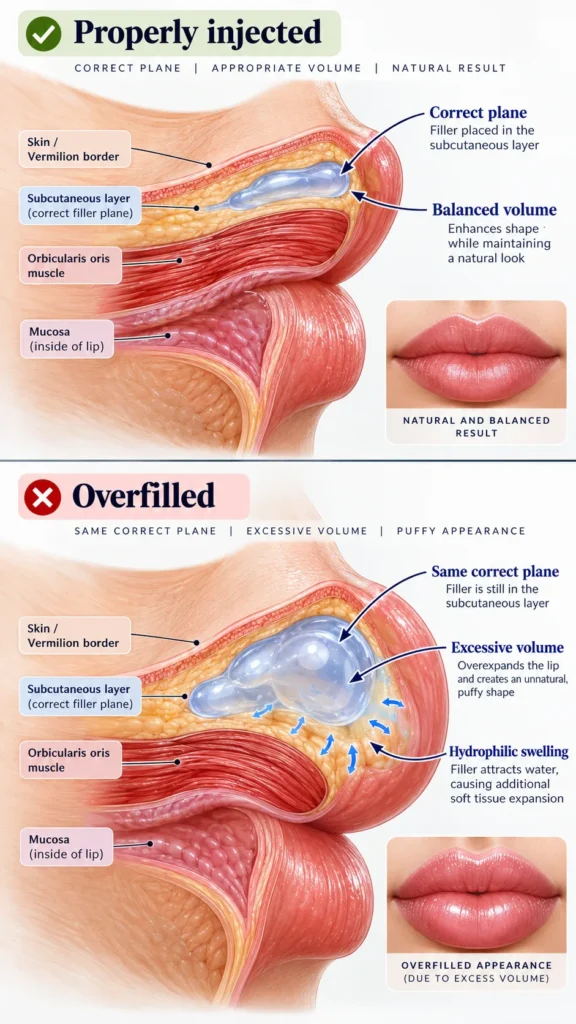
A lip, a tear trough or a cheek compartment can only hold so much. Once that capacity is exceeded, the gel follows the path of least resistance. In the lip, that path is usually upward, beyond the vermilion border into the skin of the upper lip — which is why overfilling and migration so often appear together.
Plane: the layer the filler is placed in
Filler behaves differently depending on which tissue layer it sits in. A 2026 ultrasound study of 126 patients found that the layer just under the skin of the lip averages less than a millimetre in thickness, so filler often ends up within the muscle rather than the intended plane; a vertical injection technique was associated with deeper placement and with signs of migration.3 A separate study of 216 lip treatments found that the direction of the needle influenced how the filler distributed, including how much travelled into the upper lip.4
This matters because migration is often presented to patients as their fault — that they pressed, slept on, or touched their lips too much. The imaging evidence points much more towards technique, volume and anatomy.
Movement: the face never stops working
The lips and the area around the eyes move thousands of times a day, with talking, eating and expression. Product placed in or near very mobile muscle is under constant, gentle pressure, and that is one reason these areas account for so much of the migration I see.
Filler lasts far longer than most patients are told
Hyaluronic acid filler is often described as lasting six to twelve months. Imaging tells a different story. In an MRI study of 33 patients who had mid-face filler, hyaluronic acid was still present in every patient at least two years after their last injection, with one patient showing filler up to fifteen years later.5
This changes how we should think about “top-ups”. If filler is repeated every year on the assumption that the last syringe has gone, volume can quietly accumulate — and accumulated volume is exactly the condition in which product starts to spread. It also explains why migration can appear long after the treatment someone remembers.1,6
Where migration tends to show up
- Lips — a soft ledge or “shelf” above the lip line, loss of a crisp border, fullness of the upper lip skin that becomes more obvious when you smile, or bumps inside the lip towards the wet–dry border.
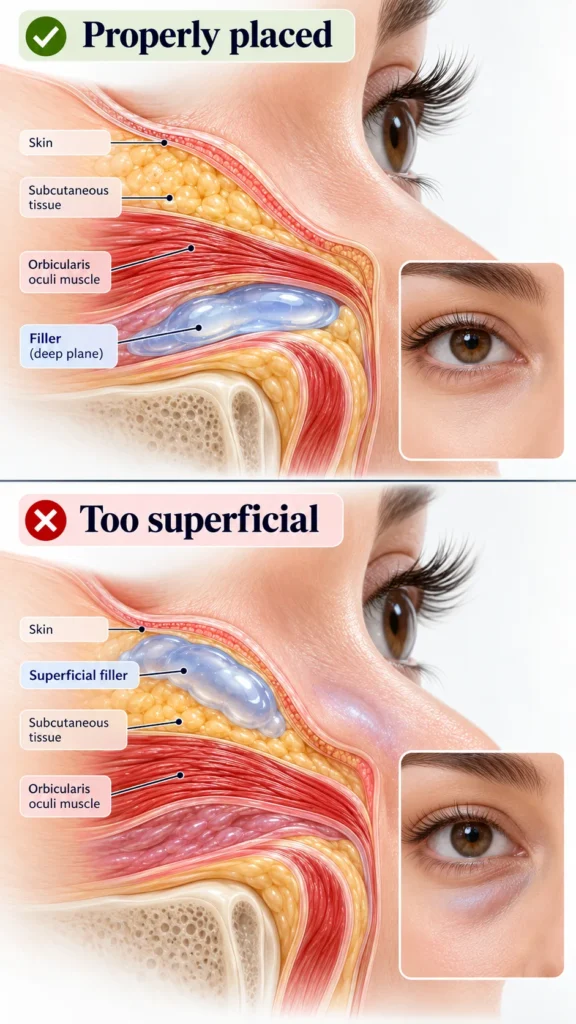
- Under the eyes — puffiness or a sausage-shaped swelling that is often worse in the morning, or a bluish tinge where product sits too close to the surface. Tear trough correction also carries a rare risk of product reaching the orbit.1
- Cheeks and midface — a heavy, slightly swollen look rather than lift, often after many sessions over several years.
- Less commonly, the forehead, nose and other areas, sometimes at a distance from the original injection site.1
Migration, swelling — or something else?
Not every change after filler is migration, and the distinction matters because each problem is treated differently.
- Swelling is diffuse, broadly symmetrical, and improves steadily over days.
- Migration produces a specific distortion in a specific place, and it persists or worsens rather than settling.
- Delayed nodules and inflammatory reactions can appear weeks to months after filler and may need anti-inflammatory treatment rather than, or as well as, dissolving.6,7
- Infection needs medical treatment, and dissolving alone does not address it.7
Under a fingertip, a filler deposit, an inflammatory lump and a small fluid collection can feel almost the same. On ultrasound they look very different, which is why imaging is increasingly used to guide these decisions.6,8,9
Think your filler may have moved? An ultrasound scan shows where your filler is sitting today — not where it was meant to be. WhatsApp Dr Shiva’s clinic: +971 52 328 6185 · Apogee Clinic, Address Beach Resort, JBR, Dubai |
How I assess suspected migration with ultrasound
I use high-frequency ultrasound with Doppler in clinic. In a few minutes it shows whether filler is present, which layer it is in, how much there is, and how it relates to the surrounding muscle and blood vessels.8 Doppler also maps the arteries in the area before any needle goes in, which is part of why I scan anyone with previous filler before treating them.
The scan turns a guess into a map. From there, the decision is usually one of three things: leave the product alone because it is not the cause of the problem; dissolve a specific migrated portion; or reduce volume in stages across several visits.
Treatment: targeted and staged, not “dissolve everything”
Hyaluronic acid filler can be broken down with an enzyme called hyaluronidase. It is a prescription medicine, its use for dissolving filler is off-label, and it carries a small risk of allergic reaction, so it belongs in a medical consultation with proper consent.10
Where possible, I dissolve under ultrasound guidance and in stages, aiming at the migrated product rather than flooding the whole area. A published case series from the Middle East describes the same principle: placing hyaluronidase precisely in the affected anatomical areas once imaging has shown where the filler is.6 A targeted approach usually means fewer surprises and less of the temporary “deflated” look some patients fear.
If re-treatment is wanted, I usually wait at least two to four weeks after dissolving, so the tissue settles and we can see the true starting point.
One important exception: permanent or semi-permanent fillers cannot be dissolved with hyaluronidase. If a scan suggests one of these, I refer to a plastic surgeon rather than injecting over it.
Can migration be prevented?
Not completely — but the risk can be reduced a great deal. The principles are not complicated: appropriate volumes, injected slowly and at low pressure, in the right layer, with the right product for the area, spread across more than one session when more volume is genuinely needed.2 Assessing what is already there before adding more is the step most often skipped.
And sometimes the best decision is no filler at all. A face that has had many treatments over many years often needs less, not more.
If you think you have migrated filler, come and find out. You don’t have to guess or live with it. A high-frequency ultrasound scan at Apogee Clinic, JBR, shows exactly where your filler is, so any decision — leave it, dissolve part of it, or rebalance — is based on what is actually there. Previous treatment at another clinic is fine; bring any records you have. WhatsApp Dr Shiva’s clinic: +971 52 328 6185 · Apogee Clinic, Address Beach Resort, JBR, Dubai |
Frequently Asked Questions
How do I know if my filler has migrated?
The typical signs are a fullness or ridge just outside the area that was treated — for example above the lip line or below the under-eye hollow — that has not settled after several weeks and is more noticeable with movement. Ultrasound confirms it by showing where the product actually sits.
Can filler migrate years after it was injected?
Yes. Migration is often a delayed problem, and imaging studies have found hyaluronic acid filler still present years after injection, so symptoms can appear long after the treatment.1,5
Is filler migration dangerous?
Usually it is a cosmetic problem rather than an emergency, and there is time to plan treatment properly.
Sudden pain, skin turning pale or dusky, or any change in vision after a filler injection is different — that needs urgent medical assessment the same day. For vision loss or neurological symptoms, call 998.
Will migrated filler go away on its own?
Not reliably. Because hyaluronic acid filler can persist for years, waiting is rarely an effective strategy once a migrated deposit has been confirmed.5
Did I cause it by touching or massaging my lips?
Very vigorous or repeated massage is one recognised mechanism, but ordinary touching is unlikely to be the main cause. Volume, injection technique and the layer the filler was placed in matter far more.2,3
Can you dissolve filler that was done at another clinic?
Yes, if it is hyaluronic acid filler. The scan helps identify the deposits even when the product name is unknown. Permanent fillers cannot be dissolved and are referred to a plastic surgeon.
How long after dissolving can I have filler again?
Usually at least two to four weeks, so that residual swelling settles and the true baseline is visible before any decision about re-treatment.
Book a filler assessment with ultrasound Filler migration assessment and ultrasound-guided correction with Dr Shiva Faramarzi at Apogee Clinic, JBR, Dubai. WhatsApp Dr Shiva’s clinic: +971 52 328 6185 · Apogee Clinic, Address Beach Resort, JBR, Dubai |
References
- Filler migration after facial injection — a narrative review. Cosmetics. 2023;10(4):115. https://doi.org/10.3390/cosmetics10040115
- Jordan DR, Stoica B. Filler migration: a number of mechanisms to consider. Ophthalmic Plastic and Reconstructive Surgery. 2015;31:257–262. https://doi.org/10.1097/IOP.0000000000000368
- Ultrasound evaluation of lip anatomy and filler placement: a cross-sectional study of injection accuracy, migration, and demographic variation. 2026. https://pubmed.ncbi.nlm.nih.gov/41494527/
- Buhsem O. Comparing the effects of different injection techniques used in lip augmentation on filler migration and patient satisfaction. Cureus. 2024;16(7):e64716. https://doi.org/10.7759/cureus.64716
- Master M, Azizeddin A, Master V. Hyaluronic acid filler longevity in the mid-face: a review of 33 magnetic resonance imaging studies. Plastic and Reconstructive Surgery – Global Open. 2024;12:e5934. https://doi.org/10.1097/GOX.0000000000005934
- Saad M, et al. Management of delayed complications of hyaluronic acid fillers: case series from the Middle East. Journal of Cosmetic Dermatology. 2025. https://doi.org/10.1111/jocd.70166
- Hong GW, Hu H, Chang K, Park Y, Lee KWA, Chan LKW, Yi KH. Review of the adverse effects associated with dermal filler treatments: Part I nodules, granuloma, and migration. Diagnostics. 2024;14(15):1640. https://doi.org/10.3390/diagnostics14151640
- Schelke LW, Decates TS, Velthuis PJ. Ultrasound to improve the safety of hyaluronic acid filler treatments. Journal of Cosmetic Dermatology. 2018;17(6):1019–1024. https://doi.org/10.1111/jocd.12726
- Wortsman X, et al. Complications of fillers in the lips and perioral area: prevention, assessment, and management focusing on ultrasound guidance. Journal of Plastic, Reconstructive & Aesthetic Surgery. 2023. https://doi.org/10.1016/j.bjps.2023.01.048
- Murray G, Convery C, Walker L, Davies E. Guideline for the safe use of hyaluronidase in aesthetic medicine, including modified high-dose protocol. Journal of Clinical and Aesthetic Dermatology. 2021;14(8):E69–E75. https://pmc.ncbi.nlm.nih.gov/articles/PMC8570661/
This article is for general education and is not a substitute for an individual medical consultation.