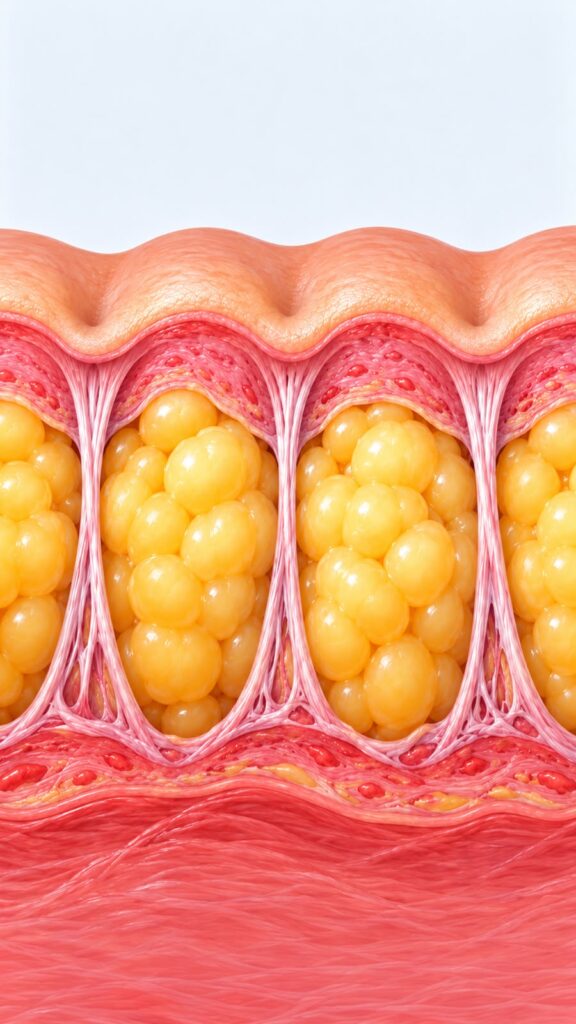
Cellulite is not simply caused by having too much fat. One of its central structural drivers is the network of fibrous septa that tether the skin from below, while the fat held between them pushes outwards.
That one idea explains most of what patients find confusing about it: why very slim women have cellulite, why losing weight often does not remove it, why creams cannot reach it, and why treatments aimed at reducing fat alone tend to disappoint.
It also points to what does change it, which is what this article is about.
The anatomy, properly
Beneath the skin of the thigh, fat is not a single uniform layer. It sits within chambers formed by a three-dimensional network of connective tissue — the septa — which anchor the skin to the layers below.
In women, that network tends towards a more perpendicular orientation, running more directly between the deeper tissue and the underside of the skin. In men it more often runs obliquely, in a criss-cross arrangement. That structural difference is considered an important reason why cellulite is overwhelmingly a female pattern, and it is anatomical rather than anything to do with fitness or discipline.
Three things then combine to make it visible:
The septa tether. Where connective tissue pulls down on the skin, you get a depression — the dimple.
The fat between them pushes up. The chambers bulge outwards between the tethering points, producing the raised areas around each dimple.
The skin thins. As dermal thickness and elasticity reduce with age, the same underlying architecture shows through far more.
The surface you can see is, in large part, a map of the structure underneath it. Which is why treatment has to reach that structure.
Why most cellulite treatments disappoint
Creams and topical products work at the surface of the skin. The connective tissue causing the tethering sits well below it. Some products improve hydration and texture, which can make the surface look a little better — but nothing applied to the outside releases a fibrous septum.
Massage and compression-based treatments can temporarily reduce fluid and make the thigh look smoother for a day or two. The architecture is unchanged, and so is the appearance by the end of the week.
Fat-reduction treatments alone reduce the volume within the chambers but leave the tethering in place. Sometimes the dimpling looks much the same afterwards; occasionally it looks more obvious, because reducing surrounding volume can define a depression more sharply.
Energy devices that tighten skin address the third factor — skin quality — and can genuinely help
the overall look. On their own, they do not release the tethering either.
None of this means those treatments are useless. It means that where septal tethering is the dominant problem, a treatment that does not address septal tethering is unlikely to solve it.
Not all cellulite is the same
For treatment planning, I broadly separate what I see into three clinical patterns.
Dimpling that appears only on pinching or contraction
Not visible when standing relaxed, and apparent only when the skin is pinched or the muscle tensed. This pattern generally responds well.
Discrete dimpling visible at rest
A recognisable pattern of defined depressions, present without pinching. This is the group that benefits most clearly from releasing the tethering, because there are defined points of tethering to release.
Diffuse, wavy skin with significant laxity
A draped, undulating appearance rather than discrete dimples, often with loose skin. Expectations here need to be set carefully: releasing tethering helps less when the dominant problem has become skin quality and laxity, and in some cases a surgical opinion is the more useful recommendation.
Part of the assessment is establishing which of these you have — and whether what is bothering you is cellulite at all, or thigh contour, or skin laxity, which are different problems with different answers.
The protocol
One — Releasing the tethering
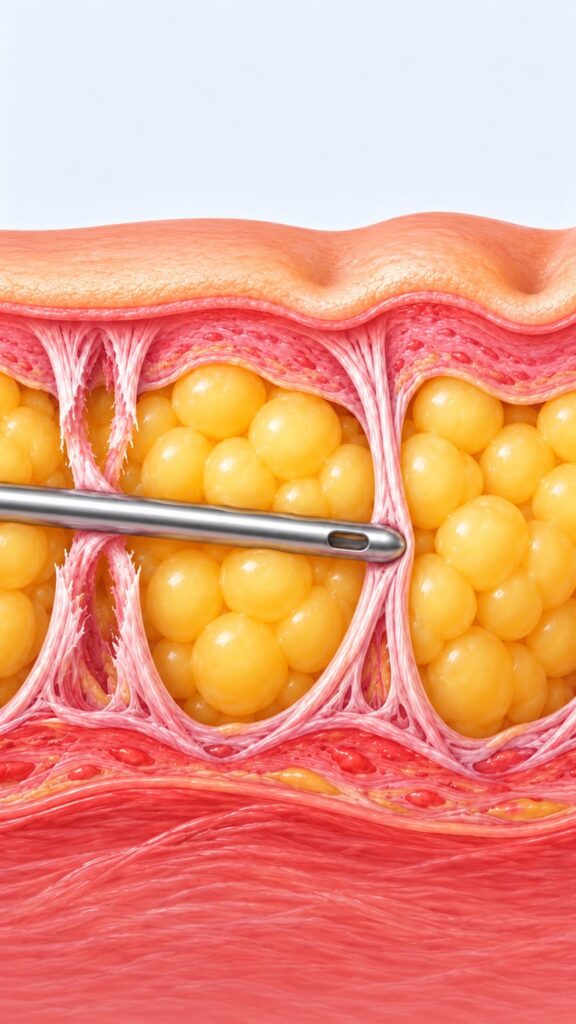
The treatment begins where the problem begins. As the local anaesthetic is infiltrated, I use a cannula to work systematically through the treatment area and divide the fibrous septa tethering the skin — a technique called subcision.
This is the stage that changes the dimples, and it is done thoroughly rather than quickly.
Two — Reassessing with ultrasound
Subcision is performed through a combination of anatomical knowledge, tactile feedback and direct assessment of the treated tissue. Ultrasound then allows me to reassess the treated plane, look for persistent areas of tethering, and compare the tissue architecture before and after release rather than relying on feel alone.
It is an additional assessment tool rather than a formality, and it is the reason I work this way: without it, the only feedback on the adequacy of the release arrives weeks later.
Three — Smoothing the contour with endolaser
A fine optical fibre is then passed beneath the skin to deliver laser energy into the fat layer. This serves two purposes here: it reduces the bulges of fat between the former tethering points, smoothing the surface relief, and the thermal effect tightens the overlying tissue as it goes.
Where the aim is a slimmer thigh as well as a smoother one, this is the stage that addresses it.
Four — A skin booster in the same session
A skin booster is then distributed through the treated area. Depending on what your skin needs, this is either Sunekos Body — a skin booster combining hyaluronic acid with amino acids — or Lanluma, a poly-L-lactic acid collagen stimulator. Both are used to support the quality and condition of the skin, and which one suits you is decided at the assessment. There are two reasons for including it at the same appointment.
The first concerns the skin itself. Since thinning skin is one of the three things that make cellulite visible, improving its quality and firmness supports the overall result.
The second is my own clinical rationale rather than an established indication, and I would rather say so plainly. Released tissue heals, and healing can bring some recurrent tethering with it. Placing material within the released plane while that healing takes place is intended to sit between surfaces that would otherwise be free to re-adhere. I consider it a sound rationale and I use it deliberately, but it is a mechanistic argument rather than a proven effect.
Recovery
Expect bruising and swelling, and expect it to be noticeable. Subcision divides tissue, and tissue that has been divided bruises.
A compression garment is worn continuously for the first seven days, and then intermittently for a period I will set according to how much was treated. Compression matters more in this treatment than in most, because it influences how the released plane settles.
You will be given a home care regimen to support recovery. Lymphatic drainage may also be recommended during the early recovery period to help manage post-procedure swelling.
Plan it with room around it. This is not a treatment to have the week before a holiday.
What to expect, and when
The early weeks are not representative. Swelling masks the result in both directions — some areas look better than they will, some look worse.
The contour change from the laser is assessed at around three months. The skin-quality component develops on its own timeline, so six months is a fairer point at which to judge the whole result than three.
And the honest part. Cellulite improves substantially with this approach. It is not abolished by it. The released tissue can heal with some recurrent tethering over time, weight change affects the result, and the architecture that produced it in the first place is still your architecture. A good result is a visibly smoother, firmer thigh — not a different leg.
Anyone describing complete and lasting removal of cellulite is describing something that does not exist.
Start with an assessment, not a decision
You do not book this treatment. You book an assessment, and then you decide.
At that appointment I examine the thigh and scan it with ultrasound — looking at the septa and
the fat layer, and working out whether septal tethering is genuinely what is bothering you, or whether the dominant problem is contour, or skin laxity, which are different problems with different answers. You leave knowing what I think is actually going on and what is realistically achievable. If that is not this treatment, I will tell you so.
If you do go ahead, measurements and standardised photographs are taken at the same appointment and your compression garment is ordered to size, so the treatment day is properly prepared.
The full protocol is AED 10,500, VAT inclusive. It is a bilateral, large-area treatment carried out in a single session, covering the thighs and the lower hip where that is required, and it includes subcision, ultrasound reassessment, endolaser, the skin booster, your compression garment and the prescribed home-care and recovery protocol.
For most patients one session is enough. Where a further skin booster session is worthwhile, that is assessed at three to six months and is AED 5,250, VAT inclusive.
Frequently asked questions
What actually causes cellulite?
A network of fibrous connective tissue called septa runs from the deeper tissue to the underside of the skin and tethers it, while the fat held in the chambers between pushes outwards. The dimples are the tethering points; the bulges are the fat between them. Thinning of the skin with age makes the same architecture more visible.
Why do I have cellulite when I am slim?
Because cellulite is largely a structural pattern rather than a measure of body fat. The orientation of the septa — which in women tends to be more perpendicular to the skin — is a central part of what produces it, and that arrangement is present regardless of weight. It is extremely common in women of every size.
Will losing weight get rid of cellulite?
Usually not on its own. Weight loss reduces the volume of fat within the chambers but does not release the tethering, so the dimpling pattern generally remains. In some cases it becomes slightly more obvious, because reducing surrounding volume can define a depression more sharply.
Do cellulite creams work?
Not for the underlying cause. The tethering sits well below the reach of anything applied to the skin surface. Some products genuinely improve hydration and texture, which can slightly improve appearance, but no topical product releases a fibrous septum.
What is cellulite subcision?
A technique in which the fibrous septa tethering the skin are divided beneath the surface — in this protocol with a cannula, during the same stage as the local anaesthetic infiltration. Releasing the tether is what allows a depression to lift.
Why do you use ultrasound during the treatment?
Subcision is performed through anatomical knowledge, tactile feedback and direct assessment of the tissue. Ultrasound lets me reassess the treated plane afterwards, look for persistent areas of tethering and compare the architecture before and after release, rather than relying on feel alone.
Does cellulite treatment hurt?
The area is thoroughly anaesthetised. Patients generally feel pressure and movement rather than sharp pain, although individual experience varies. Afterwards the thighs feel sore, tight and bruised, comparable to a heavy gym session, and this settles over the first week or two.
How many sessions will I need?
Usually one. The subcision and endolaser stages are performed once, and for most patients that is the whole treatment. Some patients then benefit from repeating the skin booster on its own — not a repeat of the laser or the subcision, but additional support for skin firmness — which is assessed at three to six months, once the first result is visible, and is AED 5,250, VAT inclusive. It is a decision made at that review rather than on the day of treatment.
How long does the result last?
The improvement is long-lasting, but it is not fixed forever. The released tissue can heal with some recurrent tethering over time, and significant weight change affects the result. Realistically this is a treatment that substantially improves the appearance for an extended period.
Can cellulite be completely removed?
No, and any clinic suggesting otherwise is overstating what is possible. Cellulite is a normal anatomical pattern in the majority of women. It can be visibly and meaningfully improved. It cannot be abolished.
Can this be combined with slimming the thighs?
Yes — the endolaser stage reduces localised fat as well as smoothing the surface relief, so a thigh that is both dimpled and fuller than you would like can be addressed in the same session. Whether that is appropriate depends on how much there is to treat and on your skin quality, which is what the assessment establishes.
Individual results vary. This article is educational and does not constitute medical advice. Suitability, risks and expected outcomes are assessed individually at consultation.