
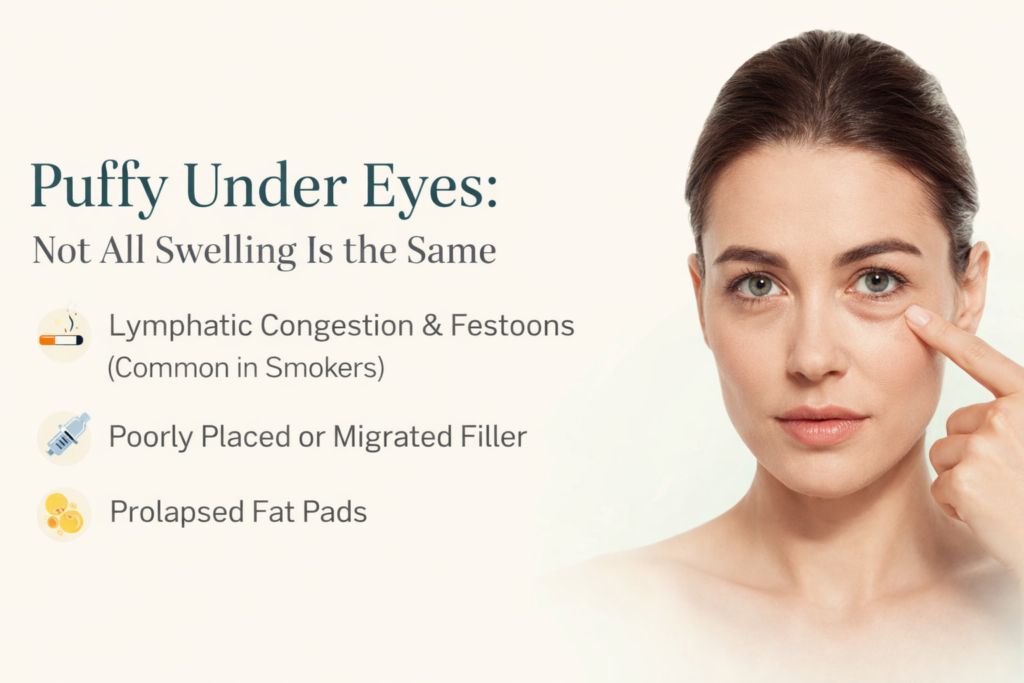
Why Old Under-Eye Fillers Can Cause Swelling Years Later — and How We Can Treat It Safely
Under-eye fillers are often marketed as temporary treatments. In reality, hyaluronic acid fillers placed in the tear trough can persist for many years, sometimes far longer than patients expect. In some cases, these long-standing fillers can interfere with normal lymphatic drainage, leading to chronic swelling, puffiness, or recurrent inflammation around the eyes.
This article explains why old under-eye fillers can cause delayed swelling, what role the lymphatic system plays, and how we can safely assess and treat these complications using ultrasound-guided dissolving and Forza laser technology.
Why Do Under-Eye Fillers Last So Long?
The under-eye (tear trough) area is unique:
-
Minimal movement
-
Thin skin
-
Limited blood supply
-
Delicate lymphatic drainage
Because of this, fillers placed too superficially or in excessive amounts may:
-
Integrate slowly
-
Break down incompletely
-
Migrate over time
-
Remain detectable 5–10 years later
Even fillers injected “many years ago” can still be present and biologically active.
The Role of the Lymphatic System Under the Eyes
The under-eye region relies heavily on lymphatic drainage to manage fluid balance. When filler sits in or near lymphatic pathways, it can:
-
Compress lymphatic vessels
-
Slow drainage
-
Create fluid retention
-
Trigger chronic swelling (especially in the morning)
In some patients, filler can also accumulate near preauricular or infraorbital lymph nodes, contributing to:
-
Recurrent puffiness
-
Tenderness
-
Inflammatory episodes
This swelling is often mistaken for allergies, aging, or fluid retention, when in fact the underlying cause is old filler.
Delayed Reactions: Why Swelling Can Appear Years Later
Patients are often surprised when swelling appears years after injection. This can happen due to:
-
Weight changes
-
Hormonal shifts
-
Illness or inflammation
-
Immune system activation
-
Aging-related changes in lymphatic flow
Old filler can act as a foreign body reservoir, becoming reactive long after the original treatment.
Assessment: Why Ultrasound Is Essential
Before treating under-eye swelling, it is critical to know:
-
Is filler still present?
-
Where exactly is it located?
-
Is there fibrosis or inflammation?
-
Are lymphatic structures involved?
Using high-resolution ultrasound, we can:
-
Visualize residual filler
-
Differentiate filler from fluid or fat
-
Assess fibrosis or encapsulation
-
Plan precise, targeted treatment
This avoids blind dissolving and unnecessary tissue trauma.
Treatment Option 1: Ultrasound-Guided Hyaluronidase (Dissolving)
If hyaluronic acid filler is confirmed, we can safely dissolve it using hyaluronidase, guided by ultrasound.
Benefits of ultrasound-guided dissolving:
-
Precise placement
-
Minimal product use
-
Reduced risk of over-correction
-
Safer treatment in the tear trough
This approach is especially important in patients with:
-
Long-standing filler
-
Recurrent swelling
-
Previous unsuccessful dissolving attempts
What If There Is Fibrosis or Lymphatic Involvement?
In some cases, filler is no longer free-flowing. Instead, it may be associated with:
-
Fibrosis
-
Thickened tissue
-
Chronic lymphatic congestion
In these situations, dissolving alone may not be sufficient
Forza Treatment for Under-Eye Fat Pad Prolapse
In selected patients with mild to moderate under-eye fat pad prolapse, surgery is not always the first or only solution. When the concern is early fat protrusion combined with skin laxity, Forza laser treatment can be a safe and effective non-surgical option.
Understanding Fat Pad Prolapse
Under-eye fat pads naturally support the eye. With aging, loss of ligament support, and skin thinning, these fat pads can protrude forward, creating a persistent “puffy” appearance.
Not all fat pad prolapse requires surgical removal. In many cases, the issue is not excess fat alone, but loss of skin tension and tissue support overlying the fat.
How Forza Works in the Under-Eye Area
Forza uses laser-assisted thermal energy to precisely target the subdermal tissue while preserving surface skin integrity.
For delicate areas such as the under eyes, Forza utilizes a special 200-micron fiber, specifically designed for:
-
Precision
-
Controlled energy delivery
-
Safety in thin, sensitive tissues
This allows treatment in an area where traditional energy-based devices may not be suitable.
Benefits of Forza for Under-Eye Fat Pad Prolapse
1. Fat Pad Retraction
Forza can help tighten and retract mild protruding fat pads, reducing the appearance of puffiness without removing fat surgically.
2. Skin Tightening
Thermal stimulation leads to immediate collagen contraction and progressive tightening over time, improving skin firmness under the eyes.
3. Collagen Stimulation
Forza stimulates new collagen production, which:
-
Improves skin quality
-
Enhances elasticity
-
Reduces crepiness and fine lines
This is particularly beneficial in patients with thin or lax under-eye skin.
4. Improved Skin Texture and Tone
Beyond reducing puffiness, patients often notice:
-
Smoother skin
-
Improved under-eye texture
-
A more rested, refreshed appearance
Why Forza Can Be Safer Than Surgery in Selected Cases
For appropriate candidates, Forza offers:
-
No surgical incisions
-
No fat excision
-
Minimal downtime
-
Lower risk profile compared to surgery
It is especially suitable for patients who:
-
Are not ready for surgery
-
Have mild to moderate fat pad prolapse
-
Want gradual, natural improvement
-
Prefer a conservative approach
Importantly, Forza does not replace surgery in all cases. In advanced fat herniation, surgical correction may still be the best option. This is why proper clinical assessment and ultrasound evaluation are essential before deciding on treatment.
A Personalized, Step-by-Step Approach
Every under-eye complication is different. Treatment may involve:
-
Detailed clinical assessment
-
Ultrasound imaging
-
Targeted dissolving (if indicated)
-
Supportive treatments such as Forza
-
Follow-up and gradual correction
The goal is not aggressive correction, but safe restoration of natural anatomy and function.
Final Thoughts
Persistent under-eye swelling is not always “normal aging” or allergies. In many cases, it is related to old filler interfering with lymphatic drainage, even years after injection.
With proper assessment, ultrasound guidance, and advanced technologies such as Forza, these complications can often be safely and effectively managed.
If you have long-standing under-eye filler, unexplained puffiness, or swelling that doesn’t respond to standard treatments, a thorough evaluation is essential.
