
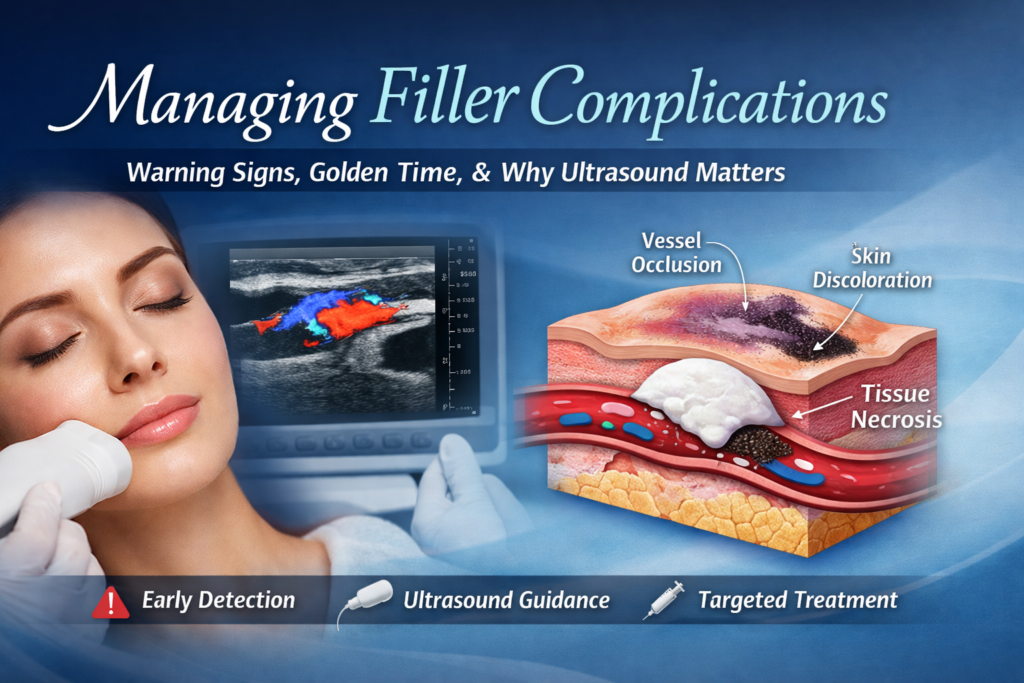
Dermal fillers can beautifully restore volume, contour the face, and rejuvenate the skin—but like any medical procedure, they carry risks. The key to safe aesthetic treatment is early recognition, correct diagnosis, and evidence-based management. Unfortunately, in Dubai, many practitioners still inject without ultrasound mapping, without understanding vascular anatomy, or without proper training—leading to preventable complications.
This blog explains the warning signs of filler complications, the golden time to seek medical help, and how ultrasound-guided assessment allows us to diagnose and treat issues with precision.
Why Do Filler Complications Happen?
Even in the hands of experts, complications can occur. But the risk is significantly higher when:
The injector lacks anatomical training
Large boluses are injected blindly
No ultrasound is used to map vessels
Injections are performed too superficially or too deep
Improper products or unsafe techniques are used
Your face contains arteries that are only 1–2 mm beneath the skin in some areas. Without ultrasound, every injection is a guess.
This is why my practice relies on ultrasound-guided mapping before injecting and ultrasound-guided complication management when needed.
Early Warning Signs to Watch For
Recognizing symptoms early can prevent long-term problems. Contact your doctor immediately if you notice:
1. Sudden Severe Pain
Pain during or after filler can indicate vascular compression or occlusion, meaning a blood vessel may be compromised.
2. Skin Color Changes
Blanching (white patches)
Mottling (purple or livedo patterns)
Greyish or dusky skin
These are red flags for vascular compromise.
3. Increasing Swelling That Feels Different from Normal Post-Injection Swelling
Especially if it’s firm, expanding, or painful.
4. Nodules or Lumps
Could be:
Inflammatory reactions
Biofilm
Product irregularities
Granulomas
5. Heat, Redness, or Fever
These can indicate infection.
6. Visual Changes
Blurry vision, shadows, headache, dizziness
→ This is an emergency. Go to the nearest hospital immediately.
The Golden Time: When You Must Contact Us
If you experience anything unusual within the first 6–24 hours, you are still inside the golden window where we can intervene quickly and reverse problems.
Urgent Timeline:
0–6 hours → Best time to dissolve (if needed), improve blood flow, prevent tissue loss
6–24 hours → Still manageable with aggressive treatment
After 24–48 hours → Treatment still possible, but recovery may take longer
After several days → Complications often become more complex
Do not wait and see.
Early intervention saves skin, tissue, and aesthetic results.
How We Manage Filler Complications (Ultrasound-Guided)
The difference between guessing and diagnosing is ultrasound.
Our approach:
1. Ultrasound Mapping
We first identify the exact location of:
The filler
The affected blood vessels
Any edema, inflammation, or occlusion
This allows targeted, precise management without dissolving unnecessary areas.
2. Targeted Hyaluronidase (If Needed)
With ultrasound, hyaluronidase can be injected directly where product is causing an issue—not blindly.
3. Improving Blood Flow
If vascular compromise is suspected:
Warm compress
Anti-inflammatories
Aspirin
Massage
Medical-grade supportive treatments
(Protocols depend on your clinical picture.)
4. Managing Infections or Inflammatory Reactions
Includes:
Antibiotics
Steroids (in selected cases)
Ultrasound to assess abscess or fluid pockets
5. Long-Term Management
For delayed nodules or granulomas:
Ultrasound assessment of the lesion
Dissolving
Steroid or 5-FU (in selected cases)
Follow-up imaging
Why Ultrasound Is Essential—Not Optional
Dubai has many injectors who rely solely on “experience” instead of imaging. But aesthetics is not guesswork.
Ultrasound provides:
Real-time visualization of vessels
Identification of filler placement
Precise complication mapping
Reduced risk of blindness or necrosis
Higher safety in high-risk zones (tear trough, nose, chin, temple, nasolabial fold)
This is the new standard of care.
Injecting without ultrasound is like operating without a CT scan—unnecessary and risky.
When to Call Us
Contact us immediately if you experience:
Pain that increases instead of decreasing
Skin discoloration
Unusual swelling
Hard lumps or nodules
Difficulty breathing or dizziness
Any concerns at all
Even mild symptoms deserve assessment, especially within the first 24 hours.
Your safety is always the priority.
Final Thoughts
Dermal fillers can create beautiful, natural results when performed safely and scientifically. Ultrasound-guided injection and complication management are essential for the modern standard of care.
If you ever feel unsure—or if you were treated elsewhere and need help—we are here to support you with evidence-based, ethical, complication-focused care.
