Facial Puffiness and Lipedema: Why It Happens, When to Worry, and Why More Filler Isn’t Always the Answer
One of the most common questions I hear from women with lipedema isn’t about their legs—it’s about their face.
“Doctor, why does my face look swollen some days?”
“My cheeks feel puffy every morning. Is this lipedema too?”
“Would filler make it look better?”
These are excellent questions, and unfortunately, they’re often answered incorrectly on social media.
The short answer is no—according to current medical knowledge, lipedema does not directly affect the face.
However, many women living with lipedema genuinely experience facial puffiness, morning swelling, fullness around the eyes, or a heavier-looking lower face.
So if it isn’t lipedema fat, what causes it?
Understanding the difference is essential because treating fluid as if it were volume can actually make the problem worse.
Does Lipedema Affect the Face?
Based on current diagnostic criteria, no.
Lipedema is defined as a chronic disorder of abnormal fat distribution affecting the legs and, in some patients, the arms, while consistently sparing the hands and feet.
The face is not considered part of the disease itself.
I think this distinction is important because there is a growing amount of misinformation online suggesting that facial fat is simply “lipedema in the face.” At present, there is no high-quality evidence supporting that claim.
But that doesn’t mean your facial swelling isn’t real.
It simply means the mechanism is usually different.
In many patients, the face appears swollen because of fluid retention, inflammation, hormonal changes, or impaired lymphatic drainage—not because lipedema fat has spread to the face.
Understanding that difference allows us to choose the right treatment instead of simply adding more filler.
Why Does Facial Puffiness Occur?
Our faces constantly move fluid through an intricate network of tiny lymphatic vessels.
This system helps remove excess water, inflammatory proteins, metabolic waste, and cellular debris from the tissues.
When this drainage slows down—even temporarily—fluid begins accumulating within the soft tissues.
The result is a face that looks:
- Puffy in the morning
- Fuller around the cheeks
- Swollen beneath the eyes
- Less defined along the jawline
- Heavier despite stable body weight
For women living with lipedema, several factors may contribute simultaneously.
Four Common Reasons Women with Lipedema Experience Facial Puffiness
1. Hormonal Fluid Retention
Lipedema has a strong hormonal component.
Many patients first notice symptoms during puberty, pregnancy, or menopause—periods associated with significant changes in estrogen and progesterone.
These same hormones also influence how much water the body retains.
This explains why facial puffiness often becomes worse:
- before menstruation
- during periods of stress
- during menopause
- after poor sleep
- after hormonal fluctuations
The face may look noticeably different from one week to another, even though body fat has not changed.
2. Chronic Low-Grade Inflammation
Modern research suggests that lipedema is associated with persistent low-grade inflammation involving the connective tissue and extracellular matrix.
Inflammation increases vascular permeability, allowing more fluid to leave the small blood vessels and enter surrounding tissues.
This contributes to:
- tissue heaviness
- swelling
- morning puffiness
- facial fullness
Although the inflammation originates throughout the body rather than specifically within the face, the facial tissues often reflect these systemic changes surprisingly well.
3. Reduced Lymphatic Efficiency
In more advanced cases, some patients develop a secondary lymphatic component known as lipolymphedema.
Even in patients without formal lymphedema, lymphatic drainage may not function at its maximum efficiency.
Because the lymphatic system works as one connected network, reduced drainage capacity can contribute to fluid accumulation beyond the legs alone.
This is one reason why many women notice that both their legs and their face feel heavier after:
- long flights
- high-sodium meals
- prolonged sitting
- poor sleep
- hot weather
4. Lifestyle Factors
Not every episode of facial puffiness is related to lipedema.
Daily habits can significantly influence how much fluid the face retains.
Common triggers include:
- High-sodium meals
- Excess alcohol
- Highly processed foods
- Poor hydration
- Chronic stress
- Inadequate sleep
- Prolonged inactivity
Many of these factors increase systemic inflammation or temporarily slow lymphatic drainage, making facial swelling much more noticeable the following morning.
Not Every Puffy Face Needs More Filler
This is perhaps the most important message I want patients to understand.
A fuller face does not always mean there is volume loss.
Sometimes there is simply too much fluid.
These two situations may look surprisingly similar—but they require completely opposite treatments.
Adding filler to a face that already struggles with fluid retention can sometimes create an even heavier appearance, especially in the midface and under-eye region.
Before considering any injectable treatment, the first question should always be:
“Am I seeing volume loss—or am I seeing fluid retention?”
Getting that answer right is the difference between a natural result and one that continues to look puffy despite repeated treatments.
Why Hyaluronic Acid Fillers Can Sometimes Make Puffiness Worse
Hyaluronic acid is an incredible material and remains one of the safest and most versatile fillers available.
However, it has one important characteristic that many patients—and even some injectors—do not fully appreciate.
Hyaluronic acid is highly hygroscopic.
In simple terms, it attracts and binds water.
For most patients, this is actually one of its advantages because it creates hydration and soft volume.
But in someone who already has a tendency toward fluid retention or sluggish lymphatic drainage, that same property can occasionally become a disadvantage.
In particular, the tear trough and malar (cheek) region deserve careful attention. These areas have delicate lymphatic anatomy, and excessive filler volume, overly superficial placement, or repeated treatments may interfere with normal fluid movement, increasing the risk of persistent puffiness in susceptible individuals.
This does not mean that hyaluronic acid fillers should be avoided altogether. Rather, it means that patient selection, product choice, injection depth, volume, and technique become especially important.
Which Fillers and Techniques Should Be Avoided?
This is where medical judgment becomes especially important.
Having a tendency toward facial puffiness does not automatically mean you should never have fillers.
Instead, it means your treatment plan should respect the anatomy of the lymphatic system rather than work against it.
For patients who are prone to fluid retention, I generally recommend being particularly cautious with the following:
Large Volumes in the Midface
Injecting large amounts of filler into the cheeks during a single session can increase tissue pressure and may reduce the already limited space available for normal lymphatic drainage.
Whenever possible, gradual correction over multiple sessions is often safer and produces a more natural result.
Highly Hydrophilic Hyaluronic Acid Fillers
Not all hyaluronic acid fillers behave identically.
Some formulations attract more water than others.
In patients who already experience morning puffiness or chronic fluid retention, selecting a filler with lower water attraction may reduce the likelihood of prolonged swelling.
The choice of product should always be individualized.
Superficial Placement
Injection depth matters just as much as product selection.
Superficial filler placement in the tear trough or malar region may interfere with delicate lymphatic pathways and increase the risk of persistent edema.
Understanding facial anatomy is therefore far more important than simply knowing where to inject.
Treating Puffiness with More Filler
Perhaps the most common mistake is adding filler to an area that already appears swollen.
If puffiness is caused by fluid rather than volume loss, adding additional filler rarely improves the appearance—and in some cases may make it worse.
Sometimes the correct treatment is less filler, not more.
Supporting Your Lymphatic System Naturally
Although no lifestyle change can eliminate lipedema or permanently prevent facial swelling, healthy daily habits can significantly reduce fluid retention.
Stay Well Hydrated
Ironically, dehydration encourages the body to retain water.
Drinking adequate water throughout the day supports normal lymphatic circulation and overall tissue health.
Reduce Excess Sodium
High sodium intake is one of the most common reasons patients wake up with a swollen face.
Reducing processed foods, fast food, and heavily salted meals—particularly in the evening—may noticeably improve morning puffiness.
Choose an Anti-inflammatory Diet
A diet rich in vegetables, fruits, lean proteins, healthy fats, and omega-3 fatty acids may help reduce chronic inflammation.
Many patients also notice improvement when limiting:
- ultra-processed foods
- refined sugars
- excessive alcohol
- sugary beverages
Some individuals may benefit from reducing gluten or dairy, although these dietary changes should be individualized rather than universally recommended.
Prioritize Sleep
Your lymphatic system performs much of its maintenance while you sleep.
Poor sleep quality, chronic stress, and elevated cortisol levels may all contribute to fluid retention.
For many patients, improving sleep produces surprisingly noticeable changes in facial swelling.
Keep Moving
Movement acts as a natural pump for both the circulatory and lymphatic systems.
Even a simple daily walk can improve circulation and reduce prolonged fluid stagnation.
Long periods of sitting should be interrupted whenever possible.
Gentle Facial Lymphatic Massage
Gentle facial lymphatic massage may temporarily reduce fluid accumulation in some patients.
The emphasis should always be on light pressure, following normal lymphatic pathways toward the neck and collarbone.
Aggressive facial massage or excessive pressure is unlikely to improve drainage and may actually increase inflammation.
Why Ultrasound Makes a Difference
One of the biggest challenges in facial aesthetics is that fluid, fat, scar tissue, and filler can all look remarkably similar from the outside.
Treating them as though they are the same often leads to disappointing results.
This is one reason I routinely use high-resolution ultrasound when assessing patients with persistent facial puffiness or previous filler treatments.
Ultrasound allows us to evaluate what is actually present beneath the skin.
It can help identify:
- retained hyaluronic acid filler
- localized fluid collections
- tissue fibrosis
- normal fat compartments
- vascular anatomy before treatment
Rather than relying on guesswork, ultrasound allows treatment decisions to be based on objective findings.
Sometimes patients arrive expecting more filler, only for ultrasound to reveal that the true issue is retained filler from previous treatments, localized swelling, or tissue changes that require a completely different approach.
My Philosophy on Treating Facial Puffiness
One principle guides every consultation:
Treat the cause—not just the appearance.
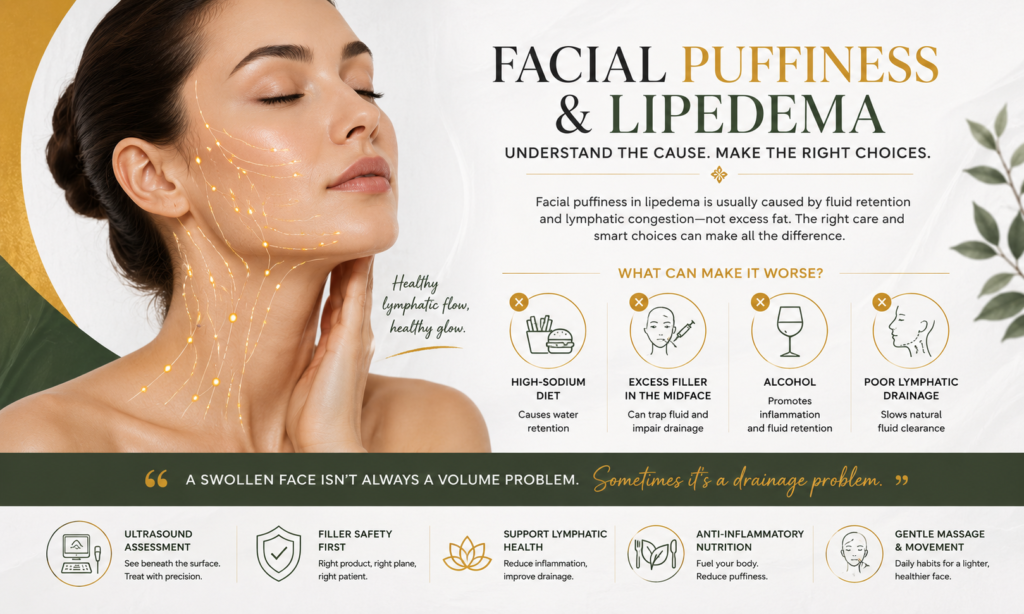
A swollen face is not always a volume problem.
Sometimes it is:
- inflammation
- fluid retention
- hormonal changes
- lymphatic congestion
- previous filler
- poor sleep
- dietary factors
Understanding why the face appears puffy is far more important than immediately deciding what to inject.
Sometimes the best treatment is filler.
Sometimes it is dissolving previous filler.
Sometimes it is improving lifestyle habits.
Sometimes it is simply choosing to wait.
Good aesthetic medicine is not about adding more product.
It is about making the right diagnosis first.
Final Thoughts
Facial puffiness is common, especially among women living with lipedema, but it should not automatically be assumed to represent facial lipedema.
In most cases, the underlying issue is fluid retention rather than abnormal fat accumulation.
Recognizing this distinction allows us to choose treatments that respect facial anatomy, protect the lymphatic system, and produce more natural, longer-lasting results.
If you have persistent facial swelling, recurrent under-eye puffiness, or are unsure whether previous filler may be contributing to your appearance, a thorough assessment—including ultrasound when appropriate—can help distinguish fluid, fat, and filler before any treatment is planned.
Sometimes the best aesthetic result comes not from adding more, but from understanding more.
Key Takeaways
- Facial puffiness is not part of the formal diagnostic criteria for lipedema.
- Most facial swelling is related to fluid retention, inflammation, hormonal changes, or lymphatic congestion.
- Hyaluronic acid fillers attract water and should be used thoughtfully in patients prone to facial edema.
- Ultrasound can help distinguish fluid, retained filler, fibrosis, and normal fat before treatment.
- Treating the underlying cause almost always leads to better long-term outcomes than simply adding more filler.
References
- Lipedema: Clinical Features, Diagnosis, and Management. Comprehensive review of the diagnosis, pathophysiology, and management of lipedema.
- Lipedema Foundation. Diagnosing Lipedema: Symptoms, Criteria & Evaluation. Clinician’s Guide.
- Filler-Induced Lymphatic Compromise: In Silico Modelling of Facial Safety Thresholds and Injection Techniques. Aesthetic Plastic Surgery. 2026.
- EyeWiki. Complications of Hyaluronic Acid Fillers — anatomy of the malar septum and malar edema.
- Post-Hyaluronic Acid Recurrent Eyelid Edema (PHAREE): Pathophysiologic Mechanisms and a Proposed Treatment Protocol.
- Simarro Blasco, J. L. et al. (2025). Clinical Signs at Diagnosis and Comorbidities in a Large Cohort of Patients with Lipedema in Spain. Biomedicines.
- University Health Network (Toronto). Lymphatic Self-Massage: Face, Head and Neck.
- Cotofana, S., Gotkin, R. H., Frank, K., Lachman, N., & Schenck, T. L. (2020). Anatomy behind the facial overfilled syndrome: The transverse facial septum. Dermatologic Surgery, 46(8), e16–e22..
- Weiner, S. F. (2022). Ultrasound for the aesthetic injector. Plastic and Aesthetic Nursing, 42(2), 88–98